Haplogroup R1a1a1b2a1

– 5 min read


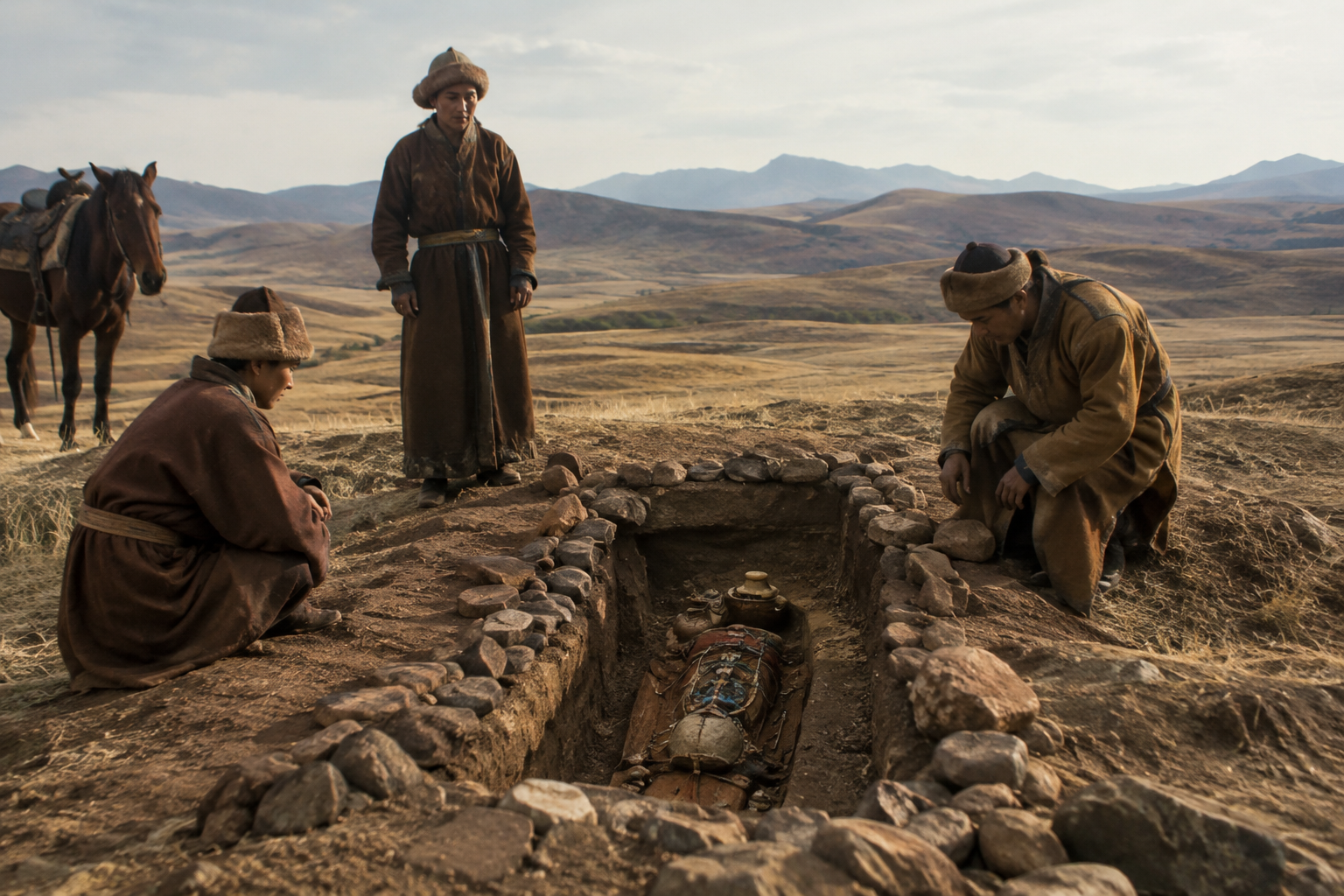
At Alai Nura, a burial dated to around AD 300 produced one of those deceptively small discoveries that can open a much larger historical landscape. The individual known as ALN005 comes from the Iron Age in the highland zone of Central Asia, a region where mountain routes, steppe corridors, and oasis worlds all pressed against one another. In this case, the Y-DNA assignment linked to the burial is R1a1a1b2a1, a paternal line that immediately places the find in one of Eurasia's most discussed male-line families.
That needs one quick clarification. Y-DNA follows a direct paternal line only: father to son to son across generations. It does not describe a person's whole ancestry, language, or ethnic identity. But when a branch such as R1a1a1b2a1 appears in an ancient burial from the Inner Asian world, it becomes historically interesting because it sits inside a wider cluster of lineages often found in ancient populations moving across the steppe and the eastern Iranian-speaking sphere.
The Alai region is not a historical backwater. It lies in a part of Central Asia where the great ecological zones of Eurasia meet awkwardly and productively: upland valleys, herding country, and the routes that later fed into Silk Road exchange. A burial here, dated to the centuries around the late Iron Age and early historical era, belongs to a world shaped by mobility, but not by mobility alone. These were also local communities with their own burial traditions, seasonal rhythms, and political entanglements.
ALN005 matters because it gives that landscape a named paternal signal. Rather than speaking vaguely about "steppe ancestry," we have an actual male-line assignment tied to a specific burial in a specific place. That does not make ALN005 the representative of all Alai people, still less of all Central Asians of the period, but it does anchor R1a1a1b2a1 in an archaeological context where mountain and steppe histories intersected.
A major ancient DNA study of the Eurasian steppes, published in Science Advances, helped sharpen this broader picture by showing how populations in and around the steppe were anything but static. The old habit of imagining a single "nomad people" sweeping unchanged across centuries simply does not survive contact with the genetic evidence.
The haplogroup label in this article, R1a1a1b2a1, is a fairly specific sub-branch within the much larger R1a family. That larger family has a long and complicated history across Eurasia, and it appears in many different populations over time. The narrower branch should therefore not be treated as a shorthand for every story ever told about R1a.
What we can say more carefully is that R1a lineages are deeply entangled with the demographic history of the Eurasian steppe and adjacent regions. In Iron Age and later Central Asia, they are often part of the paternal background associated with groups living between the Iranian plateau, the steppe, and the mountain corridors to the east. For a burial like ALN005, that makes sense historically. The Alai zone stood close to the worlds inhabited and crossed by Saka-related groups, later confederations, and the varied communities who linked highland Central Asia to wider exchange networks.
What we cannot do is leap from one male line to a fixed ethnic badge. A man carrying R1a1a1b2a1 could belong to different cultural settings depending on time and place. Archaeology, burial context, chronology, and genome-wide ancestry all matter alongside Y-DNA.
A date around AD 300 is important in its own right. This was not the earliest age of steppe expansions, nor the medieval world of Turkic and Mongol empires. It was a period after centuries of movement, alliance, conflict, and intermarriage had already transformed Inner Asia. By then, paternal lineages with older steppe associations could be living in communities that were culturally quite mixed.
That is one of the reasons ALN005 is worth lingering over. The burial sits in a period when older Iron Age patterns had not vanished, but had already been reworked by new political realities. The mountainous south of present-day Kyrgyzstan was connected not only to pastoral networks but also to broader currents running toward the Tarim Basin, Bactria, and the Iranian world. A lineage like R1a1a1b2a1 fits comfortably into that zone of overlap.
In other words, the interesting question is not whether this man belonged to some pure and timeless population. Almost nobody in ancient Eurasia did. The real point is that his paternal line preserves one thread of continuity through a region famous precisely for contact and change.
Although the single burial ALN005 should not be overburdened, it belongs to a broader archaeological conversation about Iron Age eastern Iranian and steppe-linked populations in Central Asia. Across this vast zone, ancient DNA has repeatedly shown that communities associated with Saka and related cultures were genetically varied. Some lineages persisted locally; others point to long-distance connections. Male lines from the wider R1a family are among the recurring features in that picture.
This matters because older historical writing often tried to sort steppe peoples into neat boxes: Scythian, Saka, Sarmatian, Hun, Turk. Archaeology and genetics both make those boxes look rather flimsy. Material culture can spread without total population replacement. Political names can outlast biological continuity. And paternal lines can persist through major cultural shifts.
So if your own paternal ancestry falls under R1a1a1b2a1, ALN005 is not evidence that you descend from a named tribe in a simple, documentary way. What it does show is that this branch was present in the Iron Age and early historic populations of Inner Asia, in exactly the sort of region where steppe, mountain, and Iranian-linked histories met on the ground.
Ancient DNA articles sometimes tempt readers into thinking that only huge cemeteries or royal tombs count. In fact, a single well-placed burial can be extremely useful. ALN005 gives us a firm archaeological foothold for R1a1a1b2a1 in the Alai region at roughly the turn of Late Antiquity. That is modest, but it is real. Real evidence, even when small, is always better than a grand migration tale built on guesswork.
It also reminds us how much of Eurasian history was made away from imperial capitals. Mountain valleys and upland corridors were not passive margins waiting for empires to arrive. They were lived landscapes in which herders, traders, local elites, and families maintained connections across formidable terrain. A paternal lineage surviving there is not incidental to history; it is part of how that history worked.
For members of the MyTrueAncestry community, the distinctive value of R1a1a1b2a1 is not that it unlocks a fairy-tale pedigree. It is that at least one securely ancient example, ALN005 from Alai Nura around AD 300, places this paternal branch within the historical world of Inner Asia's mountain-steppe frontier. If your own line belongs here, that may point toward a deep connection with the long, tangled history of populations moving through and settling the eastern Iranian and Central Asian zones, where continuity and mixture went hand in hand.






Comments