Haplogroup R1a1a1b1a2b3a4a2d
– 5 min read


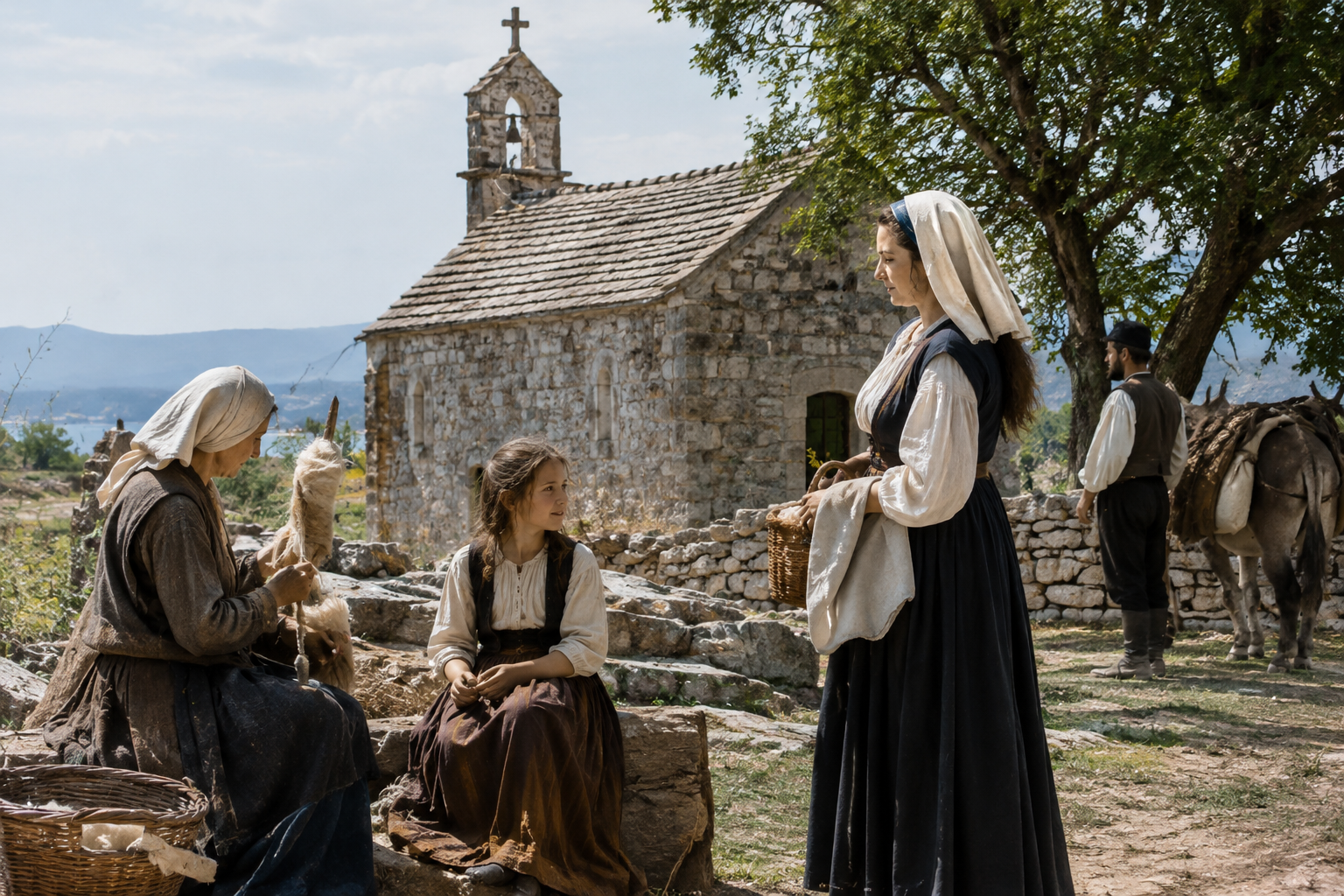
In the churchyard of Saint Ana at Gornji Kosinj in Croatia, one identified man from about AD 1675 now carries an unexpectedly long genetic label into the present: I35008, associated here with the Y-DNA branch R1a1a1b1a2b3a4a2d. That sounds forbiddingly technical, but the setting is wonderfully concrete. We are not in mythic prehistory or among half-remembered tribal names. We are in a post-medieval burial ground in the Lika region, in a landscape shaped by war, resettlement, frontier life, and the difficult centuries when the Ottoman and Habsburg worlds pressed against one another.
That is what makes this sample interesting. A very fine-grained paternal label appears not in a royal tomb or heroic saga, but in an ordinary historical community. Y-DNA traces one direct male line only, not a person's whole ancestry, yet even that narrow thread can be revealing when it turns up in a place like inland Croatia, where long-term continuity and repeated population movements met in the same valleys.
Gornji Kosinj lies in a part of Croatia with deep archaeological roots and a particularly turbulent early modern history. By the 16th and 17th centuries, the wider region had been affected by frontier conflict, shifting lordship, depopulation in some districts, and repopulation in others. So when a post-medieval man from Saint Ana can be placed within a specific paternal branch, that is not merely a genealogical curiosity. It gives us one small, datable point in the reconstruction of how male lines persisted, disappeared, or arrived anew in the western Balkans.
The ancient individual listed here, I35008, is dated to about AD 1675. That date matters because it places him after the great upheavals of the medieval period and squarely within an era when written history and genetic history can begin to speak to one another more directly. A regional ancient-DNA study of Croatia has explored exactly this longer pattern of continuity and change, including the way maternal lines may remain relatively stable while paternal lineages shift more dramatically over time: research on ancient DNA from Croatia.
Croatia's shifting paternal lineages
The haplogroup name R1a1a1b1a2b3a4a2d sits deep within the wider Y-chromosome tree of R1a, one of the best-known paternal lineages in Eurasian population history. But it is important not to let the fame of the parent branch do all the work. The broad history of R1a stretches across vast regions and many periods; this much narrower twig is a later and more specific paternal line, and its own detailed history must be reconstructed from real sample evidence, not assumed from the parent label alone.
That is especially important in the Balkans. The region has seen prehistoric migrations, Roman imperial integration, late antique disruption, early medieval Slavic expansions, and later movements under Ottoman and Habsburg rule. A man in 17th-century Croatia bearing a descendant branch of R1a may fit comfortably within that larger eastern and central European story, but the exact route by which his paternal line reached Gornji Kosinj cannot be read off the haplogroup label by itself.
So the value of I35008 lies not in proving a grand single-origin tale, but in anchoring one paternal line in a documented Croatian community at a known historical moment. In archaeology, that sort of modest certainty is often more useful than romance.
One of the most interesting themes in recent Balkan archaeogenetics is that continuity and change often operate at different scales. A region may show long-term attachment to place, recurring use of cemeteries, or persistence of local communities, while individual paternal lines turn over substantially across the centuries. That makes sense historically. Men move in armies, resettlement schemes, work groups, and refugee streams; women do too, of course, but not always in the same patterns or proportions.
For Croatia, this matters because the country sits across several historical zones at once: the Adriatic world, the Dinaric interior, the Pannonian plain, and the military borderlands. A post-medieval sample from inland Croatia belongs to a world very different from Roman Dalmatian towns or early medieval princely centres, yet all of these layers contribute to the genetic landscape later communities inherited.
The Saint Ana burial therefore belongs to a wider Croatian story rather than standing alone. It is one late checkpoint in a region where paternal ancestry was shaped by both deep local roots and repeated historical shocks. If your own Y line falls near this branch, the lesson is not that you descend from one named people, but that your direct paternal ancestors were part of the same churn of settlement and survival that marked the Balkans for centuries.
AD 1675 is late enough to feel almost modern, yet in southeastern Europe it still belongs to a world of fragile frontiers and uneven recovery. The 17th century in Croatia was not a quiet epilogue to medieval history. It was part of an era in which districts were reorganized, border populations shifted, and confessional as well as political identities hardened.
That makes a church burial at Gornji Kosinj an archaeological document of social order as much as of biology. A Christian burial ground in this context reflects a settled community, however exposed that settlement may have been to military and political pressures. The genetic data adds only one line of evidence, but it reminds us that such communities were made up of men whose paternal origins could reach back through different episodes of movement and mixture.
There is also a pleasing corrective here to the way haplogroup discussions often drift toward the Bronze Age and never return. Most paternal lines did not stop living history once prehistory ended. They passed through parishes, farms, small towns, military districts, and family graveyards. I35008 is useful precisely because he shows one such line still present in a real Croatian community long after the better-known prehistoric chapters.
R1a branches are often discussed in connection with eastern and central Europe, and with early medieval expansions of Slavic-speaking groups. That broader context is certainly relevant to inland Croatia, but it must be handled carefully. Archaeology, language, political identity, and Y-DNA are not interchangeable labels. A 17th-century man with an R1a-derived lineage in Croatia is not automatically a neat ethnic emblem of any one medieval population.
Still, the pattern is historically plausible and worth noting. Inland Croatian populations were shaped in part by movements tied to the early medieval Slavic world and then reworked by later frontier dynamics. A narrow branch such as R1a1a1b1a2b3a4a2d may therefore reflect a paternal line embedded in those later Balkan and central European histories, even if one sample cannot tell us exactly when that line first entered the region.
That is where comparison matters. Other MyTrueAncestry work on the Balkans and neighbouring regions shows again and again that medieval and post-medieval communities were rarely genetically simple. They were local, but not sealed; rooted, but not motionless.
The most responsible reading of haplogroup R1a1a1b1a2b3a4a2d, on the evidence here, begins with Saint Ana at Gornji Kosinj and sample I35008: a post-medieval man from Croatia, living in a region where older Balkan ancestry, medieval population change, and early modern frontier history all overlapped. That does not turn him into the founder of a dynasty or the representative of an entire people. But it does place one paternal branch firmly inside the lived history of Croatia.
For someone researching this Y-DNA line today, that is the real value. It suggests that this branch was present in a historical Balkan community by the later 17th century, and that its story belongs as much to villages, parishes, and borderland societies as to the grand migrations usually invoked in haplogroup summaries.
Comments