Haplogroup R1a1a1b1a2b3a3a2f
– 4 min read


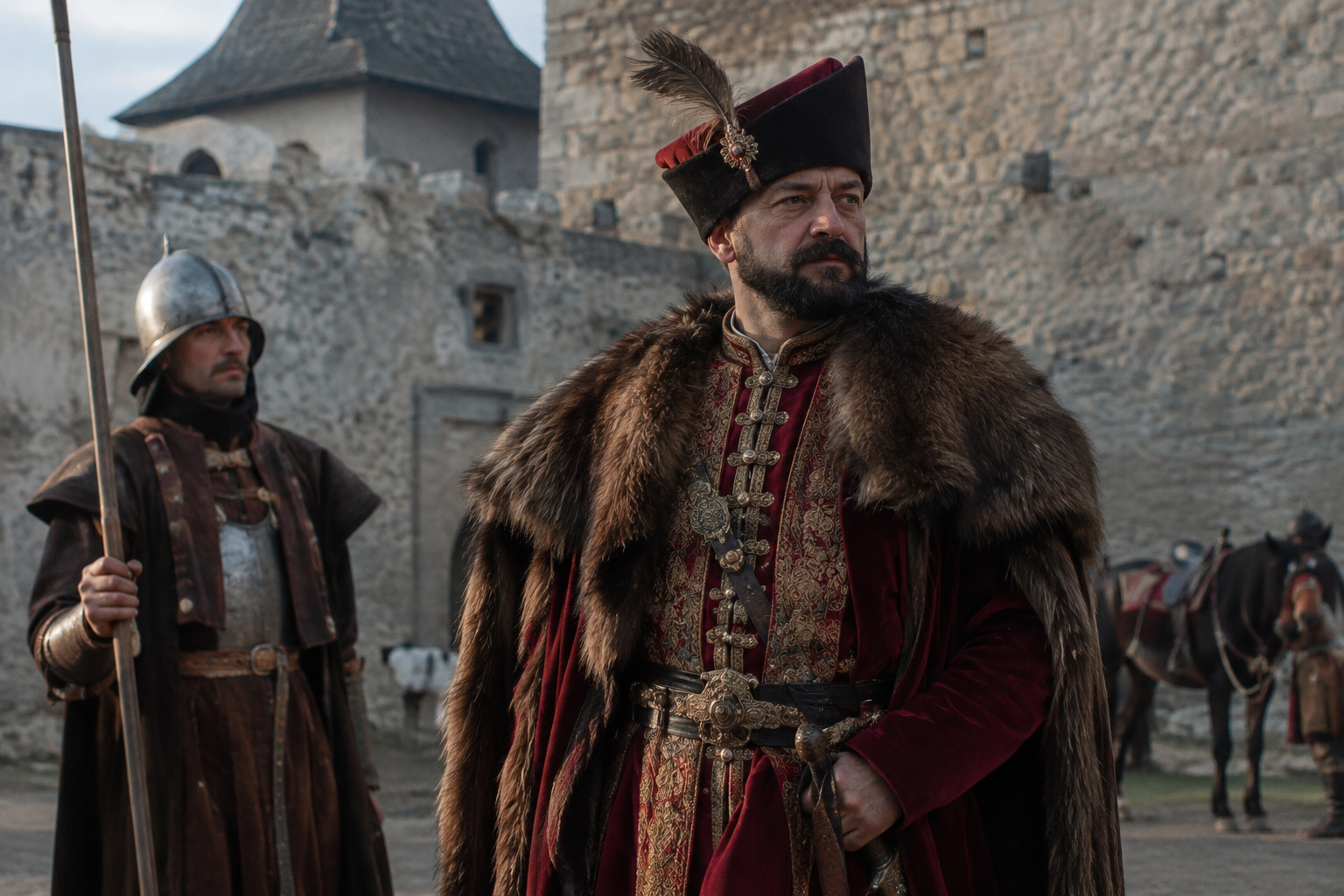
One of the clearest fixed points for haplogroup R1a1a1b1a2b3a3a2f in the material here is a single man: PER09, identified as a medieval Hungarian male of noble status from Pericei and dated to around AD 1500. That is already enough to make the case interesting. We are not dealing with a vague prehistoric spread across half of Eurasia, but with a named historical setting in the late medieval Carpathian world, where lineage, inheritance, and political status mattered intensely.
That matters because Y-DNA follows one direct paternal line only. It does not describe a whole person's ancestry, language, or identity. But when a late medieval noble burial can be tied to a highly specific branch such as R1a1a1b1a2b3a3a2f, it gives that paternal line a concrete historical address: not just "somewhere in eastern Europe", but among the elite networks of the Hungarian kingdom's borderlands at the end of the Middle Ages.
The sample record identifies PER09 as a medieval Hungarian Bathory male nobility individual from Pericei, dated to about AD 1500. Pericei, in today's northwestern Romania, lay within the political and cultural orbit of the Kingdom of Hungary. In that period this was a frontier-rich landscape of counties, noble estates, and shifting loyalties, where powerful families operated across what are now Hungary, Romania, and Slovakia.
That setting is especially useful for understanding a lineage like R1a1a1b1a2b3a3a2f. By the year 1500, paternal lines had already passed through many earlier population events: Bronze Age expansions, Iron Age regional mixtures, medieval dynastic consolidations, and the social filtering effect of noble inheritance. So PER09 is not a "founder" of the branch. He is, rather, a late and very visible bearer of it, preserved in a context where status gives the lineage historical texture.
A research article associated with these remains, published on ScienceDirect, is the key scientific anchor behind this material. Even without overclaiming details beyond the sample record itself, the larger importance is plain enough: ancient DNA is now letting historians test dynastic and noble-family traditions against biological evidence, instead of leaving them entirely to heraldry and later genealogy.
The formidable label R1a1a1b1a2b3a3a2f sits inside the much broader haplogroup R1a, one of the major Y-chromosome lineages spread across parts of Europe and Asia. But this is exactly where caution matters. The history of the large parent branch cannot simply be pasted onto the tiny terminal twig. A narrow subclade may have a much more local, recent, and socially specific history than the big umbrella lineage above it.
In practical terms, a result this specific usually suggests many generations of branching inside eastern or central European paternal networks before the line appears in a documented late medieval nobleman. What the sample shows securely is that this branch had reached, and persisted within, the elite world represented by PER09. It does not by itself tell us where the branch first arose, nor does it prove that every historically associated relative carried the same terminal call unless they too were directly tested.
Pericei belongs to a region where political borders and family influence rarely matched modern maps. Around AD 1500, the Kingdom of Hungary was a composite realm with strong regional magnates, overlapping ethnic communities, and noble families whose power depended on landholding, military service, and marriage alliances. In that kind of world, a paternal lineage could persist for centuries not because it represented a whole population, but because male-line inheritance gave certain families unusual continuity.
That is one reason noble burials matter so much in archaeogenetics. They do not stand in for everyone. What they offer instead is a sharper lens on how one paternal line could survive inside historically visible institutions: lordship, estate succession, and dynastic memory. When a branch like R1a1a1b1a2b3a3a2f turns up in such a context, it becomes part of the story of how medieval power was reproduced biologically as well as politically.
The sample description explicitly places PER09 among Bathory male nobility, which makes the historical association unusually important here. The Bathory family was one of the best-known noble houses of the Hungarian and Transylvanian world, producing high-ranking officeholders and later princely figures. That does not mean every man called Bathory, still less every collateral branch, automatically shared one identical terminal Y-DNA result. Medieval family history is rarely so tidy.
Still, a tested nobleman tied to that milieu is valuable evidence. It shows that this paternal branch was present in a lineage remembered not only through documents but now through ancient DNA. That is a more interesting and more defensible claim than the usual temptation to announce sweeping "royal descent". The real gain is historical resolution: a specific male line, in a specific noble setting, at a specific late medieval date.
Some haplogroup articles can range across many graves and centuries. This one cannot honestly do that from the evidence given, and that is perfectly fine. In fact, the narrowness is part of the appeal. PER09 is not interesting because he lets us tell every chapter of R1a history; he is interesting because he pins one very narrow paternal branch to a recognisable social world.
Late medieval and early modern noble contexts are also especially revealing because they sit at the meeting point of archaeology, written history, and genetics. A prehistoric skeleton may show us deep population movement. A nobleman like PER09 can show something different: how a direct male line endured into an age of surnames, charters, estates, and dynastic reputation.
For someone researching haplogroup R1a1a1b1a2b3a3a2f, the strongest supported insight here is not a grand migration map but a precise historical glimpse. This branch is attested in a noble male from Pericei around AD 1500, in the Hungarian political sphere and in association with the Bathory world. That places the lineage firmly within the documented social landscape of late medieval east-central Europe, where paternal inheritance could preserve a line through generations of recorded history.






Comments