Haplogroup R1a1a1b1a2b3a3a2

– 5 min read


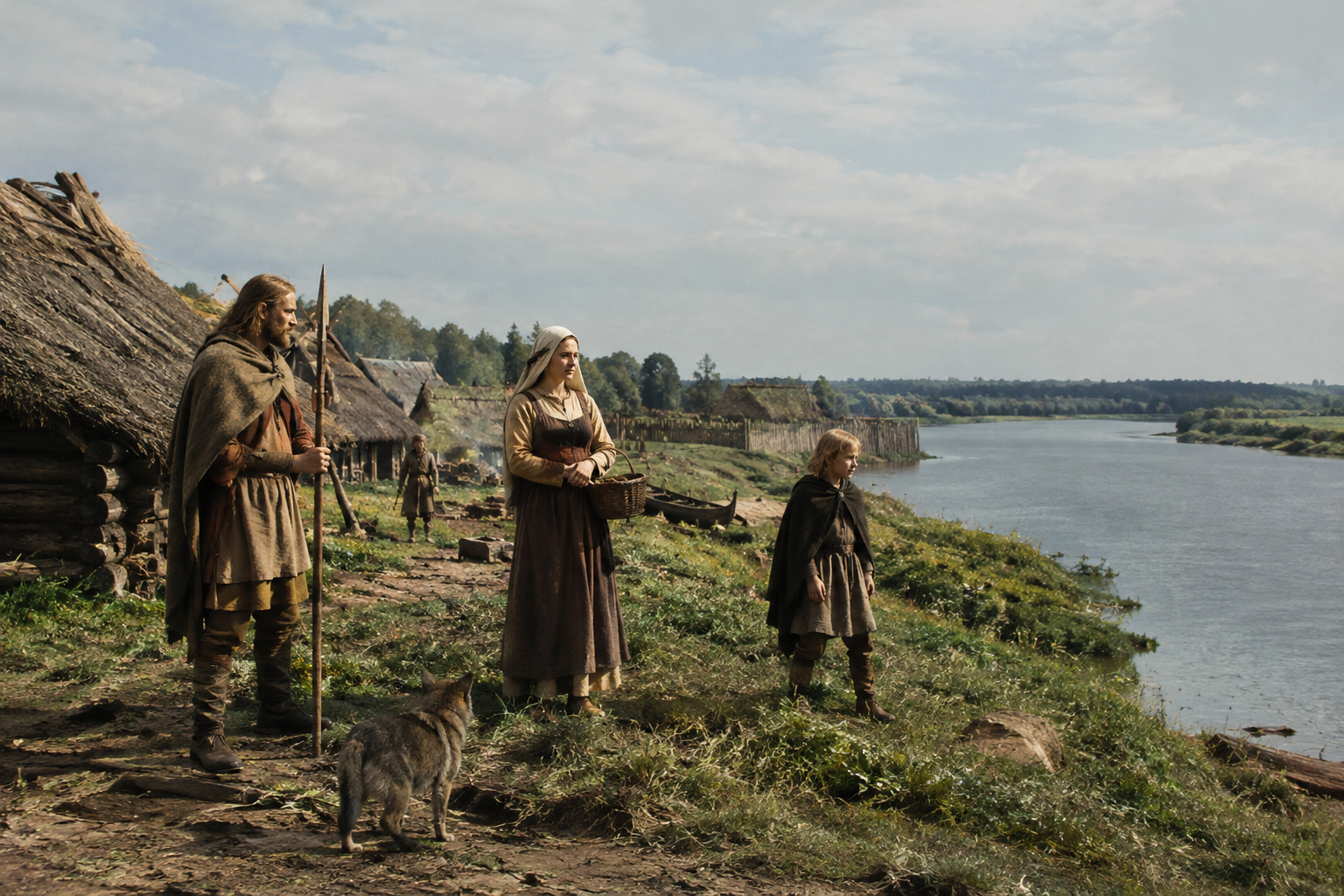
At Grodek nad Bugiem in eastern Poland, one medieval man has become a surprisingly useful guide to a much larger story. The individual labeled GRK014, dated to around AD 750, belongs to the Y-DNA haplogroup R1a1a1b1a2b3a3a2 as reported in the MyTrueAncestry context. That may look like a forbidding string of letters and numbers, but in historical terms it places a direct paternal line inside a region that mattered enormously during the early medieval reshaping of eastern Europe.
Grodek nad Bugiem sits near the Bug River, a frontier-like landscape in more ways than one: ecologically, politically, and culturally. In the centuries around AD 750, this was a zone connected to the emergence of early Slavic societies, to exchange routes running north and south, and to the slow formation of the worlds that would later become medieval Poland, Rus', and their neighbors. A Y-chromosome line such as R1a1a1b1a2b3a3a2 does not tell us everything about GRK014's ancestry, identity, or language, but it does give us one sharply focused line of descent through the male line.
The most important thing about GRK014 is not that he can be made to stand for all of medieval Poland. He cannot. It is that he is anchored in a real place and period where archaeologists and geneticists are both trying to understand how communities were forming after the end of antiquity. Eastern Poland in the eighth century was not a blank map waiting for states to appear. It was already inhabited, cultivated, and connected, with local communities participating in broader regional change.
That is where this haplogroup becomes interesting. The wider Y-DNA family R1a is well known across large parts of Eurasia, especially in many eastern and central European populations, but a precise branch such as R1a1a1b1a2b3a3a2 is much narrower. It should not be treated as though it automatically carries the whole prehistory of R1a on its back. What GRK014 offers is firmer and more modest: evidence that one direct paternal line associated with this branch was present in an early medieval community on the eastern Polish frontier.
A genetic study connected with these medieval Polish remains is linked through this research project entry, which helps place the sample in the growing body of ancient DNA work on the region. Even when a public-facing sample summary is brief, the larger value lies in the accumulating pattern: named individuals, dated sites, and comparable burials gradually turn broad assumptions about medieval populations into something testable.
It is worth pausing over the haplogroup itself, because people understandably want a lineage label to do too much. Y-DNA follows one line only: father to son, back through a single paternal chain. That makes it powerful for tracking male-line continuity and comparing one branch with another, but it is only one fraction of a person's total ancestry.
In practical historical terms, a branch like R1a1a1b1a2b3a3a2 is best read as a clue about paternal connections within a population history, not as a shortcut to ethnicity. GRK014 may have lived in a community that archaeologists would place within an early medieval Slavic cultural horizon, but the haplogroup itself is not identical to being "Slavic" in any simple sense. Languages spread, political loyalties change, and populations mix; Y-chromosome lines move through all of that rather than standing outside it.
This is exactly why ancient DNA matters so much. Instead of arguing only from present-day distributions, it gives us dated snapshots. A man buried around AD 750 at Grodek nad Bugiem tells us that this paternal lineage was there then, in that medieval landscape, not merely that related branches exist somewhere in Europe now.
The eighth century was an awkward, creative, formative time in this part of Europe. Large centralized kingdoms were only beginning to crystallize in some regions, while other areas were organized through local strongholds, tribal polities, kin networks, and riverine exchange. The Bug basin was one of those places where movement and contact mattered. It linked the forest zone to wider routes running toward the Vistula basin, the Baltic, and the Dnieper world.
That setting makes GRK014 more than a technical footnote. He belongs to the human background of the centuries before the Piast state fully emerged in western and central Polish lands. If you are looking for paternal ancestry tied to eastern-central Europe, this is the sort of evidence that helps: not a grand dynasty, not a legendary founder, but an actual medieval individual whose DNA sits inside a real archaeological context.
The broader historical point is that early medieval Poland was not genetically or culturally created in a single moment. It formed out of local continuities and regional interactions. Ancient burials like this one help correct the old habit of imagining early medieval peoples as if they arrived fully formed with neat labels attached.
Ancient DNA and Slavic Populations
There is a temptation, when only one directly relevant ancient sample is in view, to dismiss it as too little. Archaeology usually works the other way round. One well-placed individual can matter a great deal if he comes from a period or region where every securely identified genome sharpens the picture. GRK014 is precisely that sort of case.
He anchors this branch in medieval eastern Poland, and that alone is historically useful. It means that for men today whose paternal line falls within or near R1a1a1b1a2b3a3a2, there is at least one documented ancient point of contact with the early medieval societies of the Polish-Bug frontier. That is not proof of direct descent from GRK014, of course, but it is a genuine sign that the lineage belonged to the human fabric of that world.
Ancient DNA studies across neighboring regions have repeatedly shown that early medieval communities were often more locally rooted, and at the same time more connected, than older migration myths allowed. That makes eastern Polish evidence especially valuable, because it sits between several historical spheres often discussed separately: Baltic, West Slavic, East Slavic, and steppe-facing zones of contact.
Early Medieval Poland in Transition
Because the branch name is so specific, it can look more certain than the history really is. Precision in genetic labeling is not the same thing as precision in biography. We can say that GRK014 is the key ancient example supplied here, from Grodek nad Bugiem around AD 750, and that this provides a credible medieval setting for the haplogroup. We should be more cautious if someone tries to leap from that fact to claims about a named tribe, a medieval noble house, or an unbroken documented family line.
Still, caution need not mean dullness. The real fascination lies in scale. One paternal branch, carried by one man in one burial ground, opens onto the making of a frontier region at the edge of several emerging worlds. That is exactly the sort of case where genetics and archaeology work best together: the DNA gives the paternal signal, while the site gives it time, place, and historical weight.
Diversity in Eastern Polish Ancient DNA
The distinctive value of haplogroup R1a1a1b1a2b3a3a2 in this case is not that it can be dressed up with legend, but that it is tied to a documented early medieval man from Grodek nad Bugiem. GRK014 shows this paternal line present in eastern Poland around AD 750, in a region central to the formation of medieval eastern Europe. For anyone researching this branch today, that is a solid and meaningful clue: your direct paternal line belongs within the historical landscape of early medieval frontier communities, where local continuity and wider regional contacts were shaping the centuries to come.

Comments