Haplogroup R1a1a1b1a1a1c2a

– 5 min read



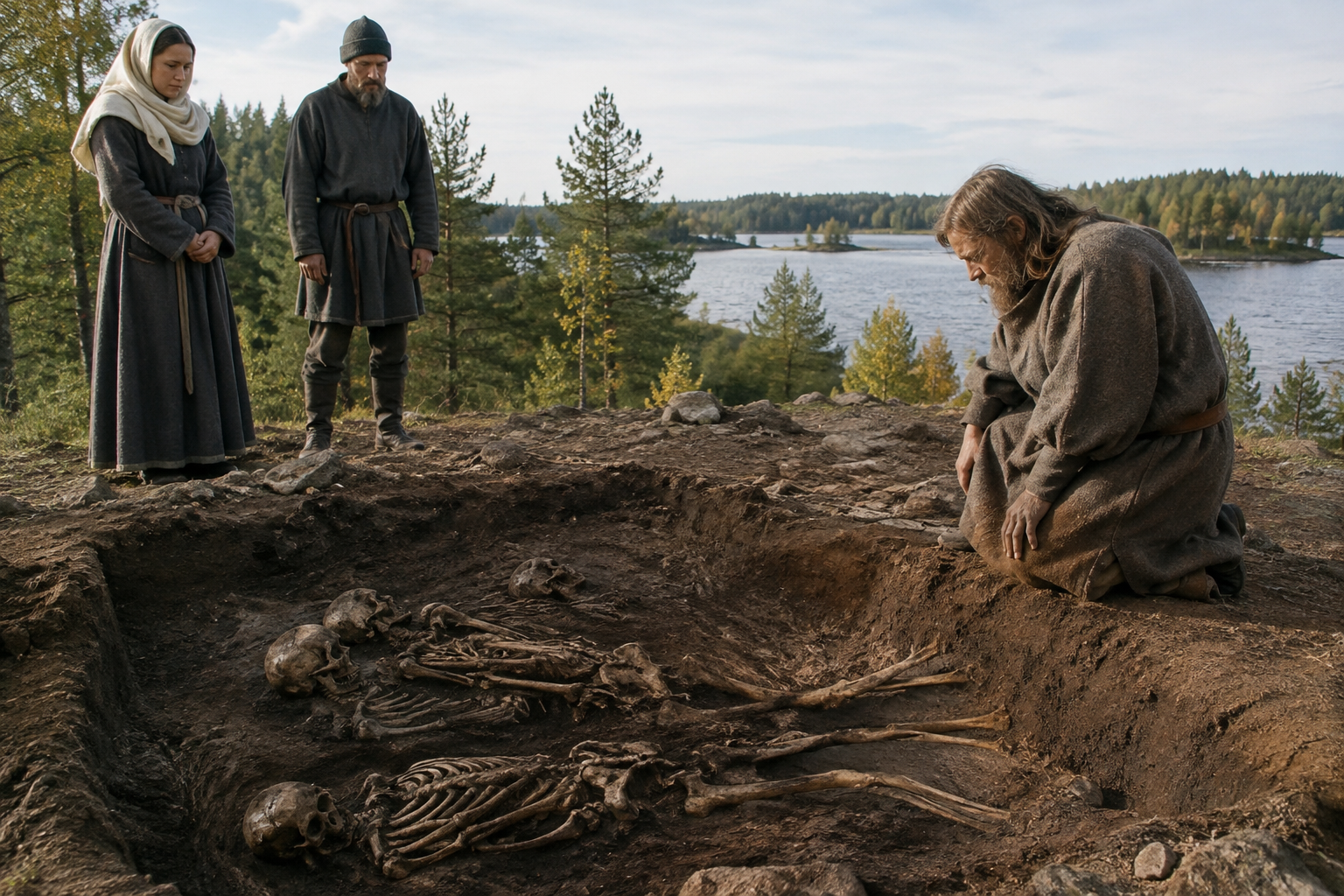
One of the more arresting appearances of the Y-DNA branch R1a1a1b1a1a1c2a comes not from a battlefield or a princely tomb, but from an emergency burial ground in London. The ancient individual P328b, dated to around 1760 AD, was recovered from St Martin-in-the-Fields and identified as a smallpox victim. That alone places him in a vivid historical moment: an urban world of crowding, disease, and rapid movement, where parish graveyards and improvised burial spaces preserved not only human stories but genetic ones as well.
For anyone tracing this paternal line today, that is a useful starting point. Y-DNA follows the direct male line only, not a person's whole ancestry, but it can anchor that line in real archaeological settings. In the case of R1a1a1b1a1a1c2a, the securely named ancient evidence provided here is late and urban rather than prehistoric and dramatic. That changes the sort of story we can tell: less about grand origin myths, more about how a paternal lineage was still circulating in the population of early modern Britain at a moment of intense social and biological upheaval.
St Martin-in-the-Fields sits in the heart of London, and by the eighteenth century it belonged to one of the busiest and most densely inhabited cities in Europe. A burial identified as a smallpox victim from this setting is historically significant even before we get to the Y chromosome. Smallpox was one of the great killers of the period, shaping childhood survival, urban demography, and even politics. A man carrying the paternal lineage linked here to R1a1a1b1a1a1c2a therefore belongs to the real, harsh history of metropolitan life rather than to a romanticized ancestral past.
Research on ancient pathogen and human DNA from historic burials has helped show just how much information can survive in such remains, even in complicated city contexts. A broad scientific discussion of ancient biomolecular work, including the growing ability to recover information from historically recent burials, appears in this Royal Society publishing article. That matters here because P328b is best understood as part of a wider archaeological shift: burials once treated as merely "post-medieval" now yield evidence about disease, identity, and family history with remarkable precision.
The long label R1a1a1b1a1a1c2a places this lineage deep within the wider R1a family, one of the major Y-chromosome groupings found across large parts of Eurasia. But it is important not to flatten the tree. The history of the broad parent haplogroup R1a is not automatically the history of this exact terminal branch. A very specific subclade can have a much narrower and later story than its ancient parent lineage.
That is especially important when the ancient evidence in hand is limited. With P328b, what we can say responsibly is that this direct paternal line was present in late medieval or early modern London by around 1760 AD, in an individual caught up in a documented disease environment. What we cannot do from this sample alone is assign the branch to one medieval dynasty, one migration event, or one ethnic label. London was a magnet for people from across Britain and beyond, so a London burial can preserve a lineage without revealing its deeper homeland by itself.
There is a temptation in ancient DNA to think only the oldest sample is the most interesting. In fact, later burials can be socially sharper. A man buried in the context of smallpox in London belongs to a world of parish records, migration into the capital, military service, apprenticeship, trade, poverty, and epidemic mortality. He stands close to the threshold where archaeology and documentary history almost touch.
That is part of what makes P328b valuable for members of the MyTrueAncestry community. He is not a symbolic ancestor from a misty prehistory. He is an inhabitant of a real city under biological pressure, living in an age when Britain was expanding commercially, urbanizing rapidly, and experiencing the demographic churn that helped shape the modern population. If your paternal line falls on this branch, the relevant historical question may be less "Which ancient tribe was I?" and more "Through which regions and social worlds did this line pass before it surfaced in the records of early modern Britain?"
Britain from Roman to Medieval DNA
Britain has received paternal lineages from many different periods: prehistoric expansions, Roman mobility, early medieval migrations, Viking settlement, Norman and later continental arrivals, and constant movement within the British Isles themselves. A branch under R1a could, in principle, have entered the British population through more than one historical route. That is why one urban burial is a point of evidence, not a complete map.
Still, the sample matters because it fixes the lineage in a concrete place and time. Archaeology often works like that. One burial does not solve the entire puzzle, but it stops the discussion drifting into fantasy. P328b tells us that by the eighteenth century, this paternal line was not theoretical, not merely inferred from modern testing, but embodied in a person buried in central London during a period when disease history can be studied directly from human remains.
That also fits a larger pattern emerging from British archaeogenetics: continuity and change sit side by side. Some lines persist locally over long periods; others arrive through later mobility and become absorbed into the wider population. The point is not to force this branch into one ready-made national narrative, but to see it as part of the layered making of Britain.
Norman Conquest DNA in England
There is another reason this sample deserves attention. Ancient DNA articles often lean toward migration and identity, but epidemic burials remind us that lineages survive through crises as much as through conquest or prestige. Smallpox did not care about rank, surname, or supposed ancestral purity. It moved through households and neighborhoods, cutting across the very social distinctions historians like to describe.
So the paternal branch R1a1a1b1a1a1c2a appears here in a setting shaped by vulnerability. That gives the lineage a different historical texture. Instead of a chieftain's mound or an elite mausoleum, we have the crowded reality of London's dead, where archaeology helps recover lives otherwise swallowed by the scale of the city. In that sense, P328b is a reminder that paternal history is not only about founders. It is also about survivors, victims, and ordinary urban men whose DNA endured where their names often did not.
Epidemics and Medieval English DNA
On the present evidence, the most distinctive thing about R1a1a1b1a1a1c2a is not a grand dynastic claim but a firmly grounded archaeological appearance in eighteenth-century London, in the person of smallpox victim P328b. That places this paternal line within the lived history of Britain at a time of urban growth, heavy mortality, and constant human movement. For descendants exploring this branch today, the strongest lesson is a good archaeological one: your direct male line may connect not only to remote migrations, but to the crowded, difficult, and very real worlds of historic people whose remains still speak through DNA.
Comments