Haplogroup R1a1a1b1a1a1c1h

– 5 min read


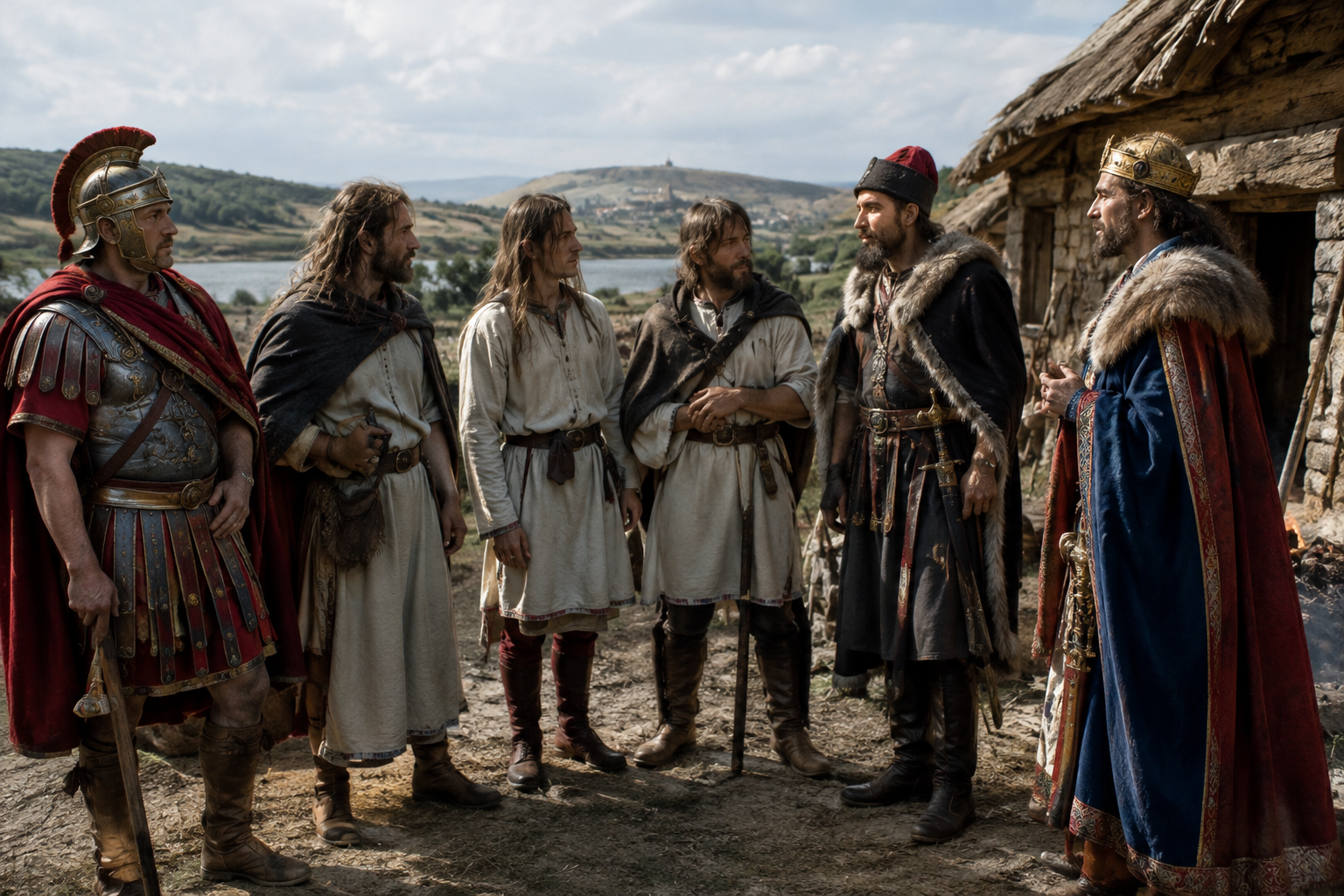
One of the clearest signposts for haplogroup R1a1a1b1a1a1c1h comes not from a vague prehistoric horizon, but from a named medieval ruler: VK541, identified as Izjaslav Ingvarevych of Dorogobuzh, a prince of the Rurik dynasty who died in 1223 AD. That matters because ancient DNA very rarely lets us place a paternal line beside an individual who is both archaeologically real and historically documented. Here, the lineage appears in a world of princely courts, frontier politics, and the expanding Christian states of eastern Europe.
Yet this branch does not appear only in elite settings. The same haplogroup assignment is also reported in burials from Late Roman Aquae Calidae in Bulgaria, in 10th-century western Slavic settlers at Steuden in Sachsen-Anhalt, and in 12th-century Peissen. Taken together, these finds suggest that this paternal line belongs to a broader medieval and late antique story running through the Balkans, the Elbe-Saale zone, and the eastern Slavic world. As ever, Y-DNA tracks only one direct male line, not a person's whole ancestry, but even that one line can be historically revealing.
The most striking sample in this set is VK541, attributed to Izjaslav Ingvarevych, prince of Dorogobuzh. With named medieval rulers, the fascination is obvious, but the real value lies in context. A result like this anchors the haplogroup in the political landscape of Rus', where dynastic rule depended on shifting branches of an extended ruling family rather than on a simple, tidy national story.
That does not mean everyone associated with the Rurik dynasty carried the same exact subclade, or that one prince can stand for every branch of the house. But it does mean that R1a1a1b1a1a1c1h, or an assignment reported in connection with that branch, belongs in the historical conversation about eastern European ruling lineages rather than being treated as an abstract string of letters. The line appears not on an anonymous map, but in a recognisable medieval polity.
If VK541 gives us a dynastic anchor, the trio from Steuden gives us something just as useful: a cluster in an ordinary settlement world. Samples SDN017, SDN018, and SDN019 are all described as western Slav settlers from Sachsen-Anhalt, dated around 900 AD. Three men from the same site and period carrying the same reported branch is exactly the sort of pattern that catches an archaeologist's eye.
Why? Because the Elbe-Saale region in the early medieval centuries was a contact zone. It was not a neat ethnic block, but a landscape of villages, political expansion, shifting loyalties, and communities later described in written sources as Slavic, Saxon, or something in between. A repeated Y-lineage here does not prove a tribe, still less a language spoken at home, but it does suggest that this paternal line had a real foothold among populations classified archaeologically and historically as western Slavic in central Germany.
An ancient DNA study of early medieval central European populations, available at https://www.ncbi.nlm.nih.gov/pmc/articles/PMC7588426/, helped establish how mixed and locally specific these post-Roman and early medieval communities could be. That is exactly the right frame for Steuden: not a simplistic migration arrow, but a lived frontier where lineages persisted, moved, and embedded themselves in new local settings.
The Steuden cluster is also important because it moves this haplogroup away from the temptation of purely princely storytelling. A medieval prince is memorable; three settlers in Sachsen-Anhalt are historically richer. They show the branch in everyday demographic history, not just in the exceptional survival of dynastic burials.
Ancient DNA and Slavic populations
The earliest sample in this group is I41193, from Aquae Calidae in present-day Bulgaria, dated to about 350 AD. Aquae Calidae was a late Roman place, part of a Balkan world that was never still for very long. Soldiers, merchants, administrators, local provincials, and incomers all passed through this region, especially in the centuries when imperial authority was under strain and older structures were being renegotiated.
That makes the appearance of this paternal line in late Roman Bulgaria particularly interesting. It does not by itself prove that the branch originated in the Balkans, nor that the man buried there belonged to any named people from later chronicles. But it does show that a lineage associated here with R1a1a1b1a1a1c1h was present in the southeastern European world before the better-known medieval evidence from Germany and Rus'.
Research on late antique Bulgaria and the movement of people through the region has increasingly shown how misleading older labels can be. Communities in the Balkans under Roman and post-Roman rule were often biologically mixed, socially flexible, and difficult to squeeze into the tidy categories beloved of 19th-century history writing. This sample sits comfortably in that more complicated picture.
The sample KRA009 from Krakauer Berg, Peissen, dated around 1140 AD, helps extend the pattern forward into the high medieval period. By then, central Europe was being reshaped by lordship, ecclesiastical organisation, agricultural expansion, and the increasingly dense web of towns and villages familiar from documentary history.
Placed beside the Steuden burials, KRA009 suggests that this paternal branch did not merely flicker through one early medieval episode. It remained present in the same broad region across centuries of political and cultural change. That is the sort of continuity archaeologists value: not because it proves an unbroken identity, but because it shows a lineage surviving through transformations that were anything but small.
A more recent research preprint on medieval and post-Roman central European material can be found at https://www.biorxiv.org/content/10.64898/2026.03.03.709317v1. Without overloading the article with technical claims, it is enough to note that such work keeps reinforcing a basic point: medieval Europe was populated by communities with deep local roots, repeated mobility, and paternal lines that cannot be reduced to one people or one moment.
At the wider level, R1a is one of the major Y-chromosome lineages of Eurasia, with a long and complicated history stretching across different regions and periods. But this article is not about the whole of R1a. It is about the much narrower branch R1a1a1b1a1a1c1h, and the danger is always to let the famous parent haplogroup do too much of the work.
The safer reading is a more interesting one anyway. Based on these ancient individuals, this sub-branch appears in settings linked to late Roman southeastern Europe, early medieval western Slavic settlement in central Germany, and medieval eastern Slavic dynastic society. That is not a single origin myth. It is a historically messy distribution across the connected worlds of the Balkans, the central European frontier, and Rus'.
The distinctive thing about R1a1a1b1a1a1c1h is not that it can be tied to one grand ethnic label, but that it turns up in several very different historical settings that were nonetheless connected by movement, settlement, and power. One bearer was buried in the late Roman Balkans, several appear among western Slavic settlers in Sachsen-Anhalt, and another belonged to the princely world of medieval Rus'. For someone researching a paternal line today, that is a reminder that ancestry often follows the real grain of history: regional, mobile, and far less tidy than later legends suggest.






Comments