Haplogroup R1a1a1b1a1a1c1c1

– 5 min read


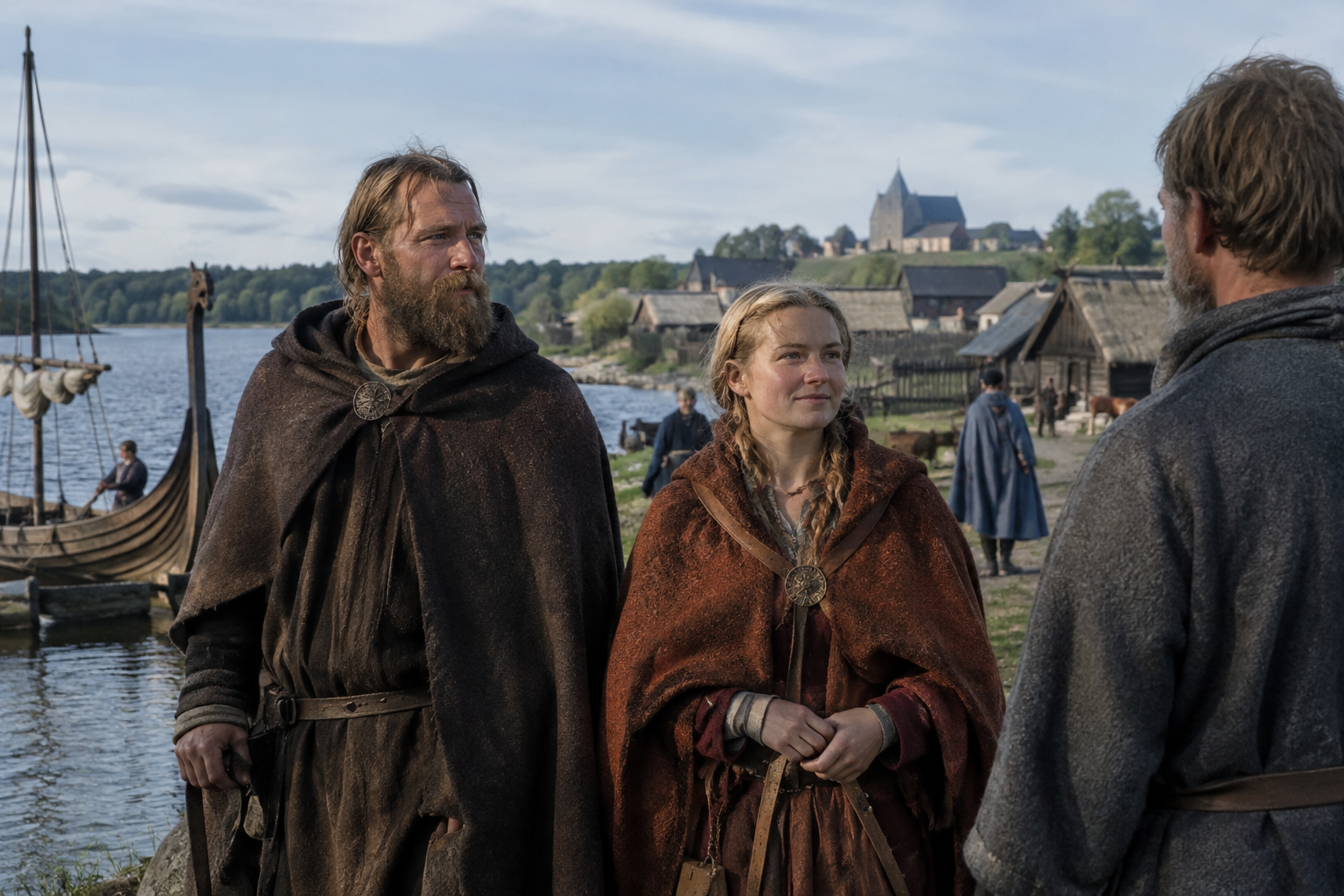
In around AD 935, two genetic records from Viking Age Sigtuna in Sweden - kls001a and kls001 - point to the same intriguing fact: a man identified as a migrant in one of early medieval Scandinavia's most important towns carried the Y-DNA haplogroup R1a1a1b1a1a1c1c1. That is a very narrow paternal branch, tucked deep inside the wider R1a family, and its appearance in Sigtuna matters because Sigtuna was not an isolated village. It was a royal and commercial centre, a place where movement, conversion, trade, and power all met.
That makes this lineage historically interesting at once. Not because one man can stand for all Vikings - he cannot - but because an urban burial from Sigtuna reminds us that Viking Age Sweden was full of arrivals, departures, and mixed backgrounds. Y-DNA tracks only one direct paternal line, not a person's whole ancestry, yet a specific branch like R1a1a1b1a1a1c1c1 can still help place one thread of family history into a recognisable historical landscape.
Sigtuna emerged in the late 10th-century orbit of kingship, Christianity, and long-distance exchange, but the world that produced the man behind kls001a and kls001 was already in motion by the early 900s. This was the age when eastern Scandinavians were tied into Baltic routes, river systems leading toward the lands of the Rus, and the wider networks linking northern Europe to the steppe and beyond. A migrant burial in this setting is not an anomaly. It is almost the point.
The most important thing here is restraint. We are not entitled to invent a biography for this man, nor to decide from Y-DNA alone whether he thought of himself as Swedish, Norse, Slavic, Rus, or something else. But the archaeological and genetic context of Viking Age central Sweden does support a broader picture of mobility and mixture. Research on Viking populations, including a major ancient DNA study of the Viking world, has shown just how interconnected these communities could be.
The haplogroup in question, R1a1a1b1a1a1c1c1, belongs to the wider R1a paternal family, a major lineage with a long and complicated history across Eurasia. But that broad fact should not be carelessly flattened into a story about one tiny descendant branch. A deep subclade is not the same thing as the whole parent haplogroup, and it does not automatically inherit every migration story ever told about R1a.
What we can say more safely is that lineages inside R1a appear frequently in ancient and medieval contexts across eastern and northern Europe, including settings shaped by steppe ancestry, later Iron Age population movements, and Viking Age mobility. In a place like Sigtuna, that matters because the town sat at the meeting-point of local Scandinavian development and much larger eastern connections. A narrow paternal branch found there may reflect one family line carried into a cosmopolitan urban environment rather than a purely local, immobile background.
That is also why the label "migrant" attached to the Sigtuna individual is so useful. It gives the genetic result historical teeth. We are not merely looking at a branch on a tree; we are looking at a paternal line attached to a person who seems, in archaeological interpretation, to have come from elsewhere.
Modern readers often imagine Viking society as if it were ethnically simple: fair enough for television, hopeless for history. Towns such as Sigtuna were made by movement. Traders, craftspeople, converts, dependants, emissaries, and families arrived from different parts of Scandinavia and beyond. The eastern Baltic and the river routes toward the Black Sea were not remote edges of the Viking world; they were part of its machinery.
So when a paternal lineage like R1a1a1b1a1a1c1c1 appears in an early medieval Swedish urban context, the real interest lies not in any crude claim of "Viking blood," but in the social fact of circulation. Men carrying branches of R1a could be found in many parts of northern and eastern Europe. In Sigtuna, that broad background becomes archaeologically meaningful because it turns up in a settlement famous for its role in state formation and external contact.
Baltic connections in the early Middle Ages
There is a nice historical irony here. We often think of migration as something done to Scandinavia in later centuries, whereas the Viking Age is usually pictured as Scandinavians moving outward. But the archaeology of towns and cemeteries shows the reverse was also true. Scandinavia was receiving people as well as sending them.
It would be rash to pin this exact subclade to one single origin point. Still, the broader historical geography is clear enough to be useful. Eastern Sweden during the Viking Age faced the Baltic world as much as the Scandinavian peninsula. Contacts with Finland, the eastern Baltic, and the trading and political spheres of the Rus were part of ordinary history, not exotic exceptions.
That helps explain why paternal lineages associated with the wider R1a family repeatedly attract attention in discussions of northern and eastern Europe. They appear in regions shaped by long-term interaction between Scandinavian, Balto-Slavic, and steppe-connected populations. The Sigtuna sample does not let us collapse those categories into one identity, but it does place this branch within a zone where such contacts were historically real.
Another useful backdrop comes from research on Scandinavian population history before and during the Viking Age, including ancient DNA work on prehistoric and early historic Scandinavia. Studies of this kind have made it increasingly clear that the north was never genetically frozen. Different regions of Scandinavia were shaped by different streams of ancestry and contact over long periods, and the Viking Age intensified some of those exchanges rather than inventing them from scratch.
The paired listings kls001a and kls001 are a small reminder that ancient DNA evidence often reaches us through technical naming systems, duplicate extractions, or linked reporting conventions rather than through the neat storytelling historians might prefer. That can look untidy, but it is normal. What matters is that the records point us back to a real burial context in Viking Age Sigtuna and to a paternal line associated with R1a1a1b1a1a1c1c1.
It is also worth noticing how modest the evidence is - and how much that modesty teaches us. One migrant burial does not prove a dynasty, a clan, or an entire ethnic bloc in the town. Yet a single securely contextualised line can still be valuable. Archaeology is full of cases where one individual opens a window onto a much larger process, and here the larger process is mobility into an emerging Scandinavian town.
That makes these Sigtuna records especially appealing for family historians. They are not grandiose evidence. They are better than that: they are concrete.
If your Y-DNA falls under R1a1a1b1a1a1c1c1, the Sigtuna evidence offers a historically grounded glimpse of what one branch of that lineage looked like in the early medieval north: not static, not sealed inside one modern nation, but present in a town built on movement. The most distinctive lesson is not that this haplogroup was "Viking" in some simple sense. It is that one paternal line from this branch was carried by a migrant living in the busy, mixed world of Viking Age Sweden.
Comments