Haplogroup R1a1a1b1a1a

– 5 min read


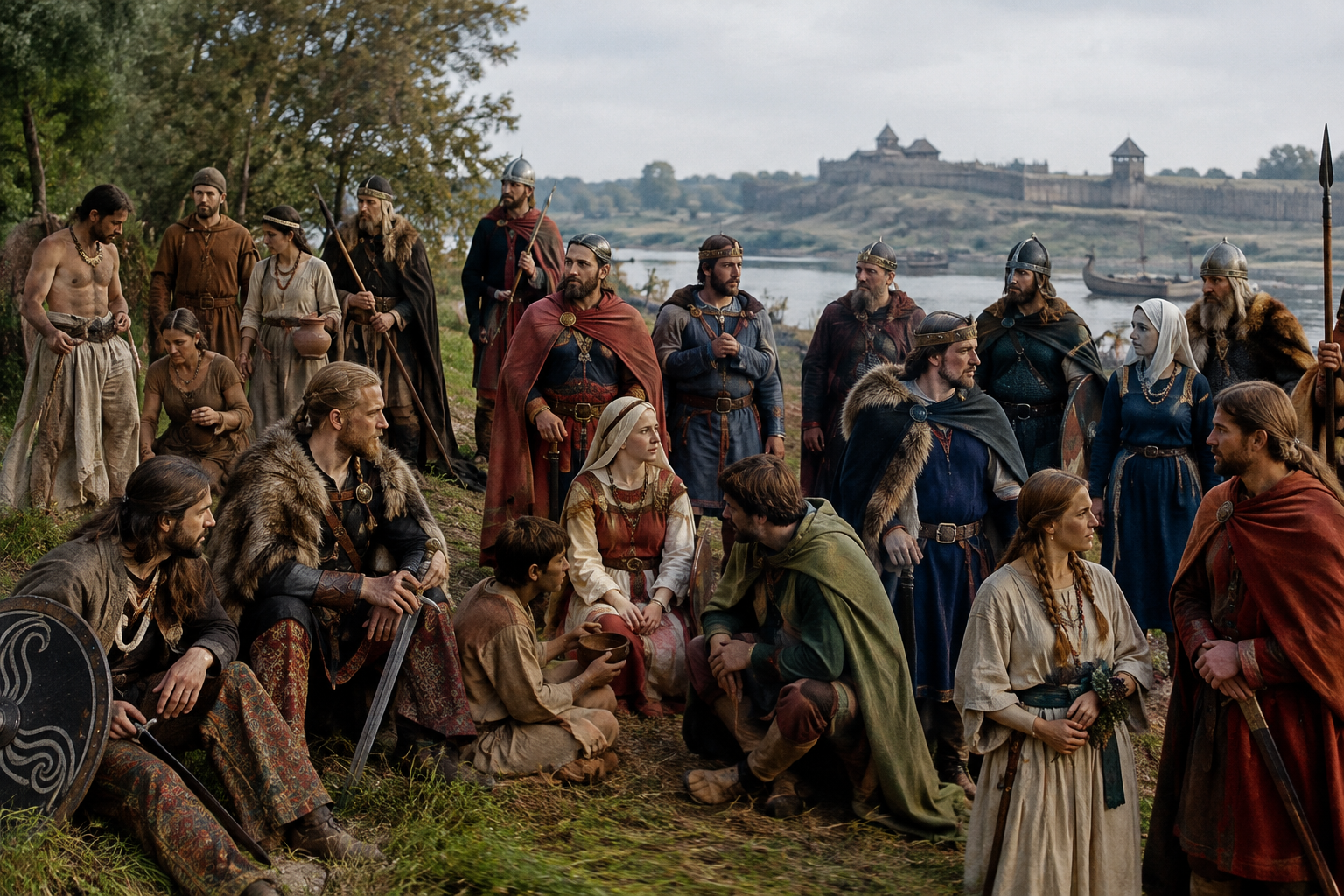
At Santok, on the borderland of Lubusz and Greater Poland, several men buried around AD 1100 have become unusually important for the history of one paternal line. Samples PCA0386 and PCA0387, both linked to the Piast sphere, sit in that dense and rather revealing cluster of medieval Polish evidence associated with haplogroup R1a1a1b1a1a. That matters because this is not a stray one-off appearance: it turns up again and again in early and high medieval Poland, especially in burials connected with the Piast dynasty and its political world.
The attraction of this lineage is not that it can explain an entire people. Y-DNA traces one direct paternal line only, not a person's whole ancestry. But when the same branch appears across multiple medieval Polish contexts, and when earlier examples also surface farther south in Bronze Age and Iron Age Hungary and Bronze Age Poland, it gives us a wonderfully archaeological question: are we looking at the long local persistence of one paternal branch in east-central Europe, later visible in the male lines of an emerging medieval state?
Santok was no sleepy village. In the early medieval centuries it stood in a strategic zone where river routes, frontier politics, and Piast expansion met. The presence of PCA0386 and PCA0387 there, both dated around AD 1100, places haplogroup R1a1a1b1a1a in a landscape shaped by fortifications, movement, and the consolidation of power in the Polish realm.
These two men are not alone. Other medieval Polish samples associated with the same branch include PCA0203 from Greater Poland, PCA0205 from a Piast-context burial dated around AD 1100, PCA0197 from around AD 950, PCA0572 from Zielonka near Poznan around AD 987, and PCA0222 from Obalczkowo in Wielkopolska around AD 1100. Taken together, they suggest that this paternal line was not peripheral to the early Piast-era population. It appears repeatedly in the very regions central to the first Polish kingdom.
A recent MyTrueAncestry discussion of these burials explores the dynastic side of the picture in more detail.
The caution, of course, is obvious and important. Repeated appearances in Piast-associated cemeteries do not mean every Piast man belonged to one identical terminal subclade, nor do they prove that every bearer of this haplogroup was noble. What they do show is that a paternal lineage linked here to R1a1a1b1a1a had a visible place in the male population around the Piast courtly and territorial core.
The strongest historical concentration comes from burials explicitly tied to the Piast dynasty. PCA0328 from Plonsk in Masovia, dated around AD 1100, and PCA0573, identified as a Piast Masovian dynasty prince around AD 1120, bring this lineage into the dynastic record more directly. PCA0574, a Piast non-Masovian dynasty prince dated to AD 1478, suggests that the same paternal association continued to appear in later branches of the dynasty as well.
That is especially interesting because dynasties are often less biologically tidy than heraldry suggests. Medieval ruling houses were political institutions as much as family trees, and archaeology regularly reveals adoption, illegitimacy, collateral branches, and all the usual complications of human history. Even so, where several Piast-related male burials repeatedly point toward the same Y-chromosomal neighborhood, the pattern deserves attention.
Research on medieval Polish dynastic remains has sharpened this picture, especially work examining the Piast rulers and their broader paternal connections in Europe. One study linked to these samples is available here: https://www.nature.com/articles/s41467-026-71457-1.
If medieval Poland gives us the political visibility of this lineage, the earlier samples give it time depth. One of the oldest associated individuals here is poz554 from Brodzica in the Lublin region of Poland, dated to about 1450 BC and linked to the Trzciniec cultural horizon. Another is Hung137 from Mezozombor-Kozsegi temet in Hungary, dated around 1050 BC. These are not medieval dynasts, and that is precisely why they matter.
They show that the wider paternal background connected with this branch was already present in east-central Europe long before the first written references to Poles, Piasts, or medieval frontiers. In the Bronze Age, what we see archaeologically is a mosaic of regional societies tied together by exchange, burial customs, and changing patterns of settlement. A Y-line that later turns up in medieval Poland was already circulating in this broader world.
Chronology matters here. The Bronze Age evidence does not prove an unbroken father-to-son line from poz554 or Hung137 to any medieval Piast burial. That would be far too neat. But it does make one thing harder to ignore: paternal lines associated with R1a1a1b1a1a were established in this part of Europe many centuries before state formation.
For readers interested in the wider Bronze Age background of this region, this related article is a useful companion.
Late Bronze Age Central Europe
The branch also appears beyond Poland in later prehistory. Sample I25524 from Komarom-Esztergom in Hungary, dated around 225 BC, places it in the Iron Age Carpathian Basin. Another intriguing case is MX265 from Singen am Hohentwiel, dated around 597 BC and described in connection with the Boii, a Celtic group known from Central European history.
These finds do not turn R1a1a1b1a1a into a specifically "Celtic" or specifically "Slavic" haplogroup. That would confuse archaeological labels, languages, and paternal markers. What they do suggest is a lineage moving through, or persisting within, the ethnically and culturally mixed societies of Central Europe, where later identities emerged from much older biological and social landscapes.
An ancient DNA study on Iron Age and later mobility around the Baltic and eastern Europe has helped underline just how connected these regions could be: https://www.nature.com/articles/s41586-021-04287-4. The larger lesson is that paternal continuity and cultural change often coexist. Men carrying related Y-lines could live under very different material cultures, political systems, and historical names.
Three more samples widen the frame still further: VK452 from Kopparsvik on Gotland in Sweden, VK438 from Frojel on Gotland, both around AD 975, and VK408 from Staraya Ladoga around AD 1000. Add VK212 from an elite Viking grave at Cedynia around AD 1010, and the medieval Baltic starts to look less like a set of separate worlds and more like a corridor.
That is a very helpful reminder for anyone reading haplogroups too literally. A paternal lineage associated with medieval Polish dynastic contexts also appears in Viking Age settings tied to trade, travel, and contact zones stretching from Gotland to Ladoga and the southern Baltic. The Viking Age was not merely Scandinavian expansion; it was a network of ports, markets, military service, marriage, and political brokerage.
Gotland in particular has become central to that story because its burials reveal both local continuity and long-distance entanglement.
Cedynia is equally interesting in a Polish context. An elite Viking-age grave there carrying the same haplogroup association hints at the sort of frontier society where Scandinavian, Slavic, and regional political worlds overlapped. That does not make every bearer of this line a Viking, of course. It does show the branch operating in the same historical theatre where the Piast state itself was taking shape.
R1a1a1b1a1a stands out here not because it belongs to one simple people, but because it appears in a strong east-central European sequence: Bronze Age Poland and Hungary, Iron Age Central Europe, Viking Age Baltic networks, and then a striking concentration in medieval Poland, including Piast-connected burials. For someone researching this paternal line today, that makes it a lineage with deep regional roots and a particularly visible medieval chapter in the Polish historical sphere.
If your own Y-DNA falls on this branch, the most responsible reading is not a fantasy of direct princely descent, but something more interesting: your paternal line may belong to one of the long-lived male threads woven through the making of Central and eastern Europe's Bronze Age communities, Baltic contact zones, and early medieval kingdoms.
Comments