Haplogroup R1a1a1a1d
– 4 min read


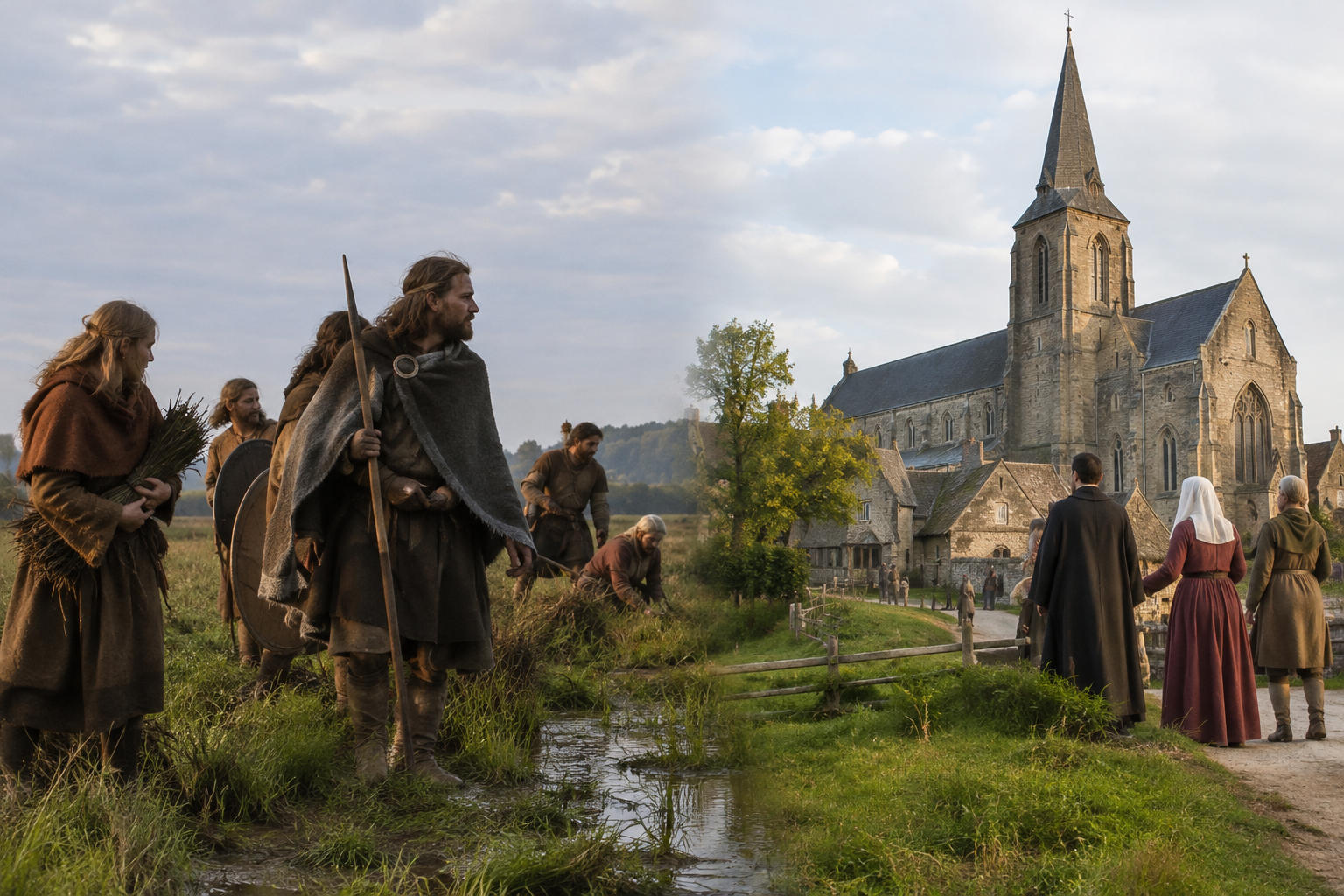
At Alken Enge in Jutland, archaeologists uncovered one of the grimmest deposits in Iron Age northern Europe: the disarticulated remains of men thrown into a bog after a violent conflict, dated here to around 47 BC. One of those individuals, sample CGG019208, has been associated with the Y-DNA haplogroup R1a1a1a1d. That matters because it places this paternal line not in an abstract genetic tree, but in a real and unsettling archaeological setting: a battlefield aftermath in pre-Roman Denmark.
The second ancient appearance in this small but suggestive record comes from a very different world. Sample ST1867, dated to about AD 900 and found at Sint-Truiden's Onze-Lieve-Vrouwekerk in medieval Belgium, links the same reported haplogroup to an early urban Christian community in the Low Countries. Between a bog filled with war dead and a church burial in a growing medieval town, R1a1a1a1d appears in two sharply contrasting settings. That is a useful reminder that Y-DNA tracks one direct paternal line only; it does not define a whole people, let alone the full ancestry of the men who carried it.
Alken Enge has become famous because it preserves not a single grave, but the remains of a defeated group treated in a highly unusual way after death. The site lies in eastern Jutland, and its human bones have been central to debates about warfare, ritual treatment of the dead, and the scale of conflict in the centuries around the Roman expansion north of the Alps. In that setting, CGG019208 anchors R1a1a1a1d in an Early Roman Era landscape shaped by organized violence.
What makes this especially interesting is not that one haplogroup "explains" the site; it plainly does not. Alken Enge is important because it shows how ancient DNA can sit alongside archaeology without flattening it. A paternal lineage can be identified, but the site itself still speaks primarily about conflict, deposition, and social practice in Iron Age Scandinavia. A recent ancient-DNA study connected to Danish material can be found here: research on ancient populations from the region.
There is also a broader historical point. Jutland in the last decades BC was not a quiet margin beyond history, waiting for "civilization" to arrive. Sites like Alken Enge show communities already capable of assembling fighting forces on a large scale, and of marking victory or defeat in memorable ways. If a branch such as R1a1a1a1d appears there, the safest conclusion is that this paternal line was part of the male population moving through that contested northern world.
The haplogroup named here is a narrow branch within the much larger Y-DNA family R1a, a major paternal lineage with a wide and complicated Eurasian history. But one must be careful. The broad history of R1a cannot simply be poured into every sub-branch as if nothing changed along the way. R1a1a1a1d is a more specific label, and with only two listed ancient individuals in this article's evidence base, the honest story is necessarily modest.
What the current record does show is a lineage present in northwestern Europe in at least two very different periods: the Iron Age of Denmark and the early medieval Low Countries. That does not prove uninterrupted descent between those two men, nor does it map a single migration route. It does, however, place this branch within the historical worlds of northern Europe rather than in purely theoretical reconstructions.
The second sample, ST1867, comes from Sint-Truiden Onze-Lieve-Vrouwekerk in Belgium and is dated here to around AD 900. By this date, we are no longer in the bog landscapes of Iron Age warfare, but in a Christian setting tied to settlement, church life, and the consolidation of medieval society in the Meuse-Scheldt region. The same reported haplogroup appearing here suggests that this paternal line had a place in the population of the early medieval Low Countries.
Sint-Truiden is an especially useful contrast because it belongs to a world of towns, ecclesiastical institutions, and increasingly dense social networks. Research on medieval burials from the site has helped scholars think about urbanization and population structure in the region, and a relevant study can be found here: an ancient DNA study examining medieval Sint-Truiden. In other words, ST1867 is not just "a man in Belgium"; he belongs to a changing medieval community in which mobility, kinship, and local continuity can all be investigated archaeologically.
That shift in context matters. The same paternal branch can pass through societies with utterly different institutions and identities. An Iron Age man deposited among war dead and a medieval man buried at a church did not inhabit the same political world, speak the same language, or think of themselves in the same terms. A Y chromosome can connect them biologically at the level of paternal descent, while history keeps their lives properly distinct.
Putting CGG019208 and ST1867 side by side reveals the real strength of this evidence. It is not quantity, but contrast. One sample comes from a site defined by conflict and post-battle deposition in Jutland around the turn of the era; the other from a Christian burial context in medieval Belgium roughly nine and a half centuries later.
That contrast helps rescue haplogroup writing from a common trap. Too often, a lineage is described as if it were marching intact through time, carrying a stable ethnic label on its back. Archaeology shows something messier and more human. Paternal lines survive through changing communities, altered burial customs, new political structures, and very different ways of understanding the dead.
For northwestern Europe, that is exactly the kind of pattern one might expect. The North Sea and adjacent inland zones connected Denmark, the Low Countries, and neighboring regions through movement, trade, war, marriage, and later church networks. None of that proves a direct line from Alken Enge to Sint-Truiden, but it does make their shared appearance within the broader northern European zone historically plausible.
Two ancient samples are not enough to turn R1a1a1a1d into a grand historical slogan. They are enough, though, to give it shape. This branch is not floating in a vacuum: it is attested in an Iron Age Danish conflict assemblage and in an early medieval Belgian ecclesiastical burial context. That is a small footprint, but a real one.
For someone researching this paternal line today, the most responsible takeaway is that R1a1a1a1d can be placed within the documented human history of northwestern Europe, in settings ranging from pre-Roman Jutland to medieval Sint-Truiden. It suggests a lineage that participated in the long, uneven history of the North Sea world, where violence, settlement, belief, and continuity all left their mark on the men whose Y chromosomes we can still recover.
Comments