Haplogroup Q1b2a

– 5 min read


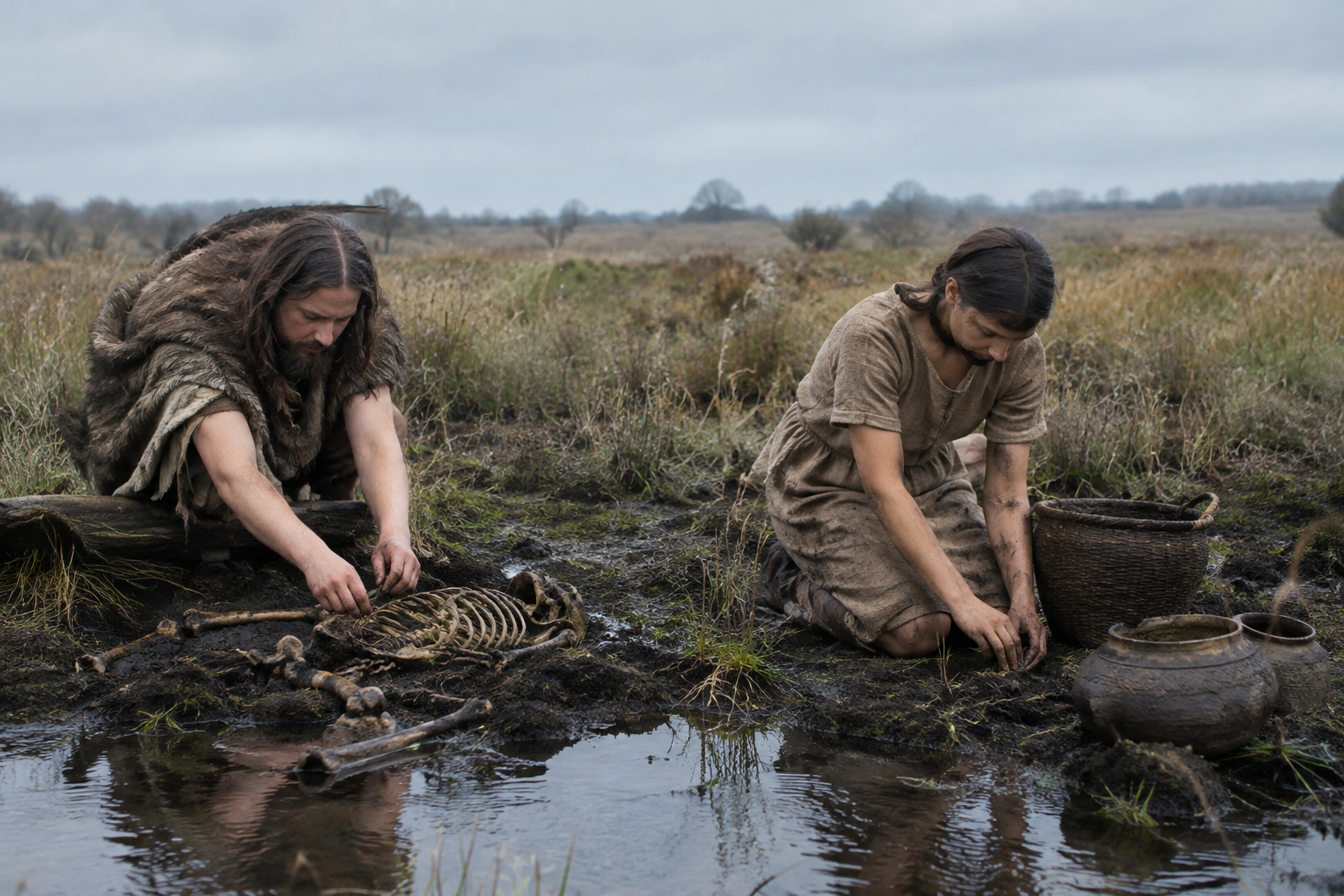
At Vanlose Mose on Sjaelland in Denmark, one prehistoric skeleton has become a particularly intriguing signpost for the paternal line Q1b2a. The individual known as NEO599, dated to around 3191 BC, belongs to the Neolithic world of southern Scandinavia, a period when farming societies, older forager traditions, and new forms of mobility were meeting in complicated ways. That alone would make him interesting. What makes him especially striking is that Q lineages are far better known, in broad outline, from northern Eurasia and the Americas than from Neolithic Denmark.
So Q1b2a does not announce itself here as a dominant "Danish" lineage in any simple sense. Instead, it appears in exactly the sort of place where ancient DNA has forced historians and archaeologists to abandon tidy maps. One paternal line, carried by one man, can illuminate movements and mixtures that larger cultural labels often blur.
Y-DNA tracks one narrow thread of ancestry: the direct paternal line from father to son. That makes haplogroups historically useful, but also easy to overread. A man assigned to Q1b2a was not "nothing but Q1b2a"; he also had hundreds of other ancestors, and his language, culture, and identity were shaped by the society around him, not by one chromosome.
The wider haplogroup Q is ancient and geographically expansive, with deep roots in northern Eurasia and major importance in the peopling of the Americas. But the branch discussed here is narrower: Q1b2a. The evidence in this article is not enough to write a grand, unbroken saga for that exact subclade. What it does offer is something more valuable: a glimpse of Q1b2a-associated paternal ancestry appearing in two very different prehistoric settings in Europe, one in Neolithic Denmark and another in a later Corded Ware context in Bohemia.
A useful background for the Danish setting comes from research on the region's population shifts during the Mesolithic-Neolithic transition, when ancestry linked to incoming farmers and ancestry linked to local hunter-gatherers were reshuffled repeatedly. That wider context is explored in a major ancient DNA study of prehistoric Denmark.
Denmark's Neolithic transition
Sjaelland was not a remote backwater in the fourth millennium BC. It sat in a zone of contact linking the Danish islands, southern Scandinavia, and the Baltic approaches. By the time of NEO599, agriculture had long since arrived, but the social landscape was still anything but settled. Ancient DNA from Denmark has shown repeated turnover, local persistence, and episodes of admixture rather than a single clean replacement.
That is why NEO599 matters. A Q1b2a line in this setting suggests that Neolithic Denmark could contain paternal variation that falls outside the lineages people often expect when they think of early European farmers or later Scandinavian populations. It is a reminder that burial grounds and bog finds preserve individuals, not stereotypes. One man in a Danish wetland context can carry a paternal history with deeper connections across northern Eurasia than the map of "Neolithic farmer Europe" might lead us to expect.
We should still be careful. One sample does not prove that Q1b2a was common in Neolithic Denmark, nor does it identify a specific migration episode on its own. But it does show that this paternal branch, or at least a closely associated reported assignment, had reached the western Baltic world by the late Neolithic horizon represented at the site.
The second ancient clue comes from DRO001, dated to around 2100 BC from Drouzkovice in what is now the Czech Republic and identified here as Corded Ware. That immediately places the sample in a very different archaeological conversation. Corded Ware communities across central and northern Europe are closely bound up with large-scale population movements after about 3000 BC, and with the spread of ancestry ultimately connected to steppe pastoralist expansions.
By 2100 BC, of course, we are already in a late phase relative to the classic early Corded Ware horizon. But the label still places DRO001 within that broad archaeological tradition in Bohemia, where funerary customs, regional interaction, and inherited ancestry patterns all mattered. A Q1b2a assignment in this milieu is notable because Corded Ware cemeteries often bring to mind other paternal lineages more commonly discussed in European prehistory. Q1b2a stands out precisely because it is unusual, and unusual lineages are often historically revealing.
Here, the significance is not that Q1b2a somehow "defines" Corded Ware. It plainly does not. The interest lies in the fact that the Corded Ware horizon was capacious enough, genetically and socially, to include paternal lines that sit outside the standard popular sketch of Bronze Age Europe. That is a useful corrective to over-simple narratives of one culture, one people, one haplogroup.
Put NEO599 and DRO001 side by side, and the shape of the evidence becomes more interesting than either sample alone. One belongs to Neolithic Denmark in the western Baltic. The other belongs to a Corded Ware context in Bohemia roughly a millennium later. That is not enough to trace a family tree, but it is enough to show that Q1b2a-associated paternal ancestry was present in more than one prehistoric European setting and in different archaeological worlds.
This matters because prehistoric Europe was not genetically uniform even within famous archaeological cultures. Labels such as Funnel Beaker, Corded Ware, or Battle Axe are useful shorthand for material culture and chronology, but they do not lock every buried individual into one biological profile. Q1b2a is the sort of lineage that reminds us to look for side currents as well as main streams.
It also opens a wider Eurasian perspective. Haplogroup Q has long been part of discussions about movements across the steppe, forest-steppe, and northern Eurasian zones. That does not mean either of these men can be neatly assigned to a single migration route. But their presence in European prehistoric contexts fits the broader picture emerging from ancient DNA: Europe received people, and paternal lines, from multiple directions over many centuries.
For the central European setting, broader work on prehistoric population structure and mobility in the region helps frame why an unexpected Y-line can matter. One study of ancient individuals from Bohemia and surrounding contexts has underlined just how dynamic these communities were over time, even when archaeological labels appear stable on the surface. That wider setting is discussed in research on ancient population history in central Europe.
Corded Ware and Bell Beaker burials
If you carry Q1b2a today, these ancient cases suggest a paternal story that may touch the less expected edges of European prehistory. Not the dominant textbook lineages, not an obvious royal dynasty, and not a single famous migration told in one sweep - but a rarer thread appearing where archaeologists now know populations were mixing, moving, and recombining in ways older history books often flattened out.
That makes the branch historically appealing. It sits comfortably in a world where Denmark's Neolithic was reshaped by contact and ancestry turnover, and where Corded Ware-era central Europe was more varied than the stereotype of a single steppe-derived male package. Rare lineages can be historically important precisely because they show how much human movement escapes the biggest headlines.
Ancient DNA in northern Eurasia
The most distinctive thing about Q1b2a in the present evidence is not quantity but placement. A man from Neolithic Sjaelland and another from a Corded Ware context in Bohemia show this paternal line turning up in prehistoric Europe where cultural boundaries were porous and ancestry was anything but simple. For someone researching Q1b2a today, that is the real historical clue: your direct paternal line may belong to one of the smaller, more surprising strands woven into Europe's prehistoric population changes.
Comments