Haplogroup Q1a2a1a1
– 4 min read


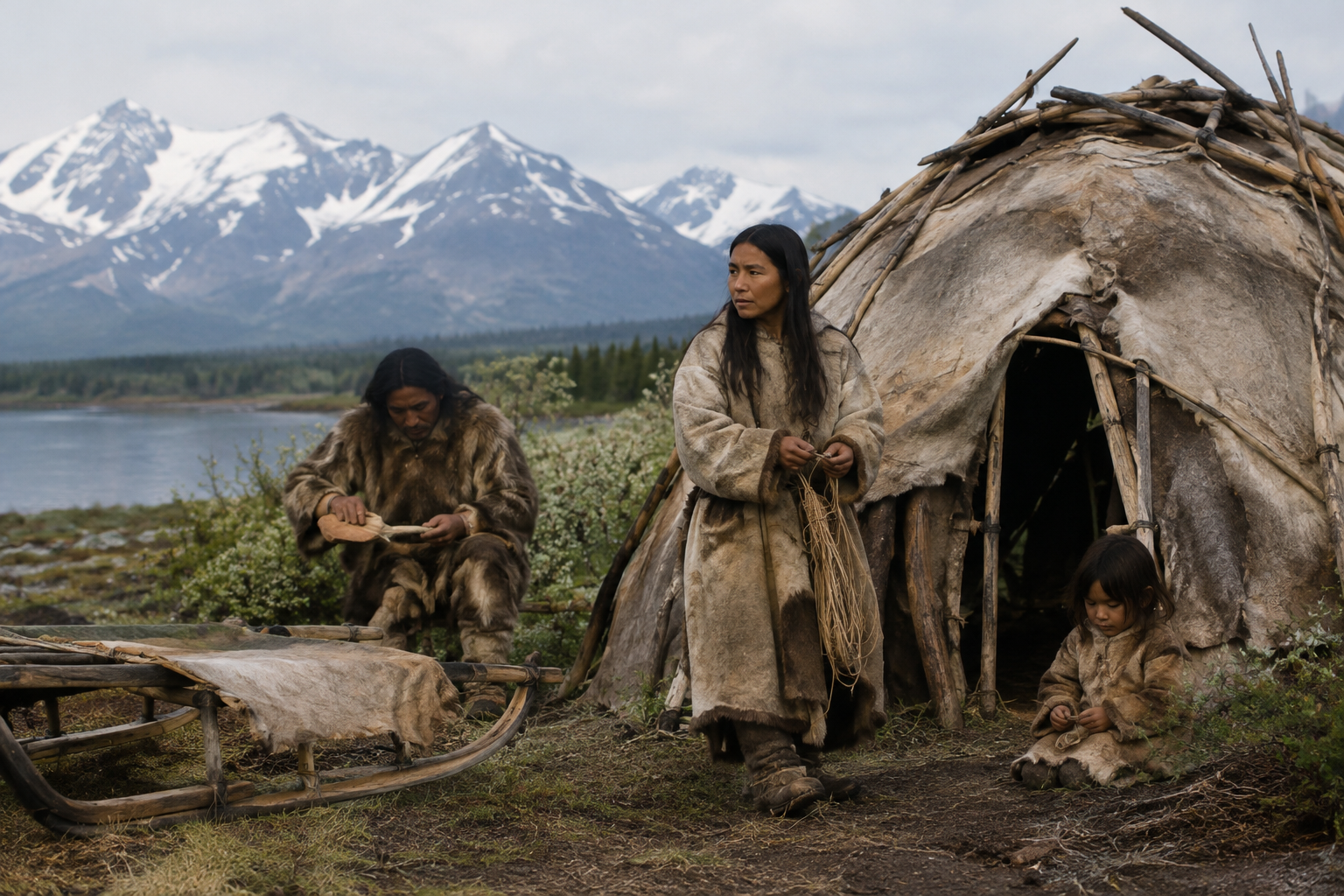
One of the clearest ancient signposts for the Y-DNA haplogroup Q1a2a1a1 comes not from a king or a grand stone tomb, but from a man identified simply as I5320, an Alaskan Athabaskan individual dated to around AD 1235. That is already enough to make him important. He places this paternal line in the far northwest of North America in the late pre-contact world, among peoples whose histories are often better preserved in oral tradition, language, and landscape than in written chronicles.
That matters because haplogroup Q, in its broader sense, is one of the major paternal lineages associated with the peopling of the Americas. But Q1a2a1a1 is not the whole of haplogroup Q. It is a narrower branch within that larger paternal tree, and the value of a sample like I5320 is that it gives this particular line a firm archaeological foothold. Y-DNA tracks one direct male line only, not a person's entire ancestry, but even that single line can anchor a much larger historical story.
The sample I5320 is described as an Alaskan Athabaskan individual dating to about AD 1235. Even without a richly described grave report here, the combination of place, date, and community is revealing. We are in medieval Alaska, long before Russian colonization and long before the region entered written European history, yet already within societies with deep regional roots and complex northern connections.
Athabaskan-speaking peoples are historically spread across a vast zone of northwestern North America, especially interior Alaska and northwestern Canada, with related language branches extending much farther south in later periods. So a paternal lineage found in an Alaskan Athabaskan context is not just a technical genetic label. It sits inside one of the great stories of northern human history: movement, adaptation, and continuity across subarctic landscapes.
Research on ancient northern populations, including the study linked to this sample, has helped show that Alaska was not some empty cul-de-sac at the edge of the world, but a region of long-term population history in its own right. An ancient DNA study examining these northern remains can be found here. For Q1a2a1a1, I5320 gives us a rare and concrete ancient bearer tied to a named Indigenous population.
Settlement of the Indigenous Americas
With a lineage such as Q1a2a1a1, it is tempting to leap straight from one ancient Alaskan man to the entire settlement history of the Americas. That would be much too tidy. The safer point is narrower and more useful: this branch belongs inside the paternal diversity of Native American populations, and in this case it is documented in an Athabaskan individual in late pre-contact Alaska.
That distinction is worth keeping in view. The parent haplogroup Q has a long and complicated history across northern Eurasia and the Americas. But a narrower label like Q1a2a1a1 should not automatically be given every migration claim ever made for haplogroup Q as a whole. Ancient DNA works best when it stays close to the evidence. Here, the evidence ties the branch to a real person in a real northern context, not to every dramatic map-arrow story one might wish to tell.
Still, even a single well-placed sample can be powerful. In archaeology, the difference between speculation and history is often the difference between "this might have been present" and "here it is, in this individual, at this date, in this place." I5320 gives Q1a2a1a1 exactly that kind of anchor.
Alaska is one of those places that can look peripheral on a schoolroom map and central on an archaeological one. It lies close to the old connection zone of Beringia, the broader region linking northeast Asia and northwest North America during the late Ice Age and after. No, that does not mean we can identify I5320 as some direct survivor of the first migration wave into the Americas. But it does mean that lineages found in Alaska often carry unusual weight in discussions of deep ancestry.
By the thirteenth century AD, when I5320 lived, Alaska had already seen millennia of human occupation, regional diversification, and adaptation to cold environments. So the sample does not represent a first arrival. It represents continuity and survival: a paternal line still present within an Indigenous northern population long after the initial settlement of the continent.
That is historically significant in its own right. Ancient DNA from the Americas is still patchier than for many parts of western Eurasia, and northern regions are especially valuable because they help connect population history, environmental adaptation, and language geography. A lineage documented in an Alaskan Athabaskan setting therefore matters beyond the single chromosome it preserves.
It is also useful to say what this article is not about. It is not evidence for a medieval migration from Europe, not a clue to a lost dynasty, and not a one-line explanation for all Athabaskan history. In fact, the absence of those usual dramatic props is rather refreshing. We are looking instead at how one paternal branch sits inside the long Indigenous history of North America.
That broader picture is one of diversity, not uniformity. Ancient American populations carried multiple Y-DNA branches within haplogroup Q and beyond, just as they spoke many languages and lived in many ecological settings. The Alaskan Athabaskan sample reminds us that northern populations were neither isolated in a simplistic sense nor interchangeable. They had their own demographic histories, their own regional networks, and their own lineages preserved across centuries.
For people today who belong to Q1a2a1a1, that can be more meaningful than a grandiose claim. It places the paternal line in the documented human history of the North American north, in a landscape of river travel, seasonal movement, kin networks, and durable Indigenous presence. Genetics does not replace archaeology or oral tradition here; it adds another thread to them.
So what is the most responsible historical reading of Q1a2a1a1? At present, it is best understood as a Native American-associated paternal branch with at least one securely noted ancient representative in an Alaskan Athabaskan individual around AD 1235. That does not tell every holder of the lineage exactly which people their direct paternal ancestors belonged to in every century. But it does place the branch within the lived history of Indigenous North America, and very specifically within the ancient north.
For family historians, that is the real value of an ancient sample like I5320. He is not a legend, and he does not need to be. He is a documented human point on the map of the past, showing that this paternal line was present in medieval Alaska among Athabaskan people whose descendants helped shape the history of the subarctic world.
Comments