Haplogroup Q1a1b

– 5 min read


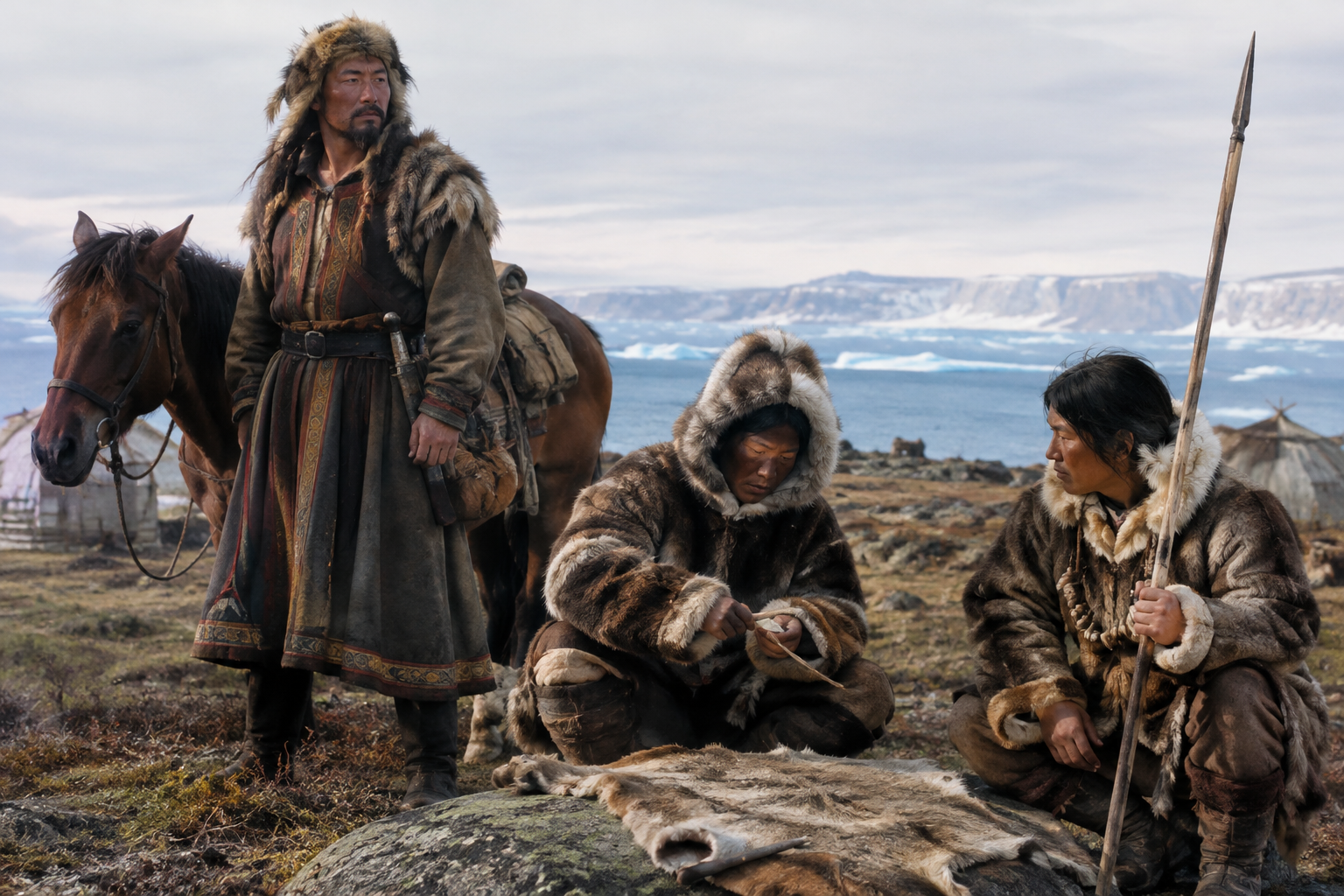
One of the clearest ancient signposts for Q1a1b comes from the far north: the Saqqaq individual from Greenland, dated to around 1950 BC and preserved well enough to become one of the landmark genomes of Arctic archaeology. This was not merely an isolated skeleton with an exotic label. It represented a human life from the earliest peopling of Greenland by Paleo-Inuit groups, and it showed that some paternal lines now associated with northern Asia and the Indigenous Americas were already established in the eastern Arctic thousands of years ago.
That matters because Q1a1b is not a catch-all label for an entire people. It is a branch within the broader haplogroup Q, a Y-chromosome lineage that traces one direct paternal line only. But when that branch appears in ancient individuals from Greenland, Arctic Canada, and the Eurasian steppe, it gives us a particularly revealing view of how male lineages could travel through very different historical worlds.
The Saqqaq genome entered archaeology as a rare gift of preservation: an ancient individual from Greenland whose DNA survived well enough to transform discussion of Arctic prehistory. Research on this individual, published in a major ancient genome study, helped show that the early Saqqaq people were closely tied to populations with northeastern Asian roots rather than to later Norse settlers or to every later Inuit population in a simple, uninterrupted line.
For readers with Q1a1b, this is where the haplogroup becomes historically vivid. Instead of talking in abstractions about "northern origins," we can point to a real person from prehistoric Greenland. The Saqqaq individual suggests that branches connected to Q were carried by small, mobile communities adapted to extreme environments, moving across the North American Arctic long before written history touched the region.
Ancient Settlement of the Americas
Archaeologically, the Saqqaq world belongs to a period of remarkable ingenuity: maritime hunting, cold-climate lifeways, and long-distance movement across coasts and sea ice. The DNA does not tell us everything about language or identity, and it certainly does not reduce Saqqaq culture to a Y-line. But it does anchor Q1a1b in one of the great chapters of northern human expansion.
A second useful point of comparison is the individual identified as I10427, described here as Inuit Canada Dorset and dated around AD 200. The Dorset cultural horizon is later than Saqqaq and belongs to a different phase of Arctic prehistory, but the appearance of Q1a1b in this northern setting is still significant. It shows that paternal lines within haplogroup Q remained part of the human story of the eastern Arctic over a very long span.
That does not mean Saqqaq and Dorset peoples were identical, nor that one sample can stand for the whole population. Arctic archaeology has repeatedly shown change as well as continuity: shifting technologies, regional adaptations, and, at times, population replacement. Yet when Q1a1b turns up in both prehistoric Greenland and Arctic Canada, it encourages a more precise question: not whether the north was static, but how certain paternal branches persisted or reappeared across changing cultural landscapes.
In this sense, Q1a1b is historically interesting because it sits at the junction of mobility and endurance. The Arctic was never a blank edge of the map. It was peopled, connected, and dynamic, and male lineages like this one help make that long chronology visible.
The sample Rise600, described as a Hunnic-period individual from Russia and dated around AD 150, introduces a very different historical setting. Here Q1a1b is no longer appearing in the Arctic but in the wider steppe zone, among populations living in a region shaped by horseback mobility, political confederations, and constant contact between Europe and inner Asia.
This is exactly why one must be careful with labels such as "Hunnic." Archaeological and historical usage often compresses a great deal of diversity into a single term. A man buried in a Hunnic-period or Hunnic-associated context need not represent a single uniform ethnic category. Still, the presence of a Q-lineage in that world is wholly plausible and historically meaningful, because haplogroup Q has long been part of the paternal landscape of northern and inner Asia.
Ancient DNA research on steppe populations has repeatedly shown that the peoples grouped under names like Scythian, Sarmatian, Xiongnu, and Hunnic were often mixtures rather than simple biological blocs. That broad picture is one reason posts on steppe mobility and frontier diversity remain so useful for context.
So what does Rise600 add to the story of Q1a1b? It widens it dramatically. This branch is not confined to one later nation or one romanticized migration tale. In the surviving ancient record given here, it appears both in the circumpolar north and in the Eurasian steppe, two regions linked by deep northern Eurasian history but separated by very different archaeological worlds.
At this point it is worth pausing over the genetics. Q1a1b is a sub-branch within haplogroup Q, and that distinction matters. The larger Q family has a wide and ancient history across northern Eurasia and the Americas, but not every statement about haplogroup Q can safely be applied to this narrower branch without sample-level support.
What the ancient individuals here do support is a pattern of northern distribution. The Saqqaq individual and the Dorset-era I10427 place Q1a1b in Arctic contexts tied to the peopling and re-peopling of the North American far north. Rise600 places the same branch, or a reported association with it, in a steppe context from Iron Age Russia. Together they suggest that this paternal line belongs to a deep northern story stretching across regions that were often connected indirectly through long chains of movement and ancestry.
A broader ancient DNA study of the Americas, published in another important research paper, has also reinforced just how complex Indigenous American population history really was. That wider scholarship is helpful here because it reminds us that paternal lineages did not move in neat, one-time waves. They were carried by real populations that split, mixed, expanded, and sometimes disappeared.
Individually, each sample is only one point on a map. Saqqaq is a prehistoric Greenlander from the early eastern Arctic. I10427 belongs to the later Arctic world of Dorset-era Canada. Rise600 comes from a Hunnic-period setting in Russia. Put together, they do not prove a single unbroken chain of fathers and sons across four millennia. What they do provide is something more solid: evidence that Q1a1b belonged to populations moving through the high-latitude and steppe zones of northern Eurasia and the Arctic over a very long period.
That is a useful corrective to simplistic ancestry myths. A Y-line can be ancient without being exclusive, mobile without being traceable to one famous tribe, and widespread without belonging to everybody in a region. Q1a1b looks, from the evidence here, like one of those lineages that rewards attention precisely because it turns up in places where climate, distance, and historical labels often obscure the deeper human story.
For someone researching Q1a1b today, the most defensible takeaway is not a promise of descent from one named people, but a connection to a paternal lineage with documented ancient roots in northern and Arctic settings, and at least one appearance in the Hunnic-period steppe. That is already a striking historical profile. It places your direct paternal line in landscapes of sea ice, long-distance mobility, and the vast northern belt that linked Asia to the Americas in prehistory.
In other words, Q1a1b is interesting not because it belongs to a single famous civilization, but because it appears in some of the most demanding and mobile human environments on earth. The archaeology suggests endurance, adaptation, and movement across immense spaces - exactly the sort of past that ancient DNA is now helping us see more clearly.






Comments