Haplogroup O2a2b1a1a1a4a

– 5 min read


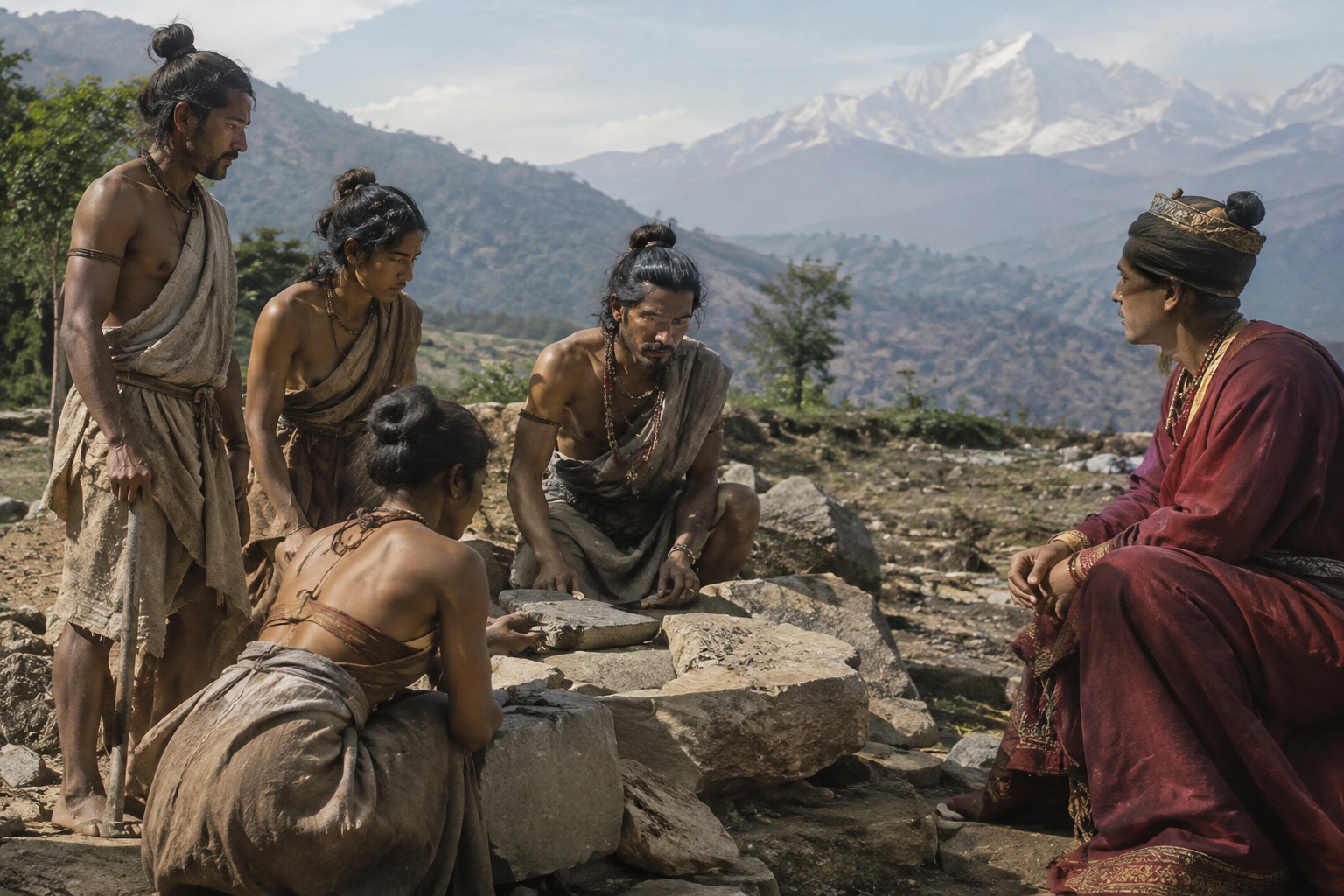
At Chokhopani in the Mustang region of Nepal, a cluster of ancient men dated to around 785 BC offers one of the clearest early archaeological appearances linked here to the Y-DNA haplogroup O2a2b1a1a1a4a. The sample set is unusually concentrated: CHO001, CHO001b, CHO001c, CHO001e, and CHO001f all come from the same Bronze Age context. That matters, because it turns a haplogroup label from an abstract code into something far more tangible: a paternal line present in a real high-altitude community on the Himalayan side of Inner Asia.
There is a useful caution to keep in view. Y-DNA traces one direct paternal line only, not a whole person's ancestry, language, or identity. Even so, when the same paternal branch appears repeatedly at one site and then turns up again centuries later in the broader trans-Himalayan world, it starts to illuminate how male lineages could persist through major cultural changes without needing a grand imperial story attached to them.
Chokhopani is not famous because of kings or conquest. It is important because of location. Mustang sits in the Himalayan corridor between the Tibetan Plateau and the South Asian world, and that makes any securely dated ancient burial there especially valuable. A repeated paternal signature from this landscape suggests that the branch represented by O2a2b1a1a1a4a, or a very close ancestral line reported with it, was already established in communities living along those mountain routes by the late 1st millennium BC.
The Chokhopani individuals should not be turned into a dynasty just because several male samples from one site share a reported haplogroup association. They may represent relatives, or simply men from the same local population across a burial ground. But either way, the pattern is archaeologically interesting: this is not a stray, isolated occurrence. It is a compact cluster, anchored in place and time.
That broader Himalayan context has become clearer thanks to ancient DNA work on the region, including research on highland populations and their long-term connections across Tibet and adjacent areas, as discussed in a recent genetic study of Himalayan and trans-Himalayan populations. For anyone following this paternal line, Chokhopani is a reminder that mountain societies were not marginal to history; they were part of enduring networks of movement, exchange, and settlement.
Ancient DNA from trans-Himalayan Ladakh
One ancient Y-DNA result can always be a curiosity. Five associated males from the same site are something more useful. CHO001, CHO001b, CHO001c, CHO001e, and CHO001f suggest continuity within a local male population, or at least a recurring paternal presence, rather than a single outsider buried far from his homeland.
This is precisely where archaeology and genetics work best together. The archaeology gives us a community in a defined landscape; the Y-chromosome gives us a narrow paternal thread passing through that community. We still cannot say that everyone at Chokhopani belonged to the same lineage, and we certainly cannot derive ethnicity from one branch. But we can say that this paternal line had a place in Himalayan life centuries before the great medieval polities of the region appear in written history.
It is also worth noting that the article haplogroup is highly specific. The wider O haplogroup and its many descendant branches are spread across large parts of East and Southeast Asia, but that does not mean every local subclade has the same story. With O2a2b1a1a1a4a, the evidence in hand is much narrower and more concrete: late prehistoric Nepal, then a later appearance in Samdzong.
The later sample S35 from Samdzong, dated here to around AD 500 and described as Licchavi-period, provides the article's second key anchor point. This is a very different historical moment from Bronze Age Chokhopani. By the early 1st millennium AD, the Himalayan world was tied into expanding political and religious networks linking Nepal, Tibet, and the northern edge of South Asia.
What makes S35 useful is not that it proves an unbroken father-to-son line from Chokhopani. It does not. What it does suggest is that a paternal lineage associated here with O2a2b1a1a1a4a remained present in the same broad mountain sphere over many centuries. That is a quieter kind of continuity than the rise and fall of states, but in population history it is often the more durable one.
Samdzong itself has attracted archaeological attention because Mustang preserves communities that sat between cultural worlds rather than neatly inside just one of them. A man carrying this paternal line in the Licchavi-era horizon belongs to that bigger story of long-lived upland populations adapting to changing political landscapes while retaining elements of local biological continuity.
A 2,800-year-old Himalayan mixed population
It is tempting, when looking at Himalayan DNA, to force tidy labels onto ancient people: Tibetan, Nepalese, South Asian, Central Asian. Real populations rarely oblige. Mountain corridors create contact zones, and ancient communities in Mustang were shaped by geography as much as by any later political frontier.
That is why this haplogroup is best understood through place rather than through modern identity categories. The Chokhopani and Samdzong men lived in a region where trade, herding, ritual life, and seasonal mobility connected valleys and plateaus. A paternal lineage can persist through all that while the language, material culture, and political affiliations around it shift substantially.
Older archaeological and genetic work on Nepal's ancient high-altitude populations helped establish just how important these Himalayan sites are for tracing human adaptation and continuity, including research published in a study of ancient individuals from Nepal. That does not by itself resolve every fine branch assignment, but it does place these men in a serious research tradition rather than in folklore.
So what does O2a2b1a1a1a4a look like in historical terms, based on the evidence here? Not a conquering house. Not a named royal clan. Instead, it looks like a paternal line rooted in the Himalayan world by the late Bronze Age or early Iron Age and still visible there many centuries later.
That may sound modest, but modesty is often where the truth lives. Ancient DNA is at its most persuasive when it reveals persistence in ordinary communities. The men of Chokhopani and the later individual from Samdzong are useful precisely because they are not draped in legend. They show that the peopling of the Himalayas was not just a matter of dramatic migrations from one side or the other, but also of local lines enduring in place.
East Asian paternal history in ancient Y-DNA
For a modern tester, the strongest supported insight is regional and archaeological rather than dynastic. O2a2b1a1a1a4a is linked here to ancient males from Mustang in Nepal, first in the Chokhopani cluster around 785 BC and later in Samdzong around AD 500. That pattern points to a paternal lineage with a documented place in the long human history of the trans-Himalayan zone, where local continuity and cross-regional contact went hand in hand.
If this is your line, the most responsible historical picture is not a single march from one homeland to another, but a durable paternal thread woven through Himalayan communities over many centuries.
Comments