Haplogroup O2a2b1a1a1a1a1b1

– 5 min read


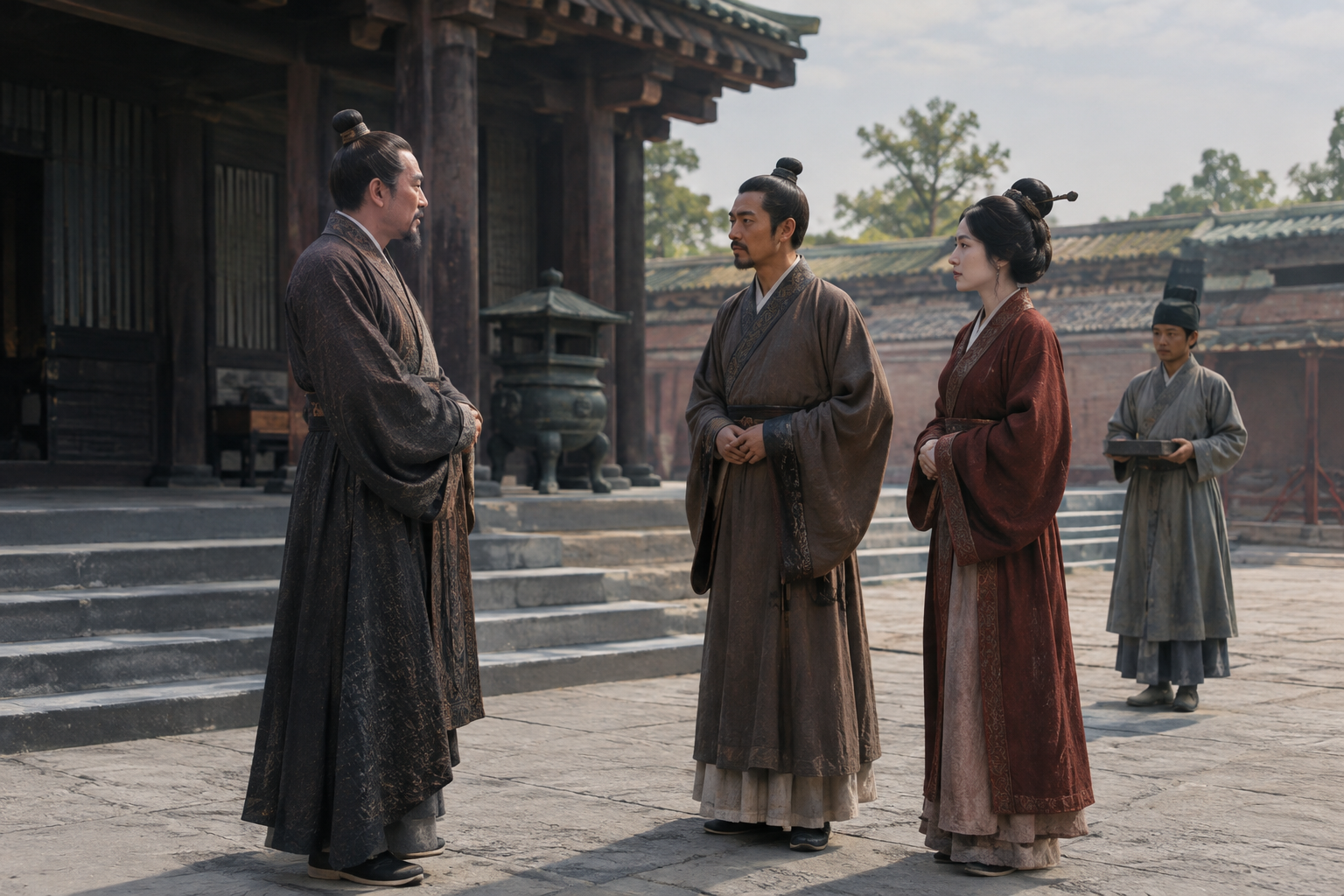
At Dacaozi in northwestern China, one ancient man dated to around AD 90 offers a small but telling glimpse into the paternal history carried today under the very specific Y-DNA label O2a2b1a1a1a1a1b1. The sample is recorded as DCZ-M21II, from the period of the Eastern Han dynasty. On its own, that is only a single individual. But single individuals matter in archaeology precisely because they put a lineage in a real place, at a real historical moment, among people living through an empire rather than in the abstract diagrams of a family tree.
That matters especially for East Asian Y-chromosome history, where broad haplogroups are widespread but the finer branches can be harder to pin to excavated people. Y-DNA follows one direct paternal line only - father to son across generations - so it does not describe a person's whole ancestry, language, or identity. Even so, DCZ-M21II shows that a lineage associated here with O2a2b1a1a1a1a1b1 was present in Han-period China, in a region that sat at the meeting point of imperial administration, frontier movement, and older local populations.
The site label points us to Dacaozi, and the date places this man firmly in the Eastern Han world. By AD 90, the Han state was not some distant textbook abstraction. It was a governing machine of roads, garrisons, farming colonies, taxation, and regional exchange. Northwestern China was particularly important because it linked the imperial heartland with the Hexi Corridor and the wider routes that later historians would bundle together under the convenient label of the Silk Road.
So when we meet DCZ-M21II, we are not simply looking at "a Han man." We are looking at someone who lived in a zone where populations mixed, resettled, and adapted over centuries. The archaeological and genetic significance lies in context: paternal lineages found in such regions may reflect long local continuity, state-sponsored movement, or the ordinary churn of families living between core and frontier.
An ancient DNA study examining populations of northern and northwestern China, published in Nature Communications, helped show just how varied these regional histories could be. One of the important lessons from that body of work is that the past in China was not genetically uniform, even within major imperial periods. Different regions preserved different blends of ancestry, and paternal lineages are one clue among several.
The unwieldy string O2a2b1a1a1a1a1b1 is a very narrow branch inside the larger East Asian haplogroup O family. That distinction is crucial. It would be careless to take the entire deep history of haplogroup O, or even of broader O2 branches, and pour it straight into this one terminal label as though every movement and every expansion automatically belonged to it.
What can be said more safely is that this branch belongs within a paternal framework strongly associated with East Asia, and that the Dacaozi sample anchors it in the Eastern Han period. If your own result falls on this branch, the value of the ancient evidence is not that it names your tribe, surname, or social rank. It is that it places one paternal relative of the distant past in an identifiable archaeological landscape: Han-era northwestern China.
That is often how archaeogenetics works at its best. It gives us points on the map rather than a complete epic. A single point, well dated, is better than a grand theory built on wishful thinking.
It is tempting to imagine imperial China as a neat block radiating outward from the capital. Archaeology is much messier, and much more interesting. Northwestern China was a hinge region. Troops moved through it, administrators were posted there, farmers were resettled there, and local communities persisted there. The Han state did not erase regional diversity; it governed across it.
That makes a sample such as DCZ-M21II especially useful. A paternal lineage found in this setting might have belonged to a family rooted locally for generations, or to people drawn into the region by Han expansion and administration, or to communities already shaped by earlier interaction across the northern zone. The point is not to force one story, but to recognize that the archaeological setting makes several historically plausible stories possible.
Other recent MyTrueAncestry coverage has shown how valuable this frontier perspective can be in East Asia, whether in Bronze Age Gansu or at later crossroads between steppe and farming worlds. Those studies collectively underline a simple point: China's past was built through regional histories, not by a single unbroken biological template.
One reason Y-chromosome results attract such interest is that they can preserve sharp signals across long periods. Maternal and genome-wide ancestry often reveal broad mixture; Y-DNA can instead show the stubborn survival, spread, or replacement of particular male lines. In Chinese archaeology, that question becomes especially intriguing because states expanded, frontiers shifted, and cultural identities changed while some paternal lines may have remained locally important.
Still, one Han-period sample is not a dynasty, and it is not a population average. DCZ-M21II should be read as evidence of presence, not exclusivity. It tells us that a branch associated with O2a2b1a1a1a1a1b1 existed in this historical world. It does not tell us that everyone nearby shared it, nor that all later carriers descend from this one excavated man.
This is where the wider ancient Y-chromosome record in East Asia becomes useful. As more ancient male burials are sequenced, researchers are beginning to track which paternal branches were more common in coastal zones, which appeared inland, and which seem to cluster in particular historical settings. That broader effort is explored in MyTrueAncestry's discussion of ancient Y chromosomes and East Asian paternal migrations, and it helps place isolated finds like Dacaozi into a growing map of male-line history.
There is a habit, when faced with only one directly relevant ancient sample, to shrug and move on. But archaeology often advances by accumulation. A securely dated individual from around AD 90 is a fixed point in a period when the Han empire connected distant regions while never fully smoothing out their differences. That makes DCZ-M21II more than a technical label in a spreadsheet.
For members of the MyTrueAncestry community with this paternal branch, the connection is therefore modest but meaningful. Your Y-line has at least one documented appearance in the lived world of Eastern Han China, in the northwest, where empire, mobility, and regional continuity all met. That is not a claim to fame or rank. It is something better: a historically grounded glimpse of where one strand of your paternal story was already present nearly two thousand years ago.
The most distinctive thing we can responsibly say about O2a2b1a1a1a1a1b1 from the evidence here is simple: this paternal line, or a very closely associated reported branch, appears in an excavated Eastern Han context through DCZ-M21II at Dacaozi. That places it in a frontier-facing imperial landscape rather than in a vague prehistoric haze. For anyone tracing this Y-line today, that is a useful anchor point - not the whole story, but a solid archaeological foothold in Han-period China.

Comments