Haplogroup O2a1b1a1a1a1d
– 5 min read


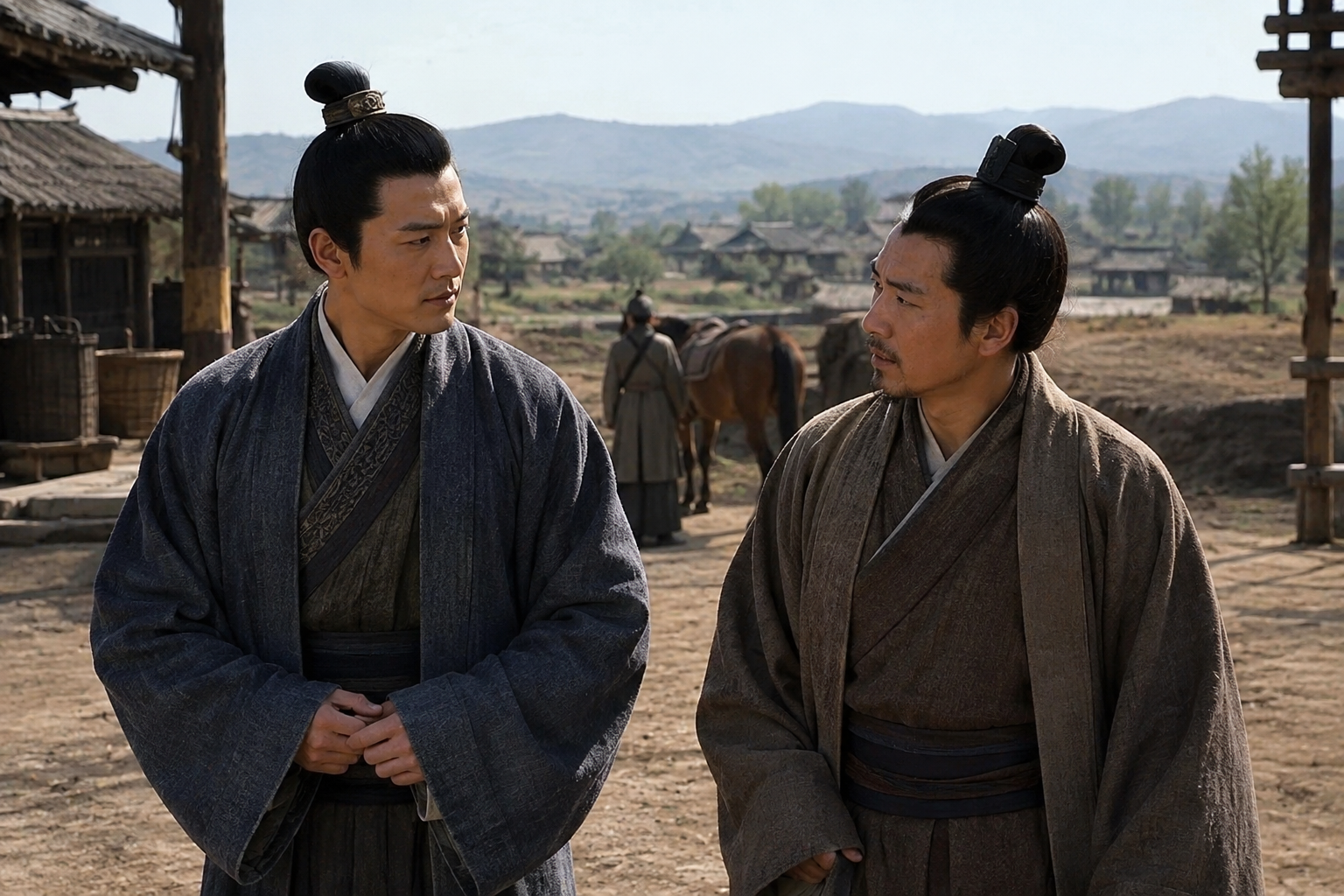
At Linzi in modern Zibo City, archaeologists recovered human remains from the Western Han period, dated to around 100 BC, that now give us a very specific glimpse of one paternal line in early imperial China. Two men from this setting, identified as M25 and M28, have been associated here with the Y-DNA haplogroup O2a1b1a1a1a1d, a narrow branch within the much broader O lineage that is common in East Asian paternal history.
That is already interesting, because Linzi was no obscure backwater. It was the heartland of the old Qi state, one of the great political and cultural powers of the eastern Zhou world before Qin unification, and it remained an important urban center under the Han. Finding the same narrow paternal branch in more than one Western Han individual from this place hints not at a grand dynasty proven by DNA, but at something historically more useful: continuity of local male lines within a major center of early Chinese state society.
Linzi is famous in Chinese history as the capital of Qi, a city associated with power, commerce, and intellectual life long before the Han empire folded the Warring States into a single imperial order. By about 100 BC, when M25 and M28 lived, that older political world had gone, but its landscapes, communities, and family networks had not simply vanished.
This is where a haplogroup like O2a1b1a1a1a1d becomes valuable. Y-DNA tracks one direct paternal line only, not a person's whole ancestry, but in the archaeological setting of Linzi it can show that specific male lineages were present in a historically crucial eastern Chinese population during the Western Han. That is a more grounded claim than trying to turn one branch into a shorthand for an empire, an ethnicity, or a language.
The two Linzi men are especially useful because they come from the same broad place and period. Even without inventing kinship, rank, or burial details that are not in evidence, their repetition matters. One isolated Y-chromosome result can always be a curiosity; two from the same historic center begin to sketch a local pattern.
The exact label O2a1b1a1a1a1d is a fine-grained subclade. That matters because broader statements about haplogroup O or even larger O2 branches cannot automatically be pasted onto this narrower line. The sensible historical use of the evidence is therefore quite modest and quite powerful at the same time: this paternal branch was present among men in Western Han Linzi, in the former Qi region of Shandong.
That places the lineage in a part of northern China that was central to some of the biggest changes in East Asian history: the consolidation of territorial states, the bureaucratic expansion of empire, and the integration of regional populations into Han political life. A narrow paternal branch surviving in such a setting suggests embeddedness in settled, long-standing communities rather than some exotic or isolated episode.
There is a broader research context here too. An ancient DNA study on East Asian paternal history has emphasized that ancient Y chromosomes can reveal different inland and coastal patterns over time. Linzi, sitting in Shandong near one of the most historically connected regions of North China, is exactly the sort of place where that larger question becomes concrete.
To understand why these two samples are more than labels on a phylogenetic tree, it helps to remember what Western Han Shandong was. This was a densely populated, agriculturally rich, and administratively significant region. It linked the old eastern states to the larger Han imperial system, and its people were living in a world shaped by taxation, law, transport, and regional exchange on a scale earlier centuries had only begun to imagine.
So when M25 and M28 carry the same narrow paternal designation, the historical point is not that they must have belonged to a ruling clan. It is that O2a1b1a1a1a1d appears in the male population of a major Han-era landscape with deep pre-imperial roots. That gives the branch archaeological depth in a real historical setting, rather than leaving it floating in modern surname lore or present-day frequency maps.
There is also a welcome corrective here to the habit of treating imperial China as genetically flat or socially uniform. Cities like Linzi were built from layers: former state populations, local lineages, migrants, officials, soldiers, merchants, and farming communities. A repeated Y-line in that environment is one thread in a much larger social fabric.
Middle Yellow River Genomic History
The great temptation with ancient DNA is always to over-read a pair of samples. Better, in this case, to appreciate exactly what they offer. M25 and M28 show that this paternal branch was not represented by a single stray result in Western Han Linzi. It appears at least twice in the same broad historical and geographical frame.
That is the sort of finding archaeologists often value most: not flashy, but cumulative. When a lineage recurs at one site or in one region, it begins to look less like accident and more like part of the demographic texture of that population. We cannot say from these data alone whether the two men were close kin, from the same household, or from different segments of Linzi society. But we can say that O2a1b1a1a1a1d had a place in the paternal landscape of Han-period Shandong.
For members of the MyTrueAncestry community, that distinction matters. Ancient DNA becomes most meaningful when tied to actual people in actual places. Here the place is not vague "ancient China" but Linzi, one of the most historically resonant urban centers in early Chinese civilization.
Linzi also sits at an important chronological hinge. Its older fame belongs to the Qi state and the eastern Zhou centuries; its sampled men belong to the Western Han, after imperial unification. That makes the site useful for thinking about continuity through political change. States rise and fall rather dramatically in our histories, but populations often carry on through them with more persistence than the texts suggest.
That is why related work on other Chinese historical populations is so relevant. Studies of later burials, family organization, and kinship in imperial China keep showing that ancient DNA can illuminate how local communities persisted while political structures changed around them. The article on Song Dynasty remains, for example, is a reminder that genetics becomes most revealing when attached to real archaeological contexts rather than abstract origin stories.
And if we widen the lens a little further, East Asian Y-chromosome work increasingly suggests that paternal history was shaped by multiple regional trajectories rather than one simple expansion. That makes each securely placed ancient sample disproportionately valuable. Western Han Linzi is one such anchor point.
East Asian Y-Chromosome Migrations
If your paternal line falls under O2a1b1a1a1a1d, the most defensible historical takeaway from these ancient matches is quite specific. This branch is attested in men from Western Han Linzi, in the old Qi region of Shandong, around 100 BC. That places your line, or a very close neighboring line within the same paternal branch, in one of the key settled societies of early imperial North China.
It does not make every bearer a descendant of a named noble house, and it does not compress all of Chinese history into one male lineage. But it does offer something better than fantasy: a documented connection to a real archaeological population living in a city whose importance long predated the Han and continued under the empire. For a Y-line, that is a serious and meaningful historical foothold.


Comments