Haplogroup O

– 5 min read


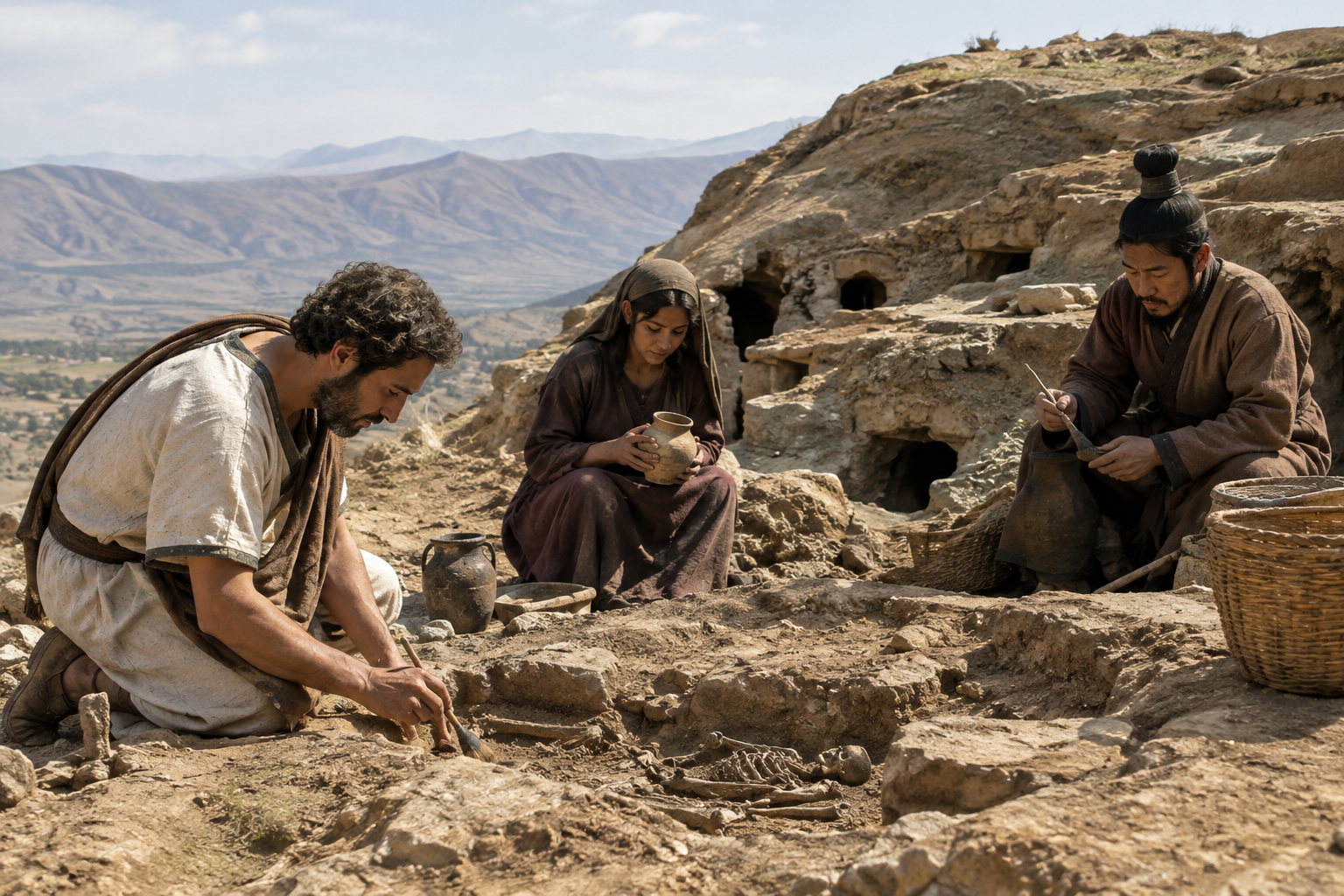
At Castel Sozzio in post-Roman Italy, one ancient man stands out precisely because he does not fit an easy local stereotype. Sample P9895e, dated to around AD 600 from the Castel Sozzio necropolis, is reported under the broad Y-DNA haplogroup O - a paternal lineage far more commonly associated with East and Southeast Asia than with early medieval Italy. That single result is enough to make the cemetery interesting, not because it rewrites Italy overnight, but because it gives us one more hard piece of evidence for how mobile the late antique and early medieval world could be.
Haplogroup O is a very large Y-chromosome branch, and here that point matters. Y-DNA traces one direct paternal line only, not a person's whole ancestry, language, or identity. In the case of these ancient individuals, the evidence links them to the broad parent haplogroup O rather than to a securely stated fine-scale terminal subclade. Even so, the appearance of haplogroup O in both Bronze Age northwestern China and post-Roman Italy makes for an unusually revealing comparison.
The Castel Sozzio necropolis belongs to a world after the western Roman Empire, when the Italian peninsula was still densely connected by war, trade, migration, military service, and church networks. A burial dated around AD 600 sits in the age of Ostrogoths, Byzantines, Lombards, and local communities adapting to political instability without ceasing to be part of larger Mediterranean systems. In that context, a man carrying Y-DNA haplogroup O is not evidence of a simple "foreign colony," but of the kind of human movement that archaeology increasingly detects once genomes are added to graves.
What makes P9895e important is not that he can be neatly assigned a biography, because he cannot. Rather, his paternal line broadens the range of lineages present in early medieval Italy. Recent archaeogenetic work on Italian sites has repeatedly shown that late Roman and post-Roman communities could include people with varied ancestry profiles and long-distance connections, even when buried in ordinary local cemeteries rather than in spectacular elite settings.
A related MyTrueAncestry article explores this same cemetery from a bioarchaeological angle:
That is one of the great correctives offered by ancient DNA. The old habit was to imagine tidy populations sitting still until a major invasion arrived. The actual evidence is usually messier, and more human: small-scale mobility, mixed communities, and individuals whose family histories stretched much farther than the burial ground where they ended up.
Because this article concerns the parent haplogroup O, caution is essential. Haplogroup O is widespread today across much of East Asia, Southeast Asia, and parts of Inner Asia, and it contains many major branches with different histories. Without a firmer downstream assignment, it would be wrong to claim that an ancient man in Italy came from any one modern population, spoke any particular language, or belonged to a specific migrating people.
Still, broad haplogroups can be historically useful. They can flag the presence of paternal lines that were unusual in a given region and period, prompting closer questions about movement and contact. At Castel Sozzio, haplogroup O does exactly that. It tells us that the male line represented by P9895e belonged to a much wider Eurasian story than one would guess from the map of Italy alone.
That wider story fits the expanding picture from other post-Roman cemeteries, where genetic diversity often turns out to be greater than older national or ethnic narratives expected.
The second key case comes from a very different landscape: the Zhanqi site in Minxian, Gansu, where sample ZhanqiM52 is dated to around 1000 BC and associated with the Siwa culture. Here haplogroup O is far less surprising geographically, but much more useful archaeologically. Northwestern China in the Bronze Age was not an isolated edge. It was a contact zone where farming communities, mobile pastoral influences, and regional cultural traditions met across the corridors linking the Yellow River world, the Tibetan Plateau margins, and the eastern steppe.
The Siwa culture has long interested archaeologists because of its position in exactly that frontier zone. A Y-chromosome result like that of ZhanqiM52 helps anchor one paternal line within this Bronze Age population landscape. It does not tell us everything about the community, of course, but it places haplogroup O firmly within the human makeup of Gansu during a period when northwestern China was already a crossroads rather than a cul-de-sac.
That matters for another reason. When people talk loosely about East Asian lineages, they often imagine a single homeland and a single direction of spread. But the archaeology of Gansu shows a more complicated world of neighboring populations, shifting cultural boundaries, and repeated local mixtures. Haplogroup O in Bronze Age Gansu is therefore not just a marker of continuity; it is part of a regional mosaic.
MyTrueAncestry has covered this archaeological setting more directly here:
The Gansu evidence is especially useful because it reminds us that lineages do not move through empty space. They move through lived landscapes shaped by ecology, exchange, and local tradition. Bronze Age communities in this region stood between agricultural centers to the east and steppe-facing networks to the north and west. A paternal lineage found there may reflect deep local roots, incoming connections, or both across earlier generations.
One reason researchers continue to focus on such regions is that they can illuminate how East Asian paternal histories were structured before the better-documented imperial periods. A broader ancient-DNA research framework for these materials is linked through this study resource on ancient human genomic data, which is associated with the Gansu material discussed here. The value of that work is less in producing a dramatic single-origin tale than in showing population history at a regional scale.
For readers interested in the deeper background of paternal line development in East Asia, another MyTrueAncestry post treats the subject more directly:
East Asian Y-chromosome migrations
It would be tempting to turn these two samples into a grand migration route: Bronze Age Gansu to early medieval Italy, one arrow across Eurasia. That would be far too simple, and the evidence does not justify it. ZhanqiM52 and P9895e are separated by roughly sixteen centuries, by enormous geographic distance, and by very different historical settings.
What they do show, taken together, is something subtler and more useful. Haplogroup O belonged to ancient populations in northwestern China, and by around AD 600 a man bearing that broad paternal lineage was present in an Italian cemetery. Between those points lies the long history of Eurasian mobility: steppe exchange, imperial armies, merchant routes, enslavement, marriage, resettlement, and the countless movements that leave only the faintest documentary trace but can still surface in bone and DNA.
Even the technical side of ancient-DNA recovery has played a role in making such finds possible. Methods for improving recovery from dense skeletal material, discussed in research on petrous bone ancient DNA yields, are part of the quiet laboratory history behind the growing ability to detect unexpected lineages in old cemeteries.
For someone researching haplogroup O today, these ancient cases offer a sensible lesson. This lineage has deep and important roots in East Asia, but ancient DNA also shows that individual paternal lines could appear far beyond the regions where we most expect them. In this small but striking dataset, haplogroup O is visible both in Bronze Age Gansu and in a post-Roman Italian burial, reminding us that one Y-line can connect very different historical worlds without making them identical.
If your own paternal line falls under haplogroup O, the safest conclusion is also the most interesting: your direct male ancestry belongs to a vast and historically mobile branch whose ancient footprints turn up in places that archaeology is only beginning to map properly.
Comments