Haplogroup NO

– 4 min read


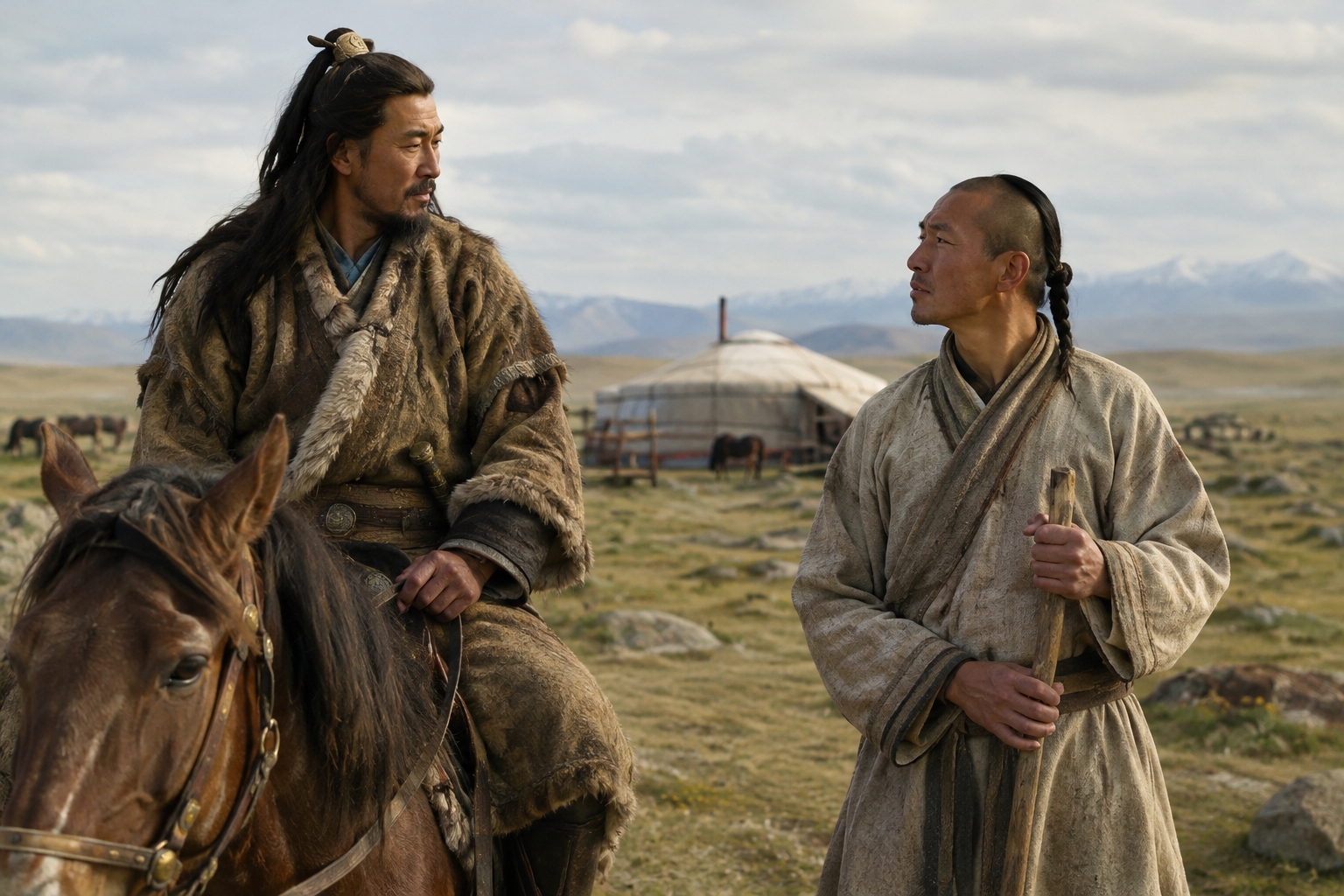
At Songino Khairkhan in Mongolia, one man from the Late Xiongnu period - sample SON001, dated to about AD 25 - carries a particularly interesting signal for Y-DNA haplogroup NO. That is a very broad paternal branch, older than the better-known lineages that later spread across much of northern and eastern Eurasia. Seeing it in a historically documented steppe-world context matters, because it reminds us that some deep Y-chromosome trunks still appear in ancient burials not as abstract prehistory, but in real communities tied to empires, movement, and frontier life.
NO is not a person's whole ancestry, nor an ethnicity. It tracks one direct paternal line only: father to son, back through time. But when that line turns up in ancient DNA, especially in places as consequential as Bronze Age northern China and Xiongnu-era Mongolia, it gives us a narrow but valuable thread through a much larger historical fabric.
The Xiongnu confederation has long stood at the centre of debates about steppe power, mobility, and the making of Inner Asian empires. Songino Khairkhan belongs to that world. Sample SON001, from the Late Xiongnu period in Mongolia, places haplogroup NO within a society that was anything but isolated: these were populations shaped by exchange, alliance, and long-distance contact across the eastern steppe.
That does not mean haplogroup NO was a "Xiongnu lineage" in any simple or exclusive sense. The Xiongnu were politically expansive and biologically diverse, and one paternal assignment cannot define the whole confederation. But the appearance of NO here is historically useful because it shows that this deep branch, or a lineage reported under it, was still present in the steppe zone during the early centuries around the turn of the era.
An ancient DNA study on the Mongolian steppe helped clarify just how mixed and regionally varied these populations could be, with individuals linked to different ancestry profiles and social settings rather than one uniform biological type. That wider context is essential when reading a sample like SON001: it is important evidence, but it is evidence for diversity within the Xiongnu sphere, not a shortcut to a single origin story. See also MyTrueAncestry's piece on Ancient DNA and Genetic History of the Mongolian Steppe.
Xiongnu and Mongolian Steppe DNA
The other sample here is older and, in some ways, even more revealing. 91KLH18, dated to about 860 BC, comes from LongTouShan in China and is associated with the Upper Xiajiadian cultural horizon. This places haplogroup NO in northeastern China during the late Bronze Age or early Iron Age transition, centuries before the Xiongnu reached their historical prominence.
The Upper Xiajiadian culture is archaeologically important because it sits in a contact zone: north China, the eastern steppe, and the frontier between farming and pastoral lifeways. One of the recurring lessons of archaeogenetics is that such frontiers are rarely neat boundaries. They are places where people, technologies, subsistence strategies, and lineages meet unevenly. A sample like 91KLH18 therefore matters not because it "explains" the whole culture, but because it shows that haplogroup NO was already part of the paternal landscape in this northern Chinese setting.
Research on ancient populations in and around northern China has increasingly shown that prehistoric and early historic communities were shaped by repeated interaction across ecological zones. The broad assignment to NO fits that larger picture well: an old paternal lineage appearing in a region where local continuity and wider connections both mattered.
For a wider regional backdrop, MyTrueAncestry has also covered Prehistoric Interactions from Central China to the Mongolian Steppe.
China-Steppe Prehistoric Interactions
There is a temptation with ancient Y-DNA to leap straight from a deep branch name to a modern map. With NO, that would be especially risky. NO is a major ancestral trunk from which later branches emerged, most notably the lineages now known as N and O. Those downstream branches became widespread across large parts of Eurasia, but a report at the level of NO does not by itself tell us which later path a line would eventually resemble most closely.
That matters for interpretation. If an ancient sample is reported only as NO, the responsible reading is that it belongs somewhere on that wider paternal stem, not that it can automatically be treated as a precise modern subclade. In other words, these two men are valuable precisely because they anchor the broad branch in time and place - northeastern China around 860 BC, and Mongolia around AD 25 - without pretending to offer more resolution than the evidence supports.
This is one reason ancient Y-chromosome work has become so useful in East Asia. Broad branches can still tell an important historical story when they appear in well-dated archaeological contexts. A recent MyTrueAncestry article on Ancient Y Chromosomes and East Asian Paternal History explores exactly that bigger problem: how deep lineages became distributed through later movements and regional expansions.
East Asian Y-Chromosome Migrations
Taken together, 91KLH18 and SON001 do not form a dynasty, a tribe, or a neat chain of descent. What they do provide is something archaeologists often value more: two fixed points in different historical settings. One sits in the Upper Xiajiadian world of northern China, where settled and mobile lifeways met. The other appears in the Late Xiongnu sphere, when Inner Asia was organised by large political networks stretching across the steppe.
That pattern suggests durability. Haplogroup NO was present across a long span of time in regions that were deeply involved in the formation of northern East Asian and Inner Asian history. It did not belong to just one archaeological culture or one political entity. Instead, it appears in precisely the kinds of places where populations were interacting, reorganising, and adapting to changing worlds.
For readers interested in ancient DNA from northern China specifically, MyTrueAncestry's article on 6,000 Years of Genomic History in the Middle Yellow River offers another useful comparison from a different but related part of the East Asian past.
Middle Yellow River Genomic History
If your paternal line falls under haplogroup NO, these ancient finds point toward deep roots in the wider story of eastern Eurasia rather than a single recent ethnic label. The strongest lesson from the current evidence is not romance or prestige, but range: this was a paternal branch present in northern China by the Upper Xiajiadian period and still visible in Mongolia during the Late Xiongnu age. That is a fascinating historical spread, and a reminder that even a very narrow line of descent can pass through many different cultures, languages, and political worlds before reaching the present.

Comments