Haplogroup N2a

– 5 min read


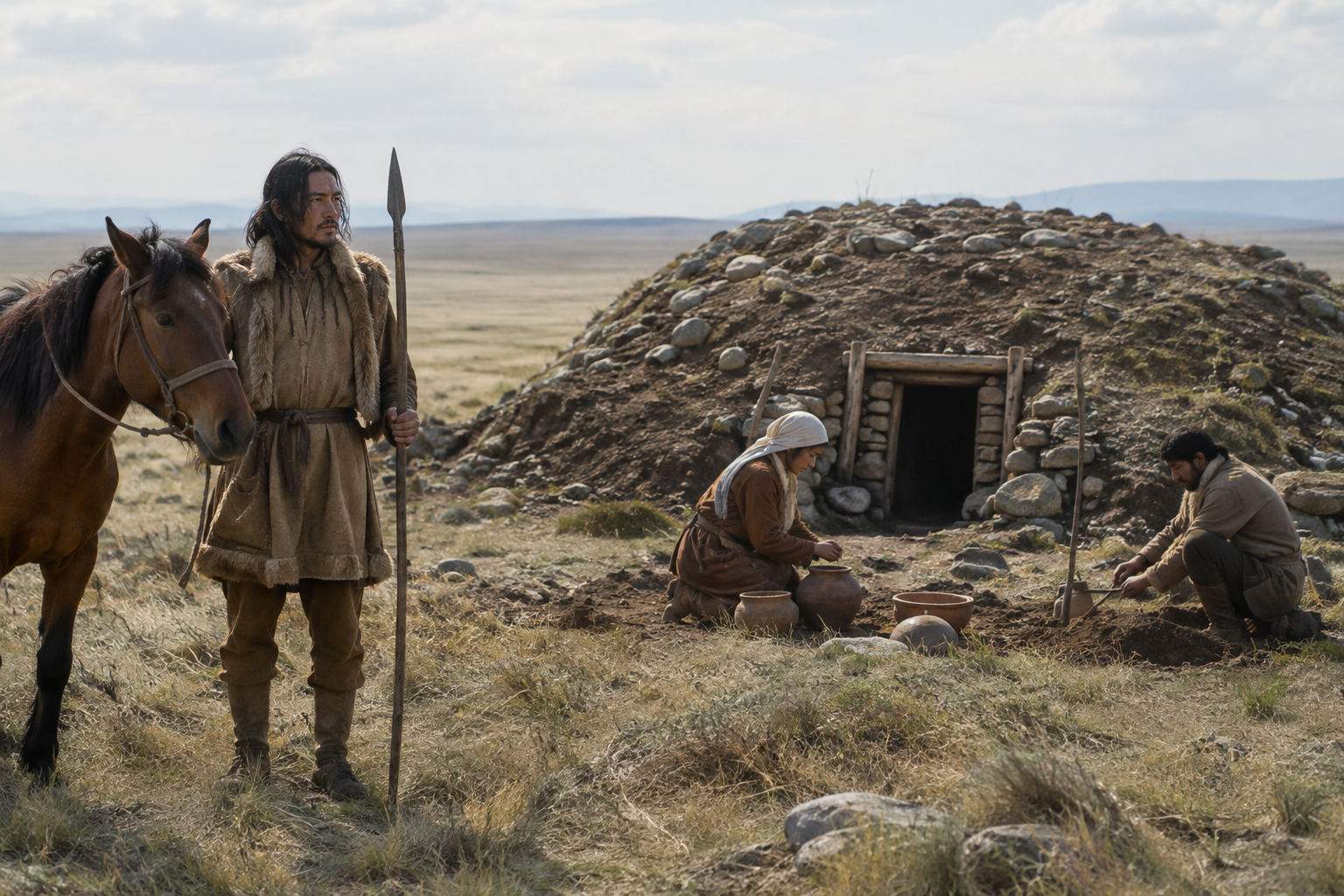
One of the earliest ancient men associated with Y-DNA haplogroup N2a appears in an unexpected place: the Botai culture of northern Kazakhstan, around 3185 BC. The individual known as BOT15 comes from a world famous for one reason above all others - horses. Botai settlements have become central to debates about early horse management, and that makes this paternal lineage interesting at once: N2a turns up not in a medieval pedigree or a neatly documented dynasty, but in a prehistoric community living on the Eurasian steppe at a moment of major economic change.
That is worth pausing over. A Y-DNA haplogroup traces one direct paternal line only, not a person's whole ancestry, language, or identity. But when a branch like N2a appears in ancient burials from both Kazakhstan and, later, Bronze Age Moldova, it gives us a small but valuable clue about how varied male lineages could be across prehistoric Eurasia.
The Botai culture, in what is now North Kazakhstan, sits at the heart of one of prehistoric archaeology's liveliest arguments: how and when humans began intensively managing horses. Ancient DNA research on Botai populations has helped place these communities within a broader prehistoric landscape that does not map neatly onto later steppe expansions. In that setting, BOT15 is significant because he shows haplogroup N2a present far to the east in the Eneolithic.
A major genetic study of the region, published in Science, helped reshape discussion of steppe populations by showing that different ancient groups across Eurasia carried different mixtures of ancestry and different paternal lines. N2a is not the headline lineage of the steppe in most popular retellings, which is precisely why BOT15 matters. He is a reminder that prehistoric populations were never genetically uniform, even at sites that later become iconic in grand migration stories.
Botai itself should not be flattened into a simple prologue to later horse-riding nomads. Its people belonged to their own time and archaeological context. So the appearance of N2a here does not prove that the lineage "came from" Botai, or that all later N2a men descend from steppe horse herders. What it does show is that one branch of paternal ancestry associated with N lineages had already spread into the northern Kazakh steppe by the late 4th millennium BC.
Early horse riding and ancient DNA
Haplogroup N as a whole has a wide and complicated history across northern Eurasia, but N2a is a narrower branch and should not simply inherit every claim made about its much larger parent lineage. With the evidence here, caution is essential. The ancient sample labels connect these men to N2a-level reporting in the MyTrueAncestry framework, but that does not automatically mean every archaeological discussion can be pushed down to a precise terminal subclade.
That matters because the temptation with Y-DNA is always to tell a single heroic migration story. Real evidence is messier. A lineage may survive in scattered pockets, appear in one burial ground and vanish in the next, or move through social networks we cannot directly observe - marriage, fosterage, migration, capture, trade, or simple demographic luck.
So for N2a, the interesting point is not numerical dominance but geographic range. The known ancient examples provided here place the lineage in two very different prehistoric settings: Eneolithic Kazakhstan and Bronze Age Moldova. That spread alone makes N2a a useful case study in how paternal lines can connect distant regions without implying a single people or culture.
The second ancient individual associated with this article's haplogroup is I7852, dated to about 2500 BC from Ciumai in Moldova, specifically a tumulus grave. A tumulus - a burial mound - immediately places the find in a recognisably different funerary landscape from Botai settlement archaeology. We are no longer in the horse-focused villages of northern Kazakhstan, but in the burial traditions of the western steppe and its neighbouring zones.
This shift in context is the real historical value of I7852. N2a is not appearing twice in near-identical settings. Instead, it turns up in two separate regions and archaeological worlds during later prehistory. That does not prove direct continuity from BOT15 to I7852, still less a documented family chain, but it does suggest that the paternal branch had a broader prehistoric footprint than one isolated eastern occurrence.
The Moldova find also places N2a closer to the North Pontic and lower Danubian spheres, regions that were deeply entangled with population movement, burial innovation, and contacts between steppe and farming societies. If BOT15 hints at eastern steppe depth, I7852 hints at western dispersal or survival.
Ancient DNA articles often work with dramatic cemeteries, dozens of burials, and beautifully resolved kinship trees. N2a, by contrast, is interesting here precisely because the evidence is sparse but pointed. Two ancient men, separated by both distance and archaeological setting, show that this paternal branch was part of the human patchwork of prehistoric Eurasia rather than a purely modern curiosity.
The underlying comparative data for these ancient individuals has circulated through research datasets such as the Harvard Dataverse resource linked with these samples: https://dataverse.harvard.edu/dataset.xhtml?persistentId=doi:10.7910/DVN/7RVV9N. Used carefully, such material helps researchers place rare lineages into broader spatial and chronological patterns, even when the number of directly relevant individuals is small.
That small number should not disappoint us. Archaeology is full of historical importance carried by a single grave, a single inscription, a single broken object. In genetics too, one well-dated ancient individual can show that a lineage existed in a place much earlier, or much farther away, than modern distributions alone would suggest.
It is tempting to imagine one clean east-to-west movement linking Kazakhstan to Moldova. But the archaeology of the 4th and 3rd millennia BC resists such tidiness. These were centuries of contact zones, local continuities, shifting exchange networks, and repeated episodes of mobility across the steppe and its fringes.
N2a fits that complexity rather well. Rather than standing for one empire, one language family, or one famous migration, it appears in the background of larger prehistoric transformations. That makes it historically useful. Rare or less-discussed paternal lines can reveal just how incomplete our simplified maps of prehistory really are.
There is also a broader lesson here for anyone comparing their own Y-DNA with ancient remains. A match to N2a should not be read as a certificate of belonging to one named ancient tribe. It is better understood as a sign that your direct paternal line belongs to a branch already present in widely separated prehistoric communities, including steppe and steppe-edge societies that lived long before written history fixed later ethnic labels in place.
For N2a, the clearest supported insight is breadth without simplification. The ancient evidence currently highlighted here places this paternal line in Eneolithic Botai Kazakhstan and in a Bronze Age Ciumai tumulus grave in Moldova. That makes N2a a lineage with real prehistoric depth across Eurasia, even if its story is still fragmentary. For descendants researching their paternal ancestry, that is perhaps the most valuable message: not a fantasy of one famous ancestor, but a documented place in the deep and varied human history of the steppe and its neighbouring worlds.


Comments