Haplogroup N1a1a1a1a4a2

– 5 min read


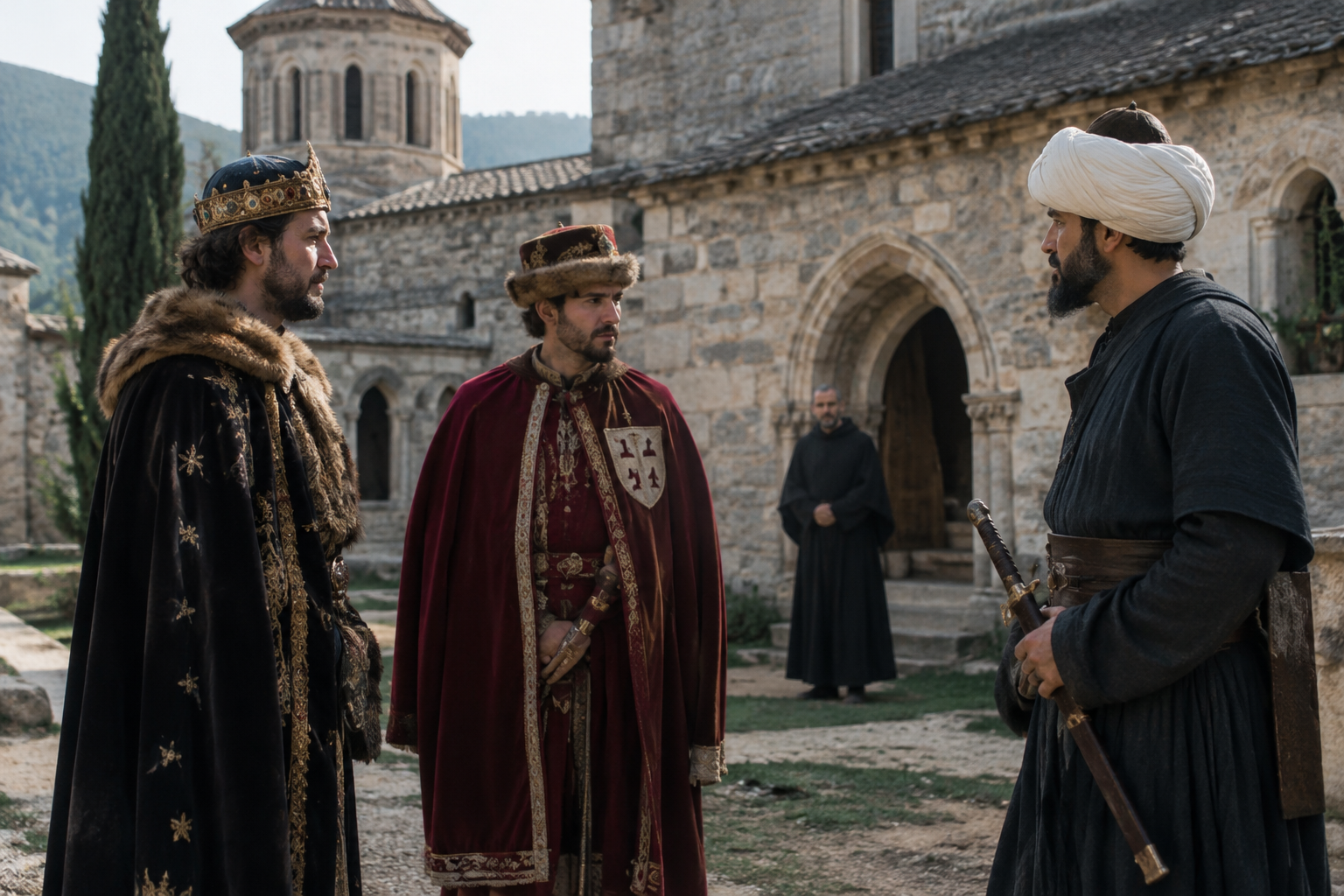
One of the clearest clues for haplogroup N1a1a1a1a4a2 in this set of medieval remains comes from the Benedictine monastery linked to Hungary's Aba kindred. Two individuals from that setting, HUAS261F dated around AD 1450 and HUASper581 dated around AD 1405, place this paternal line in a strikingly specific social world: late medieval burials associated with a noble house remembered in Hungarian history. That is already interesting, because Y-DNA traces one direct paternal line rather than a person's whole ancestry, and here that line appears not in a vague regional sample but in people tied to a named aristocratic milieu.
A third sample, I20573 from Yatagan in Mugla, in the Aegean zone of Ottoman Turkey and dated around AD 1420, widens the frame. Suddenly this is not just a monastery story in northern Hungary. It is a glimpse of the same narrow paternal branch appearing in two different late medieval settings, one tied to Hungarian nobility and one to the eastern Mediterranean world of the Ottoman period. The evidence is still modest, but the pattern is worth taking seriously.
The two Hungarian samples are the best place to begin because they come from the same broad context: the Benedictine monastery associated with the House of Aba. Sample HUASper581 is dated to about AD 1405, while HUAS261F is placed a little later, around AD 1450. The important point is not that they prove an unbroken dynastic genealogy all by themselves; they do not. It is that the same haplogroup assignment is reported in more than one burial from a noble-associated monastic setting.
That makes the monastery important as an archaeological setting in its own right. Medieval monasteries were not simply religious buildings. They were also places of commemoration, patronage, burial, and memory. When ancient DNA turns up in such places, it can illuminate how elite families used sacred institutions to anchor their status across generations.
A recent ancient DNA study on medieval Hungary has helped draw attention to these elite contexts and the persistence of steppe-linked and conquest-period elements in some high-status groups; the preprint associated with this wider line of research is here: https://www.biorxiv.org/content/10.1101/2024.03.20.585718v1. For this article, though, the central fact remains narrower and firmer: N1a1a1a1a4a2 is reported in two late medieval individuals from the Aba monastery context.
This is a very specific branch inside the broader Y-haplogroup N family, a paternal lineage with a deep history across northern Eurasia. That broader family has often been discussed in connection with Uralic-speaking regions, forest-steppe populations, and movements stretching far across the north of the continent. But one must be careful here: the ancient history of haplogroup N as a whole cannot simply be pasted onto the much narrower branch N1a1a1a1a4a2.
What these medieval samples actually show is more limited and more useful. They place this branch in documented late medieval men from Hungary and Ottoman-period southwestern Anatolia. In other words, this is not a story we can responsibly tell as a grand single migration from one point of origin to another. It is, rather, a story of how a quite specific paternal branch appears in elite and mobile societies around the fifteenth century.
That distinction matters. A haplogroup can persist for centuries while its carriers change language, political allegiance, religion, and social standing many times over. Archaeology and history give us those changing worlds; Y-DNA gives us only one thread running through them.
Hungary is a particularly revealing place to find a branch like N1a1a1a1a4a2 because medieval Hungarian society sat at the meeting point of several historical layers. There was the legacy of the Hungarian conquest of the Carpathian Basin, the Christian kingdom that emerged under the Arpad rulers, and the later reshaping of noble identities through monasteries, counties, and royal service. By the fifteenth century, old lineages were being remembered in very medieval ways: through charters, patronage, heraldry, and burial place.
The Aba name carries weight in that landscape. Samuel Aba, the eleventh-century king of Hungary, is one of the most famous figures attached to the broader kindred, though the two later monastery burials should not be turned automatically into direct proof of descent from any one ruler. What they do show is that this paternal branch was present in men connected with a house important enough to remain archaeologically and historically visible.
That is why these samples matter beyond family romance. They hint that some paternal lines associated with medieval Hungarian elites could preserve older northeastern or steppe-linked elements within a thoroughly Christian, feudal, and locally rooted society.
The Turkish sample, I20573, comes from Yatagan in Mugla and is dated to around AD 1420, almost exactly the same broad period as the Hungarian monastery burials. That chronological overlap is what makes the comparison so suggestive. We are not looking at a Bronze Age origin point and then a medieval endpoint; we are looking at contemporaries living in different political worlds around the eastern Mediterranean and the Carpathian Basin.
By the early fifteenth century, Mugla belonged to a frontier-shaped region with older Byzantine, Turkic, and Aegean connections layered together. A Y-DNA match at the level of N1a1a1a1a4a2 does not tell us whether I20573 spoke Turkish, Greek, or another language in daily life, nor does it prove any personal tie to Hungary. But it does show that this paternal branch was not confined to one isolated noble enclave.
That wider setting fits a broader picture seen in ancient DNA research on medieval and post-antique populations: political borders and cultural labels often hide a good deal of biological complexity. A major study of mobility and mixture in Europe after the Roman world, published in Science, helped establish just how varied such populations could be across regions and social groups: https://www.science.org/doi/10.1126/science.abm4247. That paper is not a shortcut to every detail here, but it is a useful reminder that medieval identities were rarely genetically simple.
It would be easy to overstate the connection between the Aba monastery and Yatagan. The evidence does not justify a claim of one family spreading neatly from Hungary to Ottoman Turkey, and it certainly does not prove a single migration event. Yet it would be equally wrong to miss the historical significance of the pairing.
Both settings belong to the fifteenth-century world that followed the fragmentation of older empires and the growth of new states. Hungary was a major kingdom on the edge of Ottoman expansion; western Anatolia was part of the Ottoman sphere and deeply entangled with the Aegean. Finding the same narrow paternal branch in both reminds us that medieval Eurasia was linked not only by armies and merchants, but by long-lived male lines whose earlier histories may reach much farther back than the local records do.
For genealogists, that is often the most useful lesson. A branch that turns up in a noble monastery burial and in Ottoman Anatolia need not belong to one nationality in the modern sense. It may reflect centuries of movement, alliance, incorporation, and survival across very different historical settings.
At present, the most distinctive thing about N1a1a1a1a4a2 is not sheer quantity of ancient finds, but the quality of the contexts in which it appears. In this small set, it is tied to late medieval Hungary's noble-monastic world through HUAS261F and HUASper581, and it also appears in the Ottoman Aegean through I20573. That combination suggests a paternal line at home in the connected but diverse societies of eastern and central Europe.
For someone researching this haplogroup today, the responsible takeaway is neither a royal claim nor a single ethnic label. It is that this branch has already surfaced in historically rich settings where aristocratic memory, frontier politics, and wider Eurasian inheritances overlapped in unexpected ways.


Comments