Haplogroup N1a1a1
– 5 min read


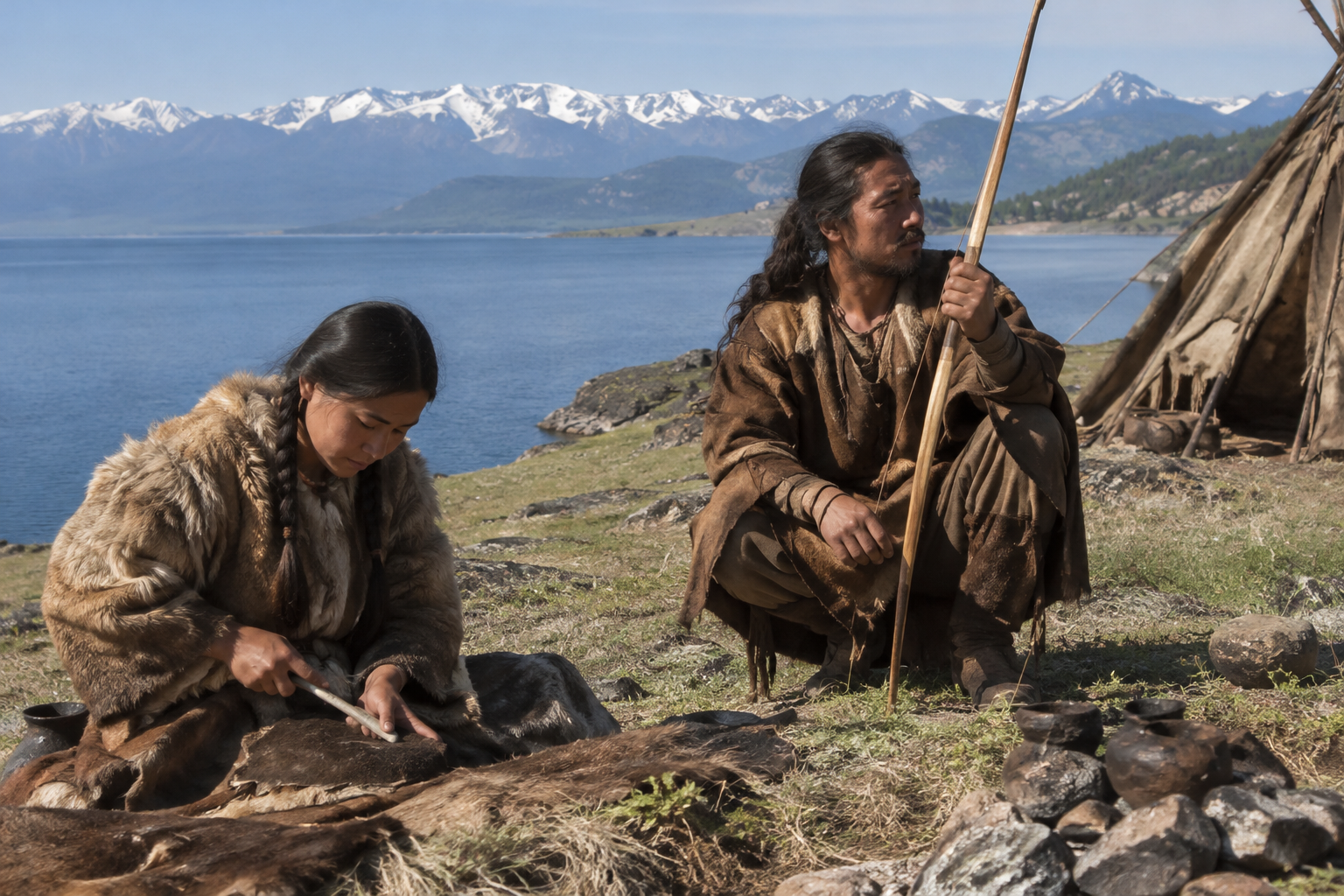
At Fofonovo near Lake Baikal, one ancient male identified as I8535 offers a small but telling glimpse into the history of Y-DNA haplogroup N1a1a1. He is dated to around 2264 BC, in the Late Neolithic of southern Siberia, a region that has long mattered to archaeologists because it sits at the meeting point of forest, steppe, and lake worlds. When a paternal lineage like N1a1a1 appears here, it matters not because one burial can explain an entire people, but because Baikal is exactly the sort of place where deep northern Eurasian histories become visible.
A second ancient man, ARS003, dated to around 1060 BC at Arbulag Soum in Mongolia, shows the same broad lineage more than a thousand years later and farther south on the eastern steppe. That is the real interest of this article: not a grandiose claim about a single tribe or nation, but the appearance of N1a1a1 in two very different archaeological settings, from the Baikal zone to Bronze Age Mongolia.
Y-DNA follows the direct paternal line: father to son to son across the generations. That makes haplogroups useful for tracing one narrow line of descent, but not for defining a person's whole ancestry, language, or identity. In the case of N1a1a1, the important point is that it belongs to the wider N family, a lineage often associated in broad terms with northern Eurasia, but the narrower branch in this article must be handled carefully and only where actual ancient evidence allows it.
With just two featured ancient finds here, we are not looking at a dynasty, a conquering wave, or a neat ethnic label. We are looking at scattered but valuable evidence that this paternal branch was present in populations moving through, or established within, the great northern and eastern Eurasian zones long before written history described them.
For a wider look at how ancient paternal lineages help reconstruct East Asian population history, see this related discussion of ancient Y chromosomes in the region.
The Baikal region is one of the most fascinating landscapes in ancient DNA research because it preserves evidence for long-lived communities shaped by both continuity and contact. Sample I8535 from Fofonovo, dated to about 2264 BC, places N1a1a1 in a zone that archaeologists have studied for its role in linking Siberian forest populations, lake-based economies, and wider northern Eurasian networks.
Even without embellishing the burial itself, that context is already rich. Lake Baikal was not some remote cul-de-sac. It was a human landscape with deep prehistory, where mobility, exchange, and adaptation were central features of life. A paternal lineage found there could persist locally, arrive through movement, or represent part of a broader web of related male lines across Siberia.
Research on the Baikal region has repeatedly shown how important this area is for understanding prehistoric population structure in northern Asia. One relevant study of ancient populations in this broader world can be found here: https://www.nature.com/articles/s41586-025-09189-3. For N1a1a1, the value of I8535 lies in showing that this branch had a documented foothold in the Baikal sphere by the later third millennium BC.
That makes Baikal a useful anchor point. If your paternal line belongs to N1a1a1, this does not mean you descend from this individual or from one Baikal community in particular. It does mean that one securely ancient occurrence of your branch, or a reported association with it, belongs to a region central to the human history of northern Eurasia.
The Baikal record becomes even more interesting when set beside other evidence from the region on disease, mobility, and long-term population history.
The second sample, ARS003, comes from Arbulag Soum in Mongolia and is dated to around 1060 BC, in the Late Bronze Age. This is a very different archaeological world from Late Neolithic Baikal. By this period, the Mongolian steppe had long been a zone of pastoral mobility, changing social formations, and contact between eastern steppe groups and neighboring regions.
That contrast matters. When N1a1a1 appears in both Baikal and Mongolia, it suggests that this paternal branch belonged to populations participating in northern and eastern Inner Asian history across multiple periods. It does not tell us that the same clan endured unchanged for twelve centuries, nor that every man with this lineage belonged to one culture. It does show that the branch was not confined to a single isolated pocket.
A broader ancient DNA investigation of the Mongolian steppe and surrounding populations is linked here: https://www.biorxiv.org/content/10.1101/2020.03.25.008078v1.supplementary-material. Without forcing the evidence, the archaeological significance of ARS003 is straightforward: N1a1a1, or a closely reported association with it, turns up in a Late Bronze Age setting tied to one of Eurasia's most important corridors of movement.
That should immediately caution against simplistic stories. The Bronze Age steppe was never genetically uniform. A lineage found in Mongolia may reflect local continuity, incoming male ancestry, or the mingling of several regional traditions. The steppe is best understood as a zone of interaction, not a one-direction highway.
For readers interested in the larger genetic background of this world, this MyTrueAncestry article gives useful context.
Put the two samples side by side and a cautious pattern appears. I8535 at Fofonovo places N1a1a1 in the Baikal region around the later third millennium BC. ARS003 at Arbulag Soum places it in Mongolia in the later second millennium BC. That is not enough to draw a straight migration arrow, but it is enough to show that this paternal lineage belonged within the human geography of Inner Asia over a long span.
Archaeologically, that is exactly the sort of pattern worth noticing. Many haplogroup articles become too eager to turn every occurrence into a founding event. The better approach is to ask what kind of landscape could connect these finds. In this case the answer is a huge zone of northern forests, lake basins, and open steppe, where communities moved, mixed, traded, herded, hunted, and adapted over millennia.
That broader picture also fits with what ancient DNA has increasingly shown across Eurasia: paternal lines can endure through major cultural changes, while languages, burial customs, and genome-wide ancestry shift around them. One Y-chromosome branch may survive through very different archaeological horizons.
For someone who discovers N1a1a1 in a modern Y-DNA result, the strongest historically grounded takeaway is not a claim to a named tribe or noble house. It is that this paternal line has credible ancient roots in northern and eastern Eurasia, with documented appearances in the Baikal region and in Bronze Age Mongolia. Those are serious archaeological coordinates, not romantic scenery.
That also makes N1a1a1 a good reminder of how ancient DNA changes the scale of family history. A surname may take you back a few centuries; a Y-line can push the story into landscapes where archaeology rather than paperwork does the talking. In this case, the conversation leads toward Lake Baikal, the eastern steppe, and the long human history of Inner Asia.
Readers following the deeper connection between Siberian, Uralic, and northern Eurasian histories may also find this piece useful.
The distinctive thing about haplogroup N1a1a1 here is not quantity but placement. With I8535 in Late Neolithic Fofonovo and ARS003 in Late Bronze Age Arbulag Soum, the branch appears in two important Inner Asian settings separated by both time and environment. For modern descendants of this paternal line, that is a meaningful clue: your direct male ancestry belongs to a lineage already present in the ancient north-eastern heartlands of Eurasia, in societies that stood between forest, lake, and steppe.


Comments