Haplogroup N

– 6 min read


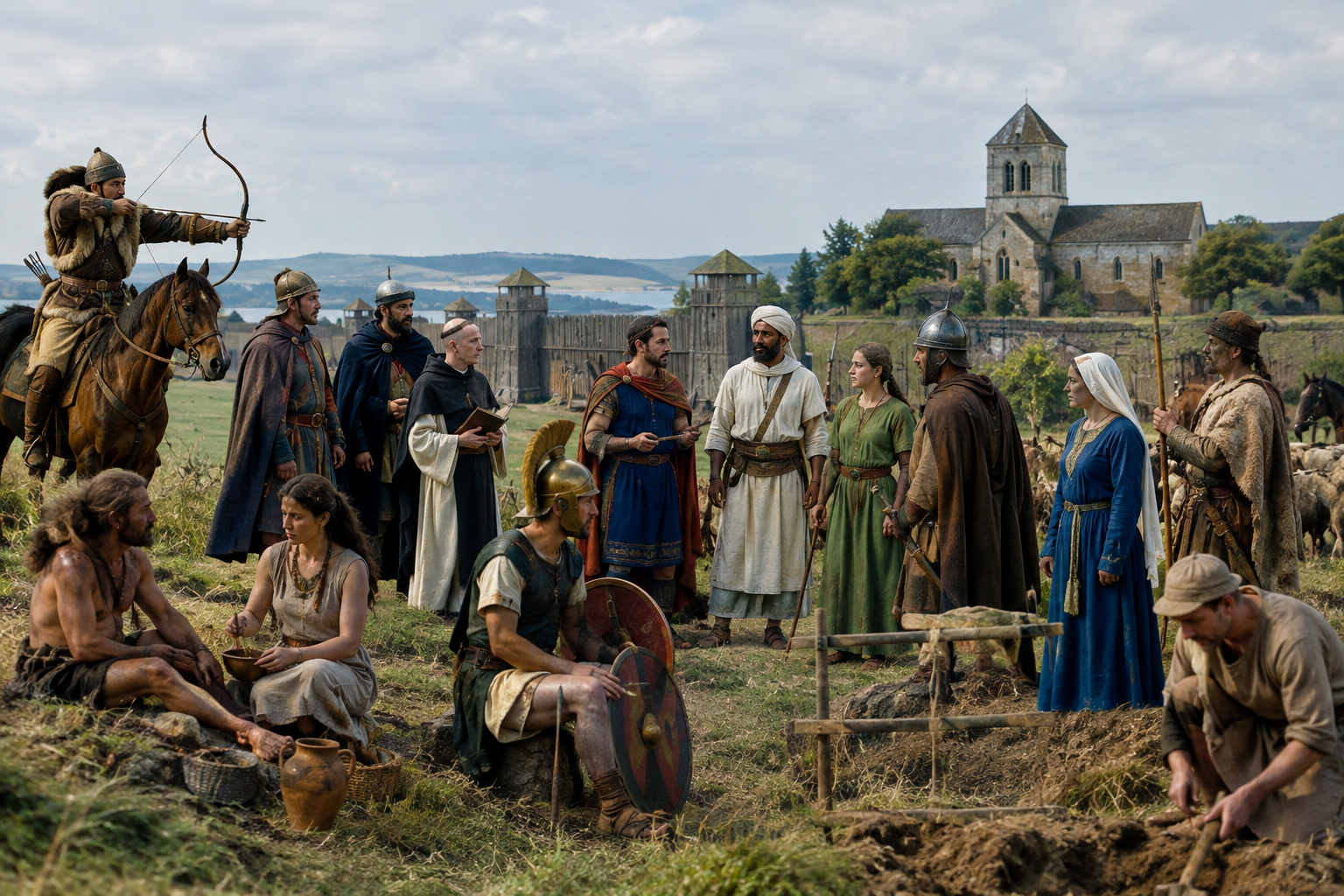
Haplogroup N has one of the most intriguing distributions in the Y-chromosome tree. It is a paternal lineage now especially associated with northern Eurasia, and it turns up in places that make historians and geneticists stop and look twice: from Siberia to the Baltic, from the forest zone of northeastern Europe to scattered finds much farther west and south. That alone makes it historically interesting. It hints at long movements of men, families, and communities across landscapes that written history barely reaches.
As ever with Y-DNA, a note of caution matters. A Y haplogroup traces only one direct paternal line: father to father to father. It does not describe a person's whole ancestry, culture, language, or identity. Still, paternal lineages can be extraordinarily useful for reconstructing population history, because they let us watch particular male lines appear, spread, diminish, and sometimes persist for millennia.
In broad terms, haplogroup N belongs to a wider northern Eurasian branch of the Y-chromosome tree and is widely discussed in connection with populations of Siberia, the forest belt, and later parts of northeastern Europe. Its deeper story is usually placed somewhere east of Europe, with later westward and northwestward expansions carrying branches of N into the Volga region, the Baltic, and Fennoscandia. The exact routes and timing of those movements are still being refined, and different downstream branches of N may have followed rather different paths.
What is clear is that ancient DNA has changed the conversation. Once, distributions in living populations encouraged broad guesses. Now, excavated individuals provide fixed points in time. They show that haplogroup N was not a static "ethnic marker" but part of a much more complicated human story involving mobility, local continuity, and contact zones between steppe, forest, and farming worlds.
Readers interested in the larger archaeological background to these eastern and northern paternal histories may also enjoy this wider look at the subject:
Explore Eastern Roots of Uralic DNA
One of the most revealing samples here is FNO001, from Pre Bronze Age Fofonovo Buryatia Russia, dated 3700 BC. Buryatia sits deep in the eastern sphere where many researchers place important phases of early haplogroup N history. A sample like this matters because it reminds us that the paternal story of N is not fundamentally a medieval or even a purely European one. Its roots lie much farther east.
From there, the record becomes geographically striking. HMM001, from Early Medieval Tavastia Hame Finland Hameenlinna Mannistonmaki, dated 1150 AD, places haplogroup N in exactly the sort of northern European setting where it later became historically important. Here we are no longer dealing with deep prehistory but with the medieval world of Finland, frontier Christianity, Baltic exchange, and regional identities taking firmer shape.
At the same time, some samples show how wide the scatter could be. UKR112, a Scythian Iron Age Horse Archer Ukraine Cheremushna Kharkiv dated 660 BC, places haplogroup N on the steppe frontier. That does not mean all Scythians were haplogroup N, nor that haplogroup N was "the Scythian line." It does show, though, that paternal lines associated more often with the forests of the north could also appear in the mobile, martial world of Iron Age steppe societies.
Equally arresting is AS_EMT from Kingdom of Characene Period Bahrain Abu Saiba, dated 50 AD. Bahrain is not where most readers expect to encounter haplogroup N. But that is precisely why such finds are valuable. They suggest that trade, military service, maritime links, or older layers of movement could carry paternal lines far outside their present-day strongholds. A single sample cannot explain the whole mechanism, but it is a reminder that the ancient world was full of movement.
For a closer look at steppe-linked elites and the genetic complexity of that world, this article is a natural companion:
The European evidence in this set is especially useful because it spans a long time range. Urzi44, from Ancient Romania Urziceni, dated 4000 BC, and OOH003, from Bronze Age Bavaria, dated 2500 BC, hint that branches related to haplogroup N were already present, at least in small numbers, in prehistoric Europe well before the Middle Ages. These are not signs of simple replacement. Rather, they suggest that Europe's paternal history contained more variety than older models allowed.
Then come the migration-period and medieval finds. COL_039b, from Lombard Era Collegno Northern Italy, dated 580 AD, sits in a classic post-Roman contact zone. Northern Italy in this period was a meeting place of local Roman populations, incoming groups associated with the Lombards, and wider networks running across the former empire. Haplogroup N appearing here is exactly the sort of detail that makes the so-called barbarian world look less simple and more human.
There is also I10944, an Ancient Mercenary First Sicilian War Himera Sicily dated 480 BC. A mercenary context is almost designed to scramble tidy assumptions about ancestry and geography. Men in such armies could come from a remarkable range of backgrounds, and that is part of what makes ancient DNA so useful: it can reveal movement that texts only dimly suggest.
By the High and Late Middle Ages, haplogroup N also appears in England: ATP_PSN_775 from Late Medieval England All Saints, dated 1150 AD; ATP_PSN_1222 and ATP_PSN_1271 from Late Medieval England Clopton Cambridgeshire, both dated 1300 AD; and LG47 from Medieval London Cisterian Abbey St Mary Graces, dated 1350 AD. None of this means medieval England was "defined" by haplogroup N. But it does show that by this period such paternal lines had become part of the population mix of towns, parishes, and burial grounds in western Europe too.
If you want to see how medieval Finland fits into this bigger northern picture, this related piece is especially relevant:
What, then, does haplogroup N actually tell us? First, that northern Eurasia mattered enormously in shaping later paternal diversity across Europe and beyond. Second, that movements were rarely one-way or culturally neat. A lineage found in Buryatia can, many centuries later, turn up in Finland, the Pontic steppe, Italy, Sicily, Bahrain, and England. That is not because one people marched in a straight line across the map. It is because human history is made of repeated episodes of migration, service, exchange, marriage, settlement, and absorption.
This is where genetics helps correct some old habits of thought. Historians once too easily imagined peoples as tidy blocks moving intact from one region to another. Ancient DNA keeps showing the opposite. Even within named cultures, there could be marked paternal diversity. Even within a single cemetery, ancestry could be mixed. Even a broad lineage like N could belong to men living very different lives in very different worlds.
In this case, no specific noble family or castle information was supplied alongside haplogroup N, and that absence is worth stating plainly rather than papering over with guesswork. It would be easy, but irresponsible, to attach a dramatic medieval dynasty to the haplogroup simply because some later northern or eastern European houses emerged in regions where branches of N are found today.
What we can say is more modest and more interesting. Noble families, castles, and clan traditions belong to the written and architectural record of the last thousand years or so; haplogroups belong to a much deeper biological timescale. Sometimes the two intersect, but they are not the same sort of evidence. A castle preserves family memory, lordship, and territory. A Y-chromosome lineage preserves one narrow paternal thread. The fascination lies in putting those forms of evidence side by side without confusing them.
For readers interested in how MyTrueAncestry handles historical lineages and named houses when evidence does exist, this dynastic case study is a good comparison:
Explore a Medieval Dynasty Case Study
Haplogroup N is a fine example of why ancient DNA is so compelling. It links forest-zone prehistory, steppe mobility, medieval northern Europe, and unexpected outliers in places like Sicily and Bahrain. It also shows the limits of simple labels. Sharing haplogroup N with an ancient individual does not make that person your direct ancestor, and it certainly does not make anyone automatically Scythian, Finnish, Lombard, or noble.
But it does place your paternal line within a documented human history. It may connect your lineage, broadly, to ancient movements across northern Eurasia, to medieval populations around the Baltic, or to smaller episodes of mobility that carried men across continents and into new societies. That is no small thing. It is the difference between seeing a haplogroup as a code and seeing it as part of the long, untidy history of real people.
If your Y-DNA belongs to haplogroup N, MyTrueAncestry can help you explore whether your deeper paternal story intersects with ancient individuals like FNO001, HMM001, UKR112, or the medieval English burials discussed here. These matches do not prove direct descent or membership in any historical family, but they can offer a vivid window into the populations among whom your paternal line once traveled.
Comments