Haplogroup MAJ89

– 4 min read


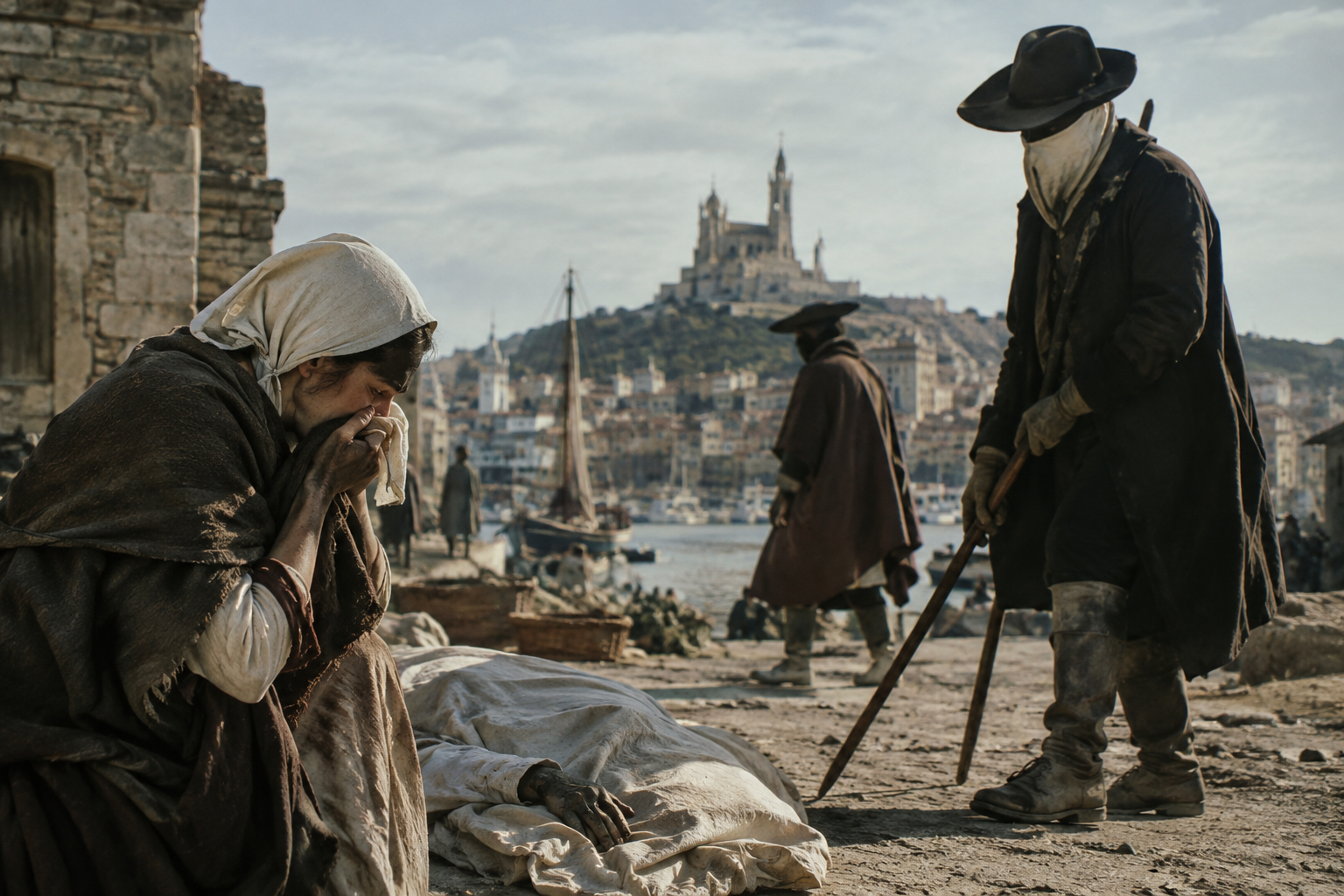
In 1720, plague struck Marseille with terrible force. One of the men buried at La Major during that epidemic has been reported with the Y-DNA designation MAJ89, preserved in sample MAJ89p. That is a very late date for an ancient-DNA article, but it is precisely what makes this case interesting: here the paternal line is not emerging from prehistory or early medieval legend, but from a named historical disaster recorded in painful detail.
La Major sits in one of the great port cities of the Mediterranean, a place where ships, goods, languages, and diseases all converged. So when a Y-chromosome lineage appears in a victim of the Great Plague of Marseille, the question is not simply "what haplogroup was he?" but what it means to find a paternal line anchored in a crowded early modern city at the edge of catastrophe.
The Great Plague of Marseille of 1720-1722 is often described as one of the last major outbreaks of bubonic plague in western Europe. Marseille was then a busy commercial gateway linking France to the wider Mediterranean and beyond. That made it prosperous, but it also made it vulnerable. Epidemic disease moves along human networks, and port cities are where those networks become brutally visible.
Sample MAJ89p, described as a plague victim from France at La Major and dated to 1720 AD, belongs to that moment. In archaeological terms, this is not a warrior grave, an elite tomb, or a prehistoric cemetery whose story must be inferred from fragments. It is part of a crisis burial landscape created by a documented epidemic, where genetics can be placed beside history rather than asked to replace it.
An ancient DNA project associated with these Marseille plague burials is linked through this research archive. Even without forcing claims beyond the available record, the value of the sample is clear: it gives MAJ89 a fixed place in time and space, in southern France during one of the best-known epidemic emergencies of the early modern Mediterranean.
Y-DNA traces one direct paternal line: father to son to son across generations. That makes it powerful, but also narrow. A man assigned to MAJ89 carried that one line among thousands of ancestors, so the haplogroup does not sum up his whole ancestry, his language, or his social identity in plague-time Marseille.
Still, a lineage attached to a specific burial matters. It tells us that MAJ89 was present in an urban population of eighteenth-century Provence, and not merely in modern testing databases. For many family historians, that kind of evidence is surprisingly valuable. It moves a lineage from abstraction into the material world of a cemetery, a city, and a historical event.
It is also worth being careful with resolution. The article haplogroup is MAJ89, and the ancient individual is associated with that branch in the supplied record. With only one listed ancient sample and no fuller branching information given here, it would be wrong to invent a deeper terminal subclade, a prehistoric homeland, or a migration path specifically for MAJ89 itself.
Marseille is not just any French city. It has been a maritime crossroads since antiquity, shaped by Greek foundation, Roman rule, medieval commerce, and early modern trade. By 1720, its population had been formed by centuries of arrivals, departures, local continuity, and regional mixing. A paternal lineage found there may reflect long local roots, recent migration into the city, or some blend of the two.
That is why plague cemeteries can be so revealing. They do not only preserve the biology of disease; they also capture the human diversity of the communities affected by it. In a port city, the dead can represent a broad social world: townspeople, laborers, traders, sailors, migrants, and families established over many generations. One Y-lineage does not define that whole community, but it does belong to it.
For readers interested in how genetic evidence can illuminate complex urban and regional histories in Iberia and the western Mediterranean, Marseille belongs to the same wider world of movement and mixture explored in other studies of Roman and post-Roman populations.
Roman Hispania's Genetic Legacy
There is another reason MAJ89p deserves attention. Epidemic cemeteries are sometimes treated as if they were only about pathogens, yet they are also about institutions, religion, emergency response, and the management of the dead. A burial at La Major belongs to that social history as much as to genetic classification.
The Great Plague of Marseille unfolded in a world with officials, hospitals, churches, quarantine policies, trade anxieties, and sharp inequalities in survival. Archaeology cannot recover every biography, but it can recover the fact that real individuals were swept into this crisis. A Y-DNA assignment such as MAJ89 therefore becomes part of a larger archive of human experience: not an emblem of prestige, but evidence of presence.
This is especially important in public discussions of haplogroups. People often expect ancient DNA to connect them only to kings, warriors, or famous migrations. In reality, one of the most historically meaningful connections may be to an ordinary man buried during an extraordinary epidemic. That is, in its way, a more democratic kind of past.
With only the La Major sample securely in view here, the responsible story is a modest one. MAJ89 is not yet a lineage surrounded by a chain of published ancient examples across many centuries. Instead, it is currently visible at a sharply defined historical point: plague-era Marseille in 1720.
But modest does not mean unimportant. Southern France has long been one of Europe's great contact zones, and lineages found there are often part of wider histories of circulation between inland France, the western Mediterranean, and maritime trade routes. The significance of MAJ89 lies not in any grand unsupported origin tale, but in its documented appearance within that connected world.
That kind of context is often where ancient DNA is at its best. Not every lineage needs a saga. Sometimes what matters is that a paternal branch can be placed in a city we know well, during a crisis we can date closely, among people whose lives were caught up in one of the last great plague disasters of Europe.
If you belong to haplogroup MAJ89, the strongest ancient foothold currently represented here is not a remote tribal ancestor or a medieval dynasty, but MAJ89p, a man buried at La Major in Marseille during the plague of 1720. That makes this lineage historically vivid in a different way: it is tied to an early modern Mediterranean city under extreme pressure, where genetics, archaeology, and written history meet on unusually firm ground. For paternal-line research, that is a useful and humanly striking place to begin.



Comments