Haplogroup M2a

– 4 min read


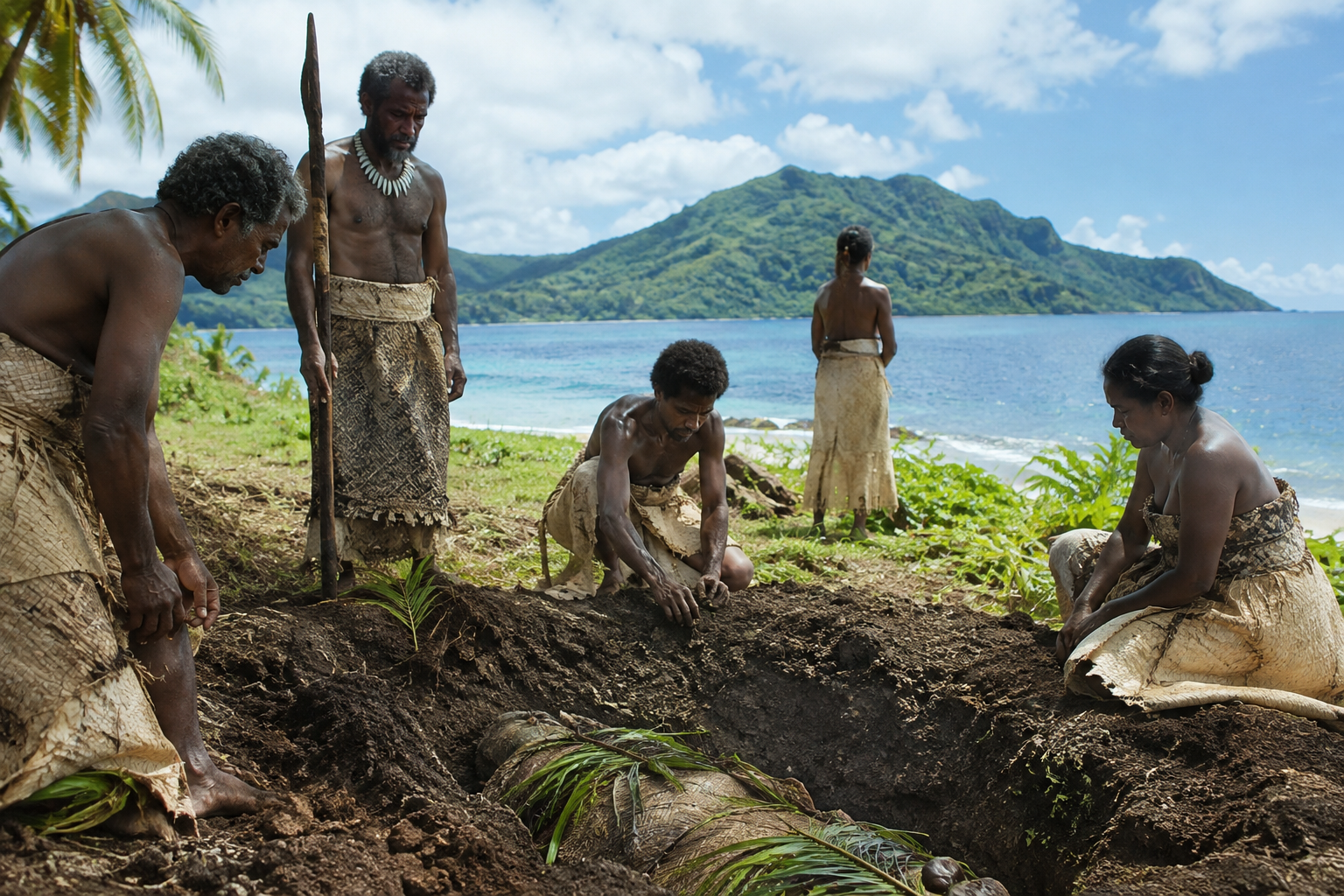
At Bourewa on Viti Levu, the largest island in Fiji, ancient DNA has put a very specific paternal line into a very specific human setting. One man, identified as BOU007 and dated to around 1725 AD, has been associated here with the Y-DNA haplogroup M2a. That is a striking detail not because one burial can stand for an entire people - it cannot - but because Bourewa is one of the key archaeological places for thinking about Fiji's long settlement history and its later island-world connections.
In other words, this is not a story about a haplogroup floating abstractly across a map. It is about a paternal lineage turning up in an actual burial from a real Fijian site, in the early modern Pacific, where archaeology, mobility, and ancestry all meet. Y-DNA tracks one direct paternal line only, not a person's whole ancestry, but even that narrow line can sometimes illuminate wider histories of contact and movement.
Bourewa is famous in Pacific archaeology because it has often been discussed in relation to the earliest human settlement of Fiji. That does not mean every burial from the site belongs to that first phase. BOU007, dated to the early eighteenth century AD, belongs to a much later horizon in Fiji's history, long after the first seafarers had established communities across the islands.
That late date matters. It places this man in a Fiji already shaped by centuries of exchange within Island Melanesia and wider Oceania. By then, communities in the region were not frozen relics of first settlement. They were living societies with their own local histories, their own marriage networks, and, very likely, complex patterns of inter-island connection.
An ancient DNA study of Pacific populations published in Cell has helped sharpen this broader picture of movement and mixture in Oceania. Even without forcing details onto one burial that the evidence does not support, the appearance of M2a in a Bourewa individual is a reminder that Pacific ancestry cannot be reduced to a single tidy founding story.
The most important point is to keep the scale of the claim under control. M2a is the haplogroup label provided for this article, but one archaeological sample is not the same thing as a population census, and a branch name is not a complete biography. We should distinguish carefully between the wider paternal tree and this reported branch assignment in one ancient individual.
That caution is especially important in Oceania, where genomes often reflect histories of repeated contact, layering, and local adaptation. A single Y-chromosome lineage can arrive in a region through many different social routes: marriage exchange, movement of small groups, later migration, or the ordinary accidents of descent over many generations. Archaeology gives us the site and the date; genetics gives us one line of inheritance; history begins when we resist the temptation to pretend that one line explains everything.
Still, the Bourewa evidence is valuable precisely because it is concrete. BOU007 is not a theoretical carrier of M2a. He was a person buried in Fiji in the early modern period, and his paternal line broadens the documented range of lineages appearing in ancient Pacific contexts.
There is something rather salutary about the date of BOU007. Readers often expect ancient DNA to produce only very old stories - first farmers, first sailors, first conquerors. But much of the real excitement comes from later periods, when communities already had long local pasts behind them. By 1725 AD, Fiji was part of a deeply peopled island world, not an untouched frontier.
That makes BOU007 historically interesting in a different way. He lived in a period close enough to recent history to remind us that archaeological sites are often used and reused across long stretches of time. Bourewa, then, is not just an origin point in textbooks. It is also a place where later island lives were lived, and where their biological histories can still sometimes be recovered.
With only one named ancient individual supplied here, the article cannot honestly pretend to build a grand series of paternal continuities. But one sample can still matter if it sits at a useful crossroads of archaeology and regional history. Bourewa does exactly that.
Fiji has long occupied an important position in discussions of Oceanian population history because it lies within a zone where different streams of ancestry and culture met and interacted. Findings from the broader Pacific have repeatedly shown that the human history of these islands involved mixtures of ancestry associated, in broad terms, with Near Oceanian and more easterly dispersals. BOU007 does not solve that history on his own, but he belongs inside it.
The presence of M2a in this burial is therefore best treated as a documented paternal data point from an early modern Fijian context. It may reflect older movements, later contacts, or lineages maintained locally over generations. What it certainly does is add another piece to the growing evidence that the Pacific past was peopled by communities more varied, and more historically dynamic, than older simplified models allowed.
There is a peculiar pleasure in keeping close to the evidence. We know the sample ID: BOU007. We know the place: Bourewa, Viti Levu, Fiji. We know the approximate date: 1725 AD. And we know that this individual has been reported in association with M2a. That is already enough to tell a worthwhile story.
It is worthwhile because ancient DNA works best when it restores texture to the past rather than flattening it. A paternal lineage in Fiji reminds us that island histories are not side notes to continental ones. They are central human histories in their own right: seafaring, settlement, kinship, exchange, and survival across enormous watery distances.
Wallace's Line and Ancient DNA
For someone exploring haplogroup M2a, the Bourewa burial offers a sober but intriguing clue: this paternal line appears in at least one documented early modern individual from Fiji. That does not make M2a a "Fijian haplogroup," nor does it establish one simple migration route. What it does suggest is that the direct male line represented by M2a formed part of the human diversity present in the Pacific island world by the eighteenth century, and that even a single burial can anchor a lineage in a real historical landscape.

Comments