Haplogroup M1a1a2a

– 4 min read


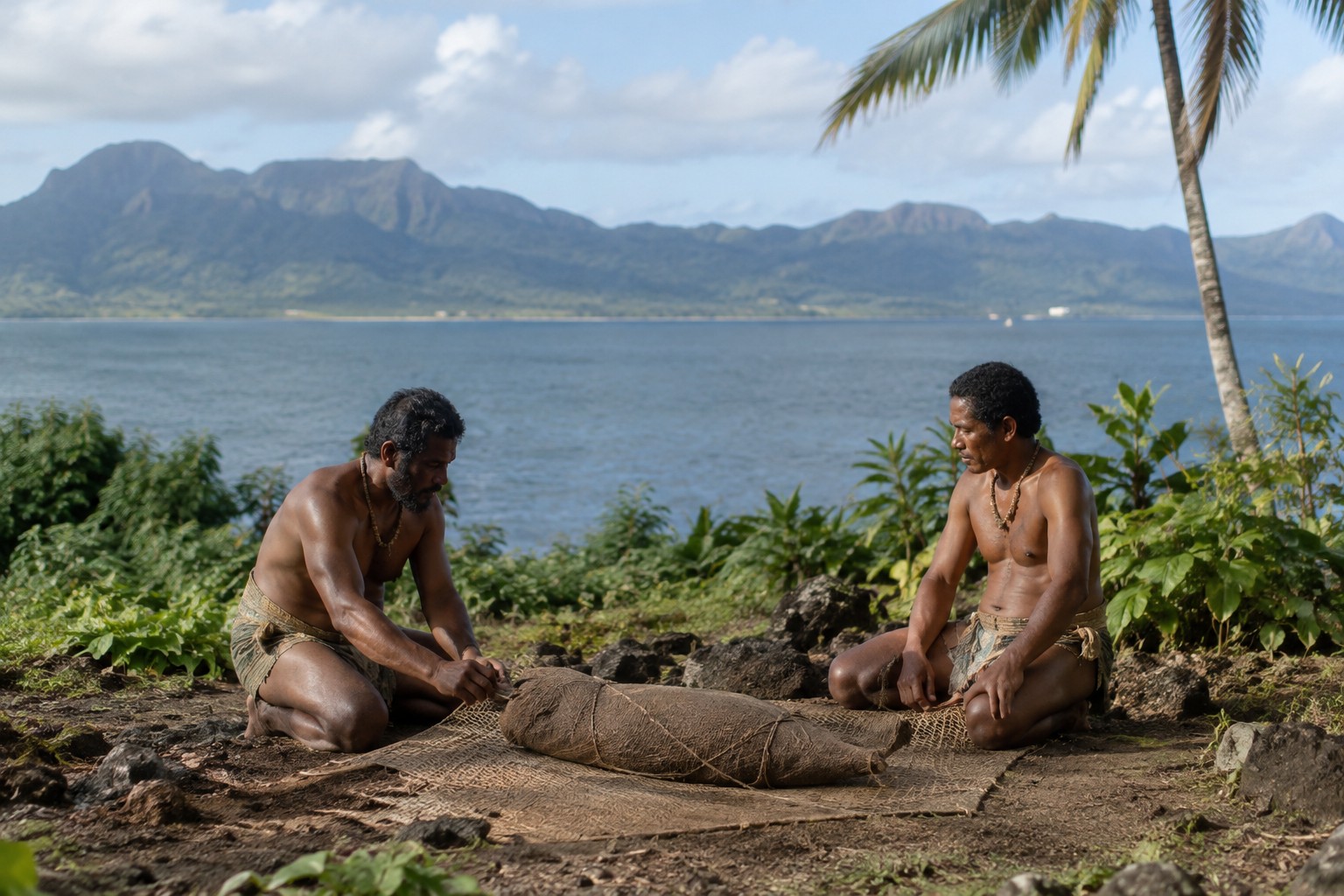
At Sigatoka on Fiji's island of Viti Levu, one ancient burial stands out not because it came with a dramatic treasure hoard or a famous name, but because it helps pin a rare paternal line to a real place and time. The individual identified as SIG053, dated to around AD 500, is one of the few ancient men currently associated here with the Y-DNA haplogroup M1a1a2a.
That matters because haplogroups can so easily drift into abstraction. M1a1a2a is a direct paternal lineage, passed from father to son, but ancient DNA gives it something better than a label: an archaeological setting. In this case, the setting is early Fiji, in a Pacific world already shaped by seafaring, settlement, and local continuity across islands and coastlines.
The evidence here is modest but valuable. Alongside SIG053 from Sigatoka, another ancient male linked to the same branch is recorded from Bourewa, also on Viti Levu: BOU017, dated to around AD 1725. These are not two men from the same moment, nor should they be treated as a single family story. What they do offer is a glimpse of the same paternal branch appearing in Fiji in very different historical periods.
That long gap is precisely what makes the pairing interesting. SIG053 belongs to an earlier phase of Fiji's past, while BOU017 comes from a much later era, close to the threshold of sustained European contact. A repeated Y-lineage across such a span may suggest persistence of one paternal branch within island populations, though not necessarily unbroken local dominance or a simple one-to-one descent from one excavated man to the other.
An ancient DNA study of Pacific populations, published in Cell, is the obvious broader research context for findings like these, even where the most detailed sample-by-sample archaeological descriptions are not all publicly laid out in the brief records alone. The important point is to keep the scale clear: the paper helps frame regional population history, while the burials themselves give the lineage its archaeological footing.
Sigatoka is one of the key archaeological landscapes in Fiji, known for burials and settlement evidence that have long mattered to Pacific prehistory. With SIG053, the significance lies less in an individual biography than in chronology. A man associated with M1a1a2a was buried there around AD 500, placing this paternal line firmly in Fiji well over a millennium ago.
That is useful for anyone tempted to read Pacific Y-DNA only through modern distributions. Ancient evidence reminds us that island histories are not recent improvisations. By the first millennium AD, communities in Fiji were already part of a developed Oceanic world, with inherited local lineages, regional interaction, and population structures that cannot be reconstructed from present-day surnames or national borders alone.
It is also worth being precise about the genetic claim. This article concerns M1a1a2a, a narrow branch, not every wider M lineage. The Fiji samples are important because they associate this specific paternal line with excavated individuals in place and time, rather than encouraging vague statements about broad prehistoric movements detached from actual burials.
The second sample, BOU017 from Bourewa, is dated to around AD 1725. Bourewa is widely known as an important early settlement area in Fiji, but this particular individual belongs to a much later horizon than the island's earliest colonising phases. That distinction matters. One must not collapse all Bourewa finds into a single founding episode.
Instead, BOU017 shows that the paternal branch associated here with M1a1a2a still appears in Fiji many centuries after SIG053. By the early eighteenth century, Fiji was part of a deeply connected island world with its own regional rivalries, exchange systems, and local histories. A lineage surviving into that period suggests continuity, but continuity in the sensible archaeological sense: persistence within a population, not a fairy-tale pedigree.
Seen together, Sigatoka and Bourewa give us an unusually neat contrast. One sample anchors the branch in early medieval-era Fiji; the other shows it still present in the late precolonial period. That is not a giant sample set, but in Pacific ancient DNA even a small number of securely placed individuals can be historically informative.
There is a temptation, whenever a Y-haplogroup turns up in ancient remains, to make it stand for an entire people. Archaeology is usually less tidy than that. Fiji's past was shaped by movement, intermarriage, settlement shifts, and contact across the wider Pacific. A paternal lineage like M1a1a2a traces only one line of descent among many that any individual carried.
Still, paternal lines are useful precisely because they can reveal patterns hidden within the larger picture. If a branch appears in different burials separated by more than a thousand years, that points to some degree of demographic staying power. It suggests that, amid all the maternal lines, cousin marriages, alliances, adoptions, and social identities that made up real island communities, one father-to-son line endured long enough to leave multiple ancient traces.
This sits well with a broader lesson from Pacific archaeogenetics: island societies were neither static nor perpetually replaced. Research on the region often shows a combination of deep local continuity and shifting mixtures, rather than a single wave explaining everything. That is a useful caution for anyone hoping a haplogroup alone will hand them a complete ethnic label.
It would be easy to overreach and turn M1a1a2a into a sweeping story about every stage of Pacific settlement. But the more disciplined reading is better, and frankly more interesting. We have two ancient Fijian individuals, SIG053 and BOU017, from two different periods on Viti Levu, both associated here with the same paternal branch. That gives M1a1a2a a documented antiquity in Fiji and hints at long-term local persistence.
What we do not have, from these records alone, is a license to assign the branch to a named chiefdom, language community, or dynasty. Nor can we say that every man at Sigatoka or Bourewa belonged to it. Ancient DNA works best when it keeps close to the graves, the dates, and the scale of the evidence.
For MyTrueAncestry members with M1a1a2a in their paternal line, the distinctive point is this: your haplogroup is not floating free in an abstract tree. It is already visible in ancient Fiji, from around AD 500 through the late precolonial centuries, attached to real men buried on Viti Levu. That is a small archive, but a very human one.
Comments