Haplogroup J2b2a1a2

– 5 min read


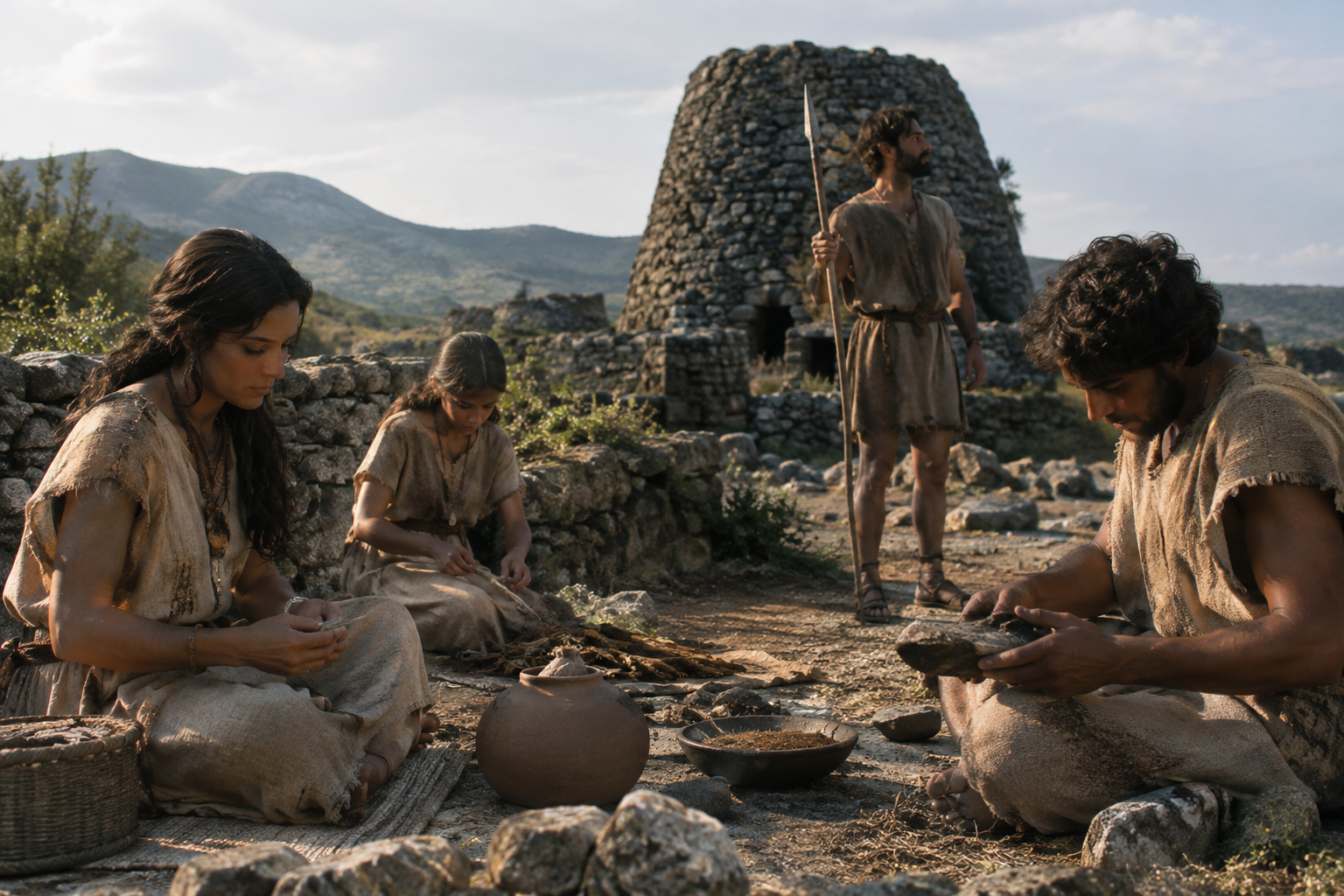
At Perdasdefogu in southeastern Sardinia, a cluster of Late Bronze Age individuals from the site of S'Orcu 'e Tueri offers one of the clearest ancient glimpses yet into the paternal line now labelled J2b2a1a2. The names are clinical rather than poetic - ORC003x, ORC003a, ORC003b, and the related record ORC003 from interior Nuragic Sardinia - but the setting is anything but dull. We are in the world of the Nuragic culture, around 1250-1180 BC, when Sardinia was dotted with stone towers, linked into Mediterranean exchange, and far from isolated.
That matters because Y-DNA tracks one direct paternal line only, not a person's whole ancestry, yet even a single paternal branch can tell us something precise about how male lines persisted within real communities. In this case, the interesting point is not that J2b as a broad lineage has a long history around the Mediterranean and Balkans; it is that a much narrower branch associated here with J2b2a1a2 appears in multiple Nuragic individuals from the same Sardinian context. That turns an abstract haplogroup into a local archaeological story.
The sample cluster from Perdasdefogu, at S'Orcu 'e Tueri, is the obvious place to begin because repetition changes the scale of the evidence. Instead of one isolated male line, we have several records tied to the same broad site and period: ORC003x, ORC003a, and ORC003b, all dated around 1250 BC, plus ORC003 from interior Sardinia at around 1180 BC. Even if we resist the temptation to turn them into a neat little pedigree, the pattern suggests that this paternal lineage was genuinely present within Nuragic society rather than appearing as a one-off curiosity.
That is an important distinction. Ancient DNA often gives us a spectacular but lonely sample: one man, one grave, one branch. Here, the interest lies in recurrence. A paternal line linked with J2b2a1a2 showing up repeatedly in Nuragic Sardinia hints at continuity within a local male population during the Late Bronze Age, in a landscape better known to the public for towers, sanctuaries, and the island's connections with wider Mediterranean trade.
A recent ancient DNA study on the peopling of the Italian islands provides the larger framework for thinking about Sardinia in exactly this period, showing how island populations can preserve continuity while still participating in wider networks of movement and contact: https://www.nature.com/articles/s41586-024-07546-2.
Now for the necessary bit of clarity. J2b2a1a2 is a very specific sub-branch inside a much larger Y-chromosome family. It would be careless to load onto that narrow label every grand claim ever made about haplogroup J2 as a whole. The safe point is narrower and, in its way, more interesting: this paternal line was present among men in Nuragic Sardinia during the Late Bronze Age.
That presence fits the sort of world archaeologists already know from material culture. Nuragic Sardinia was not some sealed prehistoric box. Metal, ideas, and probably people moved through the island's harbours and inland routes. But one must not jump from that general Mediterranean openness to a specific migration tale for each man carrying this lineage. A branch can be locally established for generations before it ever appears in our ancient DNA record.
The sample names themselves also deserve care. ORC003x, ORC003a, and ORC003b look like closely related designations, perhaps reflecting different analyses or records tied to the same archaeological context, but those labels alone are not permission to invent kinship. They tell us that the evidence clusters at one site; they do not, by themselves, prove a father, son, or brothers.
There is a persistent old habit in writing about Sardinia: either to romanticise the island as timeless and isolated, or to turn every new genetic signal into proof of constant colonising waves. The Nuragic evidence sits awkwardly, and usefully, between those extremes. These Perdasdefogu males belonged to an unmistakably Sardinian Bronze Age culture, yet their paternal line also reminds us that Sardinia formed part of a larger Mediterranean human landscape.
By the later second millennium BC, the island's communities had long experience of exchange. The great Nuragic towers and associated settlements speak to organised local societies, while the archaeological record more broadly places Sardinia in contact with other seafaring and trading worlds. A paternal branch like J2b2a1a2 appearing in this context therefore works best as evidence of embedded connectivity: not strangers passing through for a season, but lineages absorbed into the island's own history.
The presence of ORC003 in "Nuragic Interior Sardinia" around 1180 BC broadens the picture slightly. Even with sparse descriptive detail, that record helps move the story beyond a single labelled findspot. We are still in the Nuragic world, still in the Late Bronze Age, and still looking at a paternal branch associated with the article's haplogroup. The simplest reading is that this was not just a freak occurrence confined to one excavated context at Perdasdefogu.
That, in turn, bears on a larger question in Sardinian archaeogenetics: how much continuity existed between local Bronze Age populations and later island communities? One ancient DNA study circulated earlier as a preprint explored the genetic history of Sardinia across time, helping to establish the island as one of the most informative places in Europe for studying continuity and change: https://www.biorxiv.org/content/10.1101/583104v1.full. Whatever later periods brought, the Nuragic paternal evidence shows that specific male lines had already taken root in the island's interior by the 13th-12th centuries BC.
And that matters for family historians today. People often imagine haplogroups as arrows on a migration map, always moving, always dramatic. The Sardinian case suggests another possibility: a branch may become part of a durable local community and remain there long enough to be detected more than once in the archaeological record.
J2b-related lineages are often discussed in connection with the wider Mediterranean and Balkan worlds, but the Nuragic samples warn against crude map-colouring. A branch found in Sardinia around 1250 BC is not a neat ethnic badge, nor does it identify language, political allegiance, or a named people from later texts. What it does show is that central Mediterranean populations of the Bronze Age could contain paternal diversity that modern readers too easily file under rigid regional stereotypes.
That point becomes even more useful when Sardinia is compared with other island and coastal settings in the ancient Mediterranean. Islands preserve continuity, yes, but they also attract contact. Sardinia, Sicily, the Balearics, and the Italian mainland all show in different ways that sea routes did not erase local identities; they complicated them.
Mediterranean island diversity
The distinctive thing about J2b2a1a2 in this article is not an empire, a royal house, or a heroic founder. It is something more archaeologically solid: multiple Late Bronze Age males in Nuragic Sardinia, especially at Perdasdefogu and S'Orcu 'e Tueri, tie this paternal line to a real island community living more than three thousand years ago. For anyone researching this haplogroup today, that offers a grounded historical image - not just of movement somewhere in the deep past, but of settlement, persistence, and local belonging in Bronze Age Sardinia.
Comments