Haplogroup J2a1a1b2a1

– 5 min read


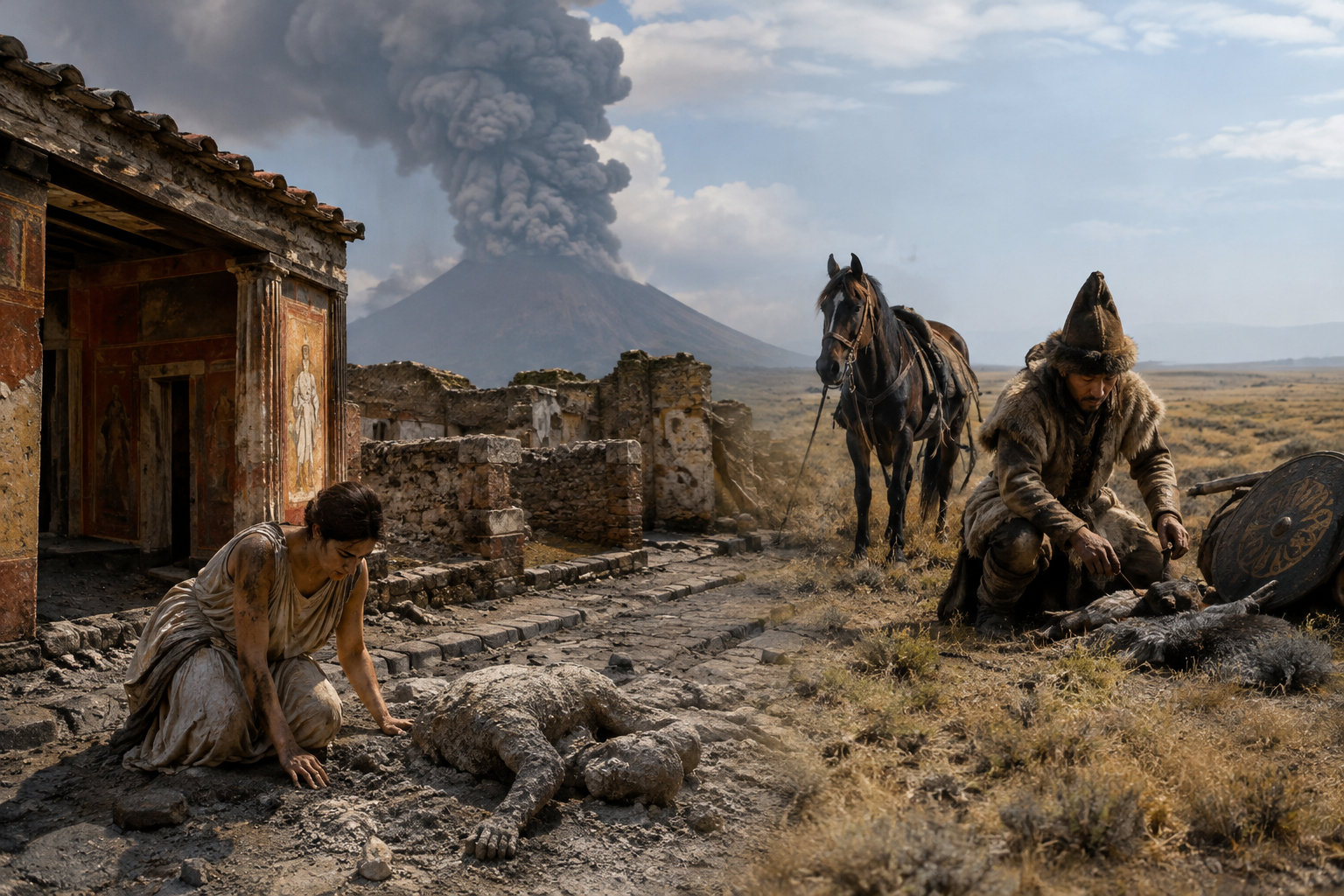
In AD 79, when Vesuvius buried Pompeii, it also sealed away a remarkable cross-section of Roman life. One of the individuals recovered from the House of the Golden Bracelet, sample I3686, belongs in this story because he is associated here with the Y-DNA haplogroup J2a1a1b2a1, a very specific paternal branch within the wider J2 family. That matters not because a single Y-line can define a whole person, still less an entire city, but because Pompeii gives us something unusually vivid: a man from a real Roman household, fixed in a precise historical catastrophe, whose paternal line can now be set alongside ancient finds from very different worlds.
The surprise is that the same narrow branch is also reported from a second setting almost unimaginably far away in culture and landscape: an Iron Age burial in central Kazakhstan. There, sample SRK004, dated to around 700 BC and found in a Scythian-era Tasmola grave at Serekty, places this paternal lineage in the steppe world centuries before Pompeii's destruction. Put those two appearances together and the interest of J2a1a1b2a1 is immediately clear. This is not a lineage tied neatly to one empire, one language, or one "people." It appears instead in two historically connected but culturally very different zones of Eurasia.
Pompeii is often treated as a frozen Roman time capsule, and in some ways it is. But genetically, Roman Italy was never simple. By the imperial period, the peninsula sat at the centre of a dense Mediterranean network of mobility, trade, slavery, military service, and family movement. A lineage like J2a1a1b2a1 fits that larger historical pattern rather well, because the broader J2 haplogroup is often associated in ancient DNA discussions with populations of the eastern Mediterranean, Anatolia, the Aegean, and parts of the Near East, though one must be careful not to assume that every fine-grained descendant branch followed the same exact route.
What makes I3686 so compelling is not that he can be made to stand for "the Romans," but that he shows how individual paternal lines in Roman Campania could reflect the Mediterranean's long history of mixture. Pompeii was a local city in one sense, yet also unmistakably part of an imperial world. The House of the Golden Bracelet was not a mythic setting or a literary trope; it was a real urban household in a prosperous Vesuvian town, overtaken by a documented eruption in AD 79.
An ancient DNA study of Pompeii and its victims has helped sharpen this picture of Roman-era biological diversity without turning it into caricature. For readers interested in the wider context of how genetics is reshaping our view of Roman Italy, the Pompeii research itself is part of that larger move away from simple, old-fashioned ideas of fixed ancient populations.
The second sample, SRK004, comes from Serekty in central Kazakhstan and is described as a Scythian grave of the Tasmola horizon, around 700 BC. This is a very different archaeological world from Roman Campania: not a tightly packed Italian town under volcanic ash, but the mobile and regionally varied societies of the Iron Age steppe. The term "Scythian" is useful, but broad. It covers a range of communities across a vast zone, and the Tasmola culture of central Kazakhstan has its own local profile within that larger steppe mosaic.
That is exactly why the lineage is interesting here. J2a1a1b2a1, or a reported placement close enough to connect SRK004 with this branch, appears in a milieu more often imagined through horse gear, kurgans, and steppe elites than through Mediterranean-style urban life. The presence of such a paternal line reminds us that the Iron Age steppe was not genetically sealed off. Central Eurasia was a meeting ground, and paternal lineages could move across it through exchange, alliance, migration, and long-term interaction.
Research on Iron Age steppe populations has repeatedly shown mixed ancestries and complex local histories rather than a single Scythian genetic template. A genetic study of Scythian-era elites and related steppe burials is relevant here because it underlines that dynastic or high-status contexts on the steppe could contain varied paternal backgrounds. That does not prove a direct link between SRK004 and Pompeii, of course, but it does make their shared branch historically plausible in a world of far-reaching Eurasian connections.
To understand J2a1a1b2a1, it helps to separate the narrow branch from its larger family tree. The broader haplogroup J2 has a long association with the eastern Mediterranean and southwest Asia in both modern and ancient datasets. It turns up in discussions of early farming expansions, later Bronze and Iron Age movements, and the maritime and overland worlds that connected the Aegean, Anatolia, the Levant, Mesopotamia, and beyond.
But a narrower branch like J2a1a1b2a1 is not automatically entitled to every chapter of that bigger story. It would be careless to say that because J2 as a whole has deep roots in one broad region, this exact terminal lineage must have formed there, moved in one particular migration, and arrived unchanged in every later context. Ancient DNA works best when it stays close to actual evidence. Here, the firm points are the archaeological appearances we have: one in Iron Age central Kazakhstan and one in Roman Pompeii.
Even so, these two appearances sit comfortably within what historians already know about Eurasia in the first millennium BC and first century AD. The steppe and the Mediterranean were not separate theatres with the curtain drawn between them. Goods, people, military practices, and ideas travelled across intermediate zones for centuries. Some lineages would have moved quietly through those networks long before they surface in the graves we can test.
If one were looking for a single theme in the evidence for J2a1a1b2a1, it would be connectivity. Not glamorous connectivity, perhaps; no need to imagine heroic riders galloping from Kazakhstan to Campania. Rather, the slow and ordinary connectivity of Eurasian history: families shifting region by region, men entering new communities, descendants speaking different languages from their paternal ancestors, and lineages surviving political collapse after political collapse.
That is why the pairing of SRK004 and I3686 is more useful than it first appears. The steppe sample shows this branch in an Iron Age world often linked to mobility and frontier exchange. The Pompeian sample shows it later in an urban Roman setting shaped by imperial integration. Together they suggest that this paternal line was capable of crossing historical boundaries that modern readers often keep too rigidly apart.
This broader Roman context also fits with other work on Italy and the western empire, where ancient DNA has steadily complicated any tidy distinction between "local" and "foreign." Roman communities could absorb lineages from many directions while still remaining recognisably local in language, law, and daily life.
For someone exploring J2a1a1b2a1 today, the value of these ancient samples lies in their range. This is a paternal line that appears, at least in the evidence currently highlighted here, in both a Scythian-period burial of central Kazakhstan and a Roman victim of Pompeii. That does not give a complete map of the branch, nor a guaranteed origin story for every modern tester. What it does offer is a historically grounded clue: this lineage belonged to the connected worlds of Iron Age Eurasia and the Roman Mediterranean, not to a single closed ethnic box.
In other words, J2a1a1b2a1 is most distinctive here not for royal glamour or tidy tribal labels, but for its presence in two archaeological settings that reveal how porous the ancient world really was. A paternal line could live in the steppe, appear later in Roman Italy, and carry with it no simple cultural script except the fact of human movement across centuries.
Comments