Haplogroup J2a1a1a2b2a3b1b3b1a1a1

– 5 min read


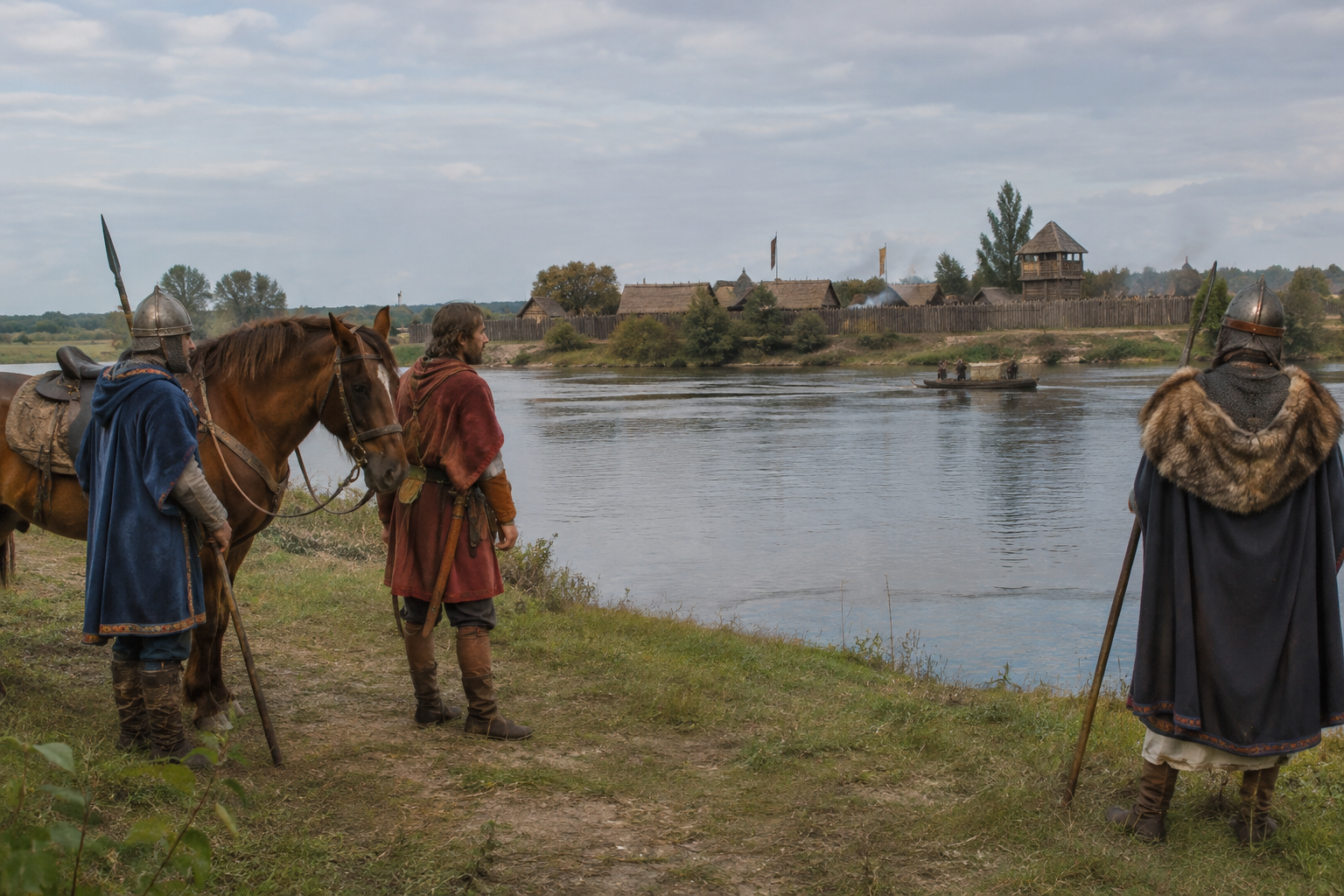
At Zalavar-Varsziget in western Hungary, one excavated man from around AD 850 carries an unexpectedly long genetic label: J2a1a1a2b2a3b1b3b1a1a1. The individual is recorded as sample AHS05, from a Carolingian-period context in medieval Hungary. That may sound forbiddingly technical, but the interest is quite straightforward. Here is a paternal line usually associated, at broad J2 level, with histories rooted further south and east in the Mediterranean and Near East, turning up in a frontier landscape of the early medieval Carpathian Basin.
Zalavar matters because it was not some forgotten backwater. In the ninth century it sat in a politically charged zone between the Carolingian world, local elites, and the shifting powers of the wider region. A Y-chromosome lineage traces only one direct paternal line, not a whole identity, but even so sample AHS05 offers a sharp reminder that early medieval Pannonia was populated by people whose family histories could be much more varied than older, simpler ethnic labels ever allowed.
Zalavar-Varsziget is tied to one of the most historically interesting landscapes in western Hungary: the fortified and ecclesiastical center usually connected with Mosapurc or Blatnohrad in the ninth century. This was a place of power, diplomacy, and religious change, lying in the zone where Frankish influence met older Avar and emerging Slavic and later Hungarian worlds. A sample from here is therefore valuable not because it can stand for everyone, but because it comes from a place where populations, allegiances, and family histories were likely to be mixed and mobile.
In that setting, AHS05's assignment to J2a1a1a2b2a3b1b3b1a1a1 is striking. The deeper parent haplogroup J2 is well known in many parts of the eastern Mediterranean, the Caucasus, Anatolia, the Balkans, and further afield, often appearing in contexts shaped by long-distance contact, farming dispersals, and later urban and imperial networks. But the exact terminal branch in this article is much narrower. We should be careful: one medieval man in Zalavar does not map the whole history of that tiny sub-branch. What it does show is that such paternal lines were present in the Carolingian-period population of the Carpathian Basin.
There is a temptation, when people see a very specific haplogroup, to treat it like a passport stamp. History is not that tidy. A lineage such as J2a1a1a2b2a3b1b3b1a1a1 could have reached medieval Hungary through many generations of movement long before AHS05 was buried: via Roman provincial populations, Late Antique mobility, Byzantine-linked exchange, Balkan settlement, merchant families, soldiers, clerics, or older communities already living in the region.
That is exactly why the context is so interesting. The Carpathian Basin had already seen centuries of population turnover before AD 850. Roman rule had tied Pannonia into Mediterranean systems. The post-Roman centuries then brought new political formations, including Hunnic, Gothic, Lombard, Avar, and Frankish phases, none of which represented a genetically uniform people. By the Carolingian period, a place like Zalavar was sitting on top of layers of earlier movement.
So the value of AHS05 is not that he can be forced into one neat migration story. Rather, he belongs to the sort of archaeological moment where mixed paternal ancestries are historically plausible and archaeologically meaningful. He fits a world in which western Hungary was linked both to Central Europe and to southeastern networks beyond it.
It is worth separating the broad branch from the tiny twig. Haplogroup J2 in general has a long history in West Eurasia and is frequently discussed in relation to Neolithic and post-Neolithic populations around the Aegean, Anatolia, the Caucasus, the Levant, and parts of the Mediterranean. That broad background helps explain why a J2-derived lineage appearing in medieval Hungary is not bizarre at all.
But the article haplogroup is not simply "J2." It is the much more specific J2a1a1a2b2a3b1b3b1a1a1. Without a dedicated phylogenetic study of this exact branch in multiple ancient and modern men, it would be wrong to assign it a single homeland, a single ethnic label, or a single migration route. Ancient DNA is at its best when it disciplines our imagination. In this case, it lets us say something both modest and important: a highly specific J2 paternal line was present in a Carolingian-era individual from Zalavar.
Zalavar's importance lies in its position at a crossroads. Early medieval power centers often gathered precisely the sort of people whose family histories had different geographic origins: retainers, craftsmen, clerics, administrators, farmers attached to elite estates, and families who had already been local for generations but descended from earlier incomers. The archaeology of such places rarely supports a simple one-people, one-lineage picture.
That makes AHS05 more than an isolated curiosity. A paternal lineage like this one, found in a central site of the ninth-century Carpathian Basin, adds to the wider picture now emerging from medieval Hungary: populations were heterogeneous, and elite or politically important regions could preserve lineages connected to several earlier historical horizons at once. Research published on this wider ancient population in Science Advances helps frame exactly that kind of complexity, even when any single sample must be handled with caution.
It also helps correct a very old habit in writing about the period. Historians and archaeologists used to be pushed toward grand labels such as "Avar," "Slav," "Frank," or "Hungarian" as though each were biologically tidy. Ancient DNA has been steadily dismantling that assumption. AHS05 does not abolish those historical categories, but he shows why they can never do the whole job on their own.
If one wants the longer historical backdrop, Pannonia is the real star of the story. This region had been tied into the Roman Empire for centuries, and Roman frontier provinces were famous for moving people around: troops, administrators, traders, enslaved people, and settlers. Later centuries did not wipe that slate clean. They layered new migrations and local survivals on top of older provincial populations.
That is one reason lineages with stronger associations in the Mediterranean or Balkan worlds can appear in medieval Hungarian contexts without requiring a dramatic one-generation explanation. The region had long functioned as a corridor. By AD 850, when AHS05 lived, the population of western Hungary was the product of many centuries of accumulation, disruption, and reassembly.
This wider perspective also fits other MyTrueAncestry work on neighboring zones and mixed medieval populations. Posts on subjects such as frontier graves, medieval Sicilian diversity, and post-Roman Europe repeatedly show the same basic lesson: paternal lines can travel through empires, faiths, and languages while leaving only a thin documentary trace. Genetics sometimes catches what the texts missed.
If your paternal line falls under J2a1a1a2b2a3b1b3b1a1a1, the Zalavar sample does not tell you that your direct ancestor was a Carolingian subject in Hungary. What it does offer is a solid historical illustration of where this kind of lineage could appear: in a ninth-century population at the intersection of Central Europe, the Balkans, and older Mediterranean worlds. That is a historically rich setting, not a narrow one.
The most responsible takeaway is also the most interesting. This haplogroup points toward a paternal history that may have been shaped by long-standing connectivity rather than isolation. In AHS05 at Zalavar, that deep connectivity surfaces in one documented medieval life at the edge of empires.
Comments