Haplogroup J2a1a1a2b2a3b1a1b1a2

– 5 min read


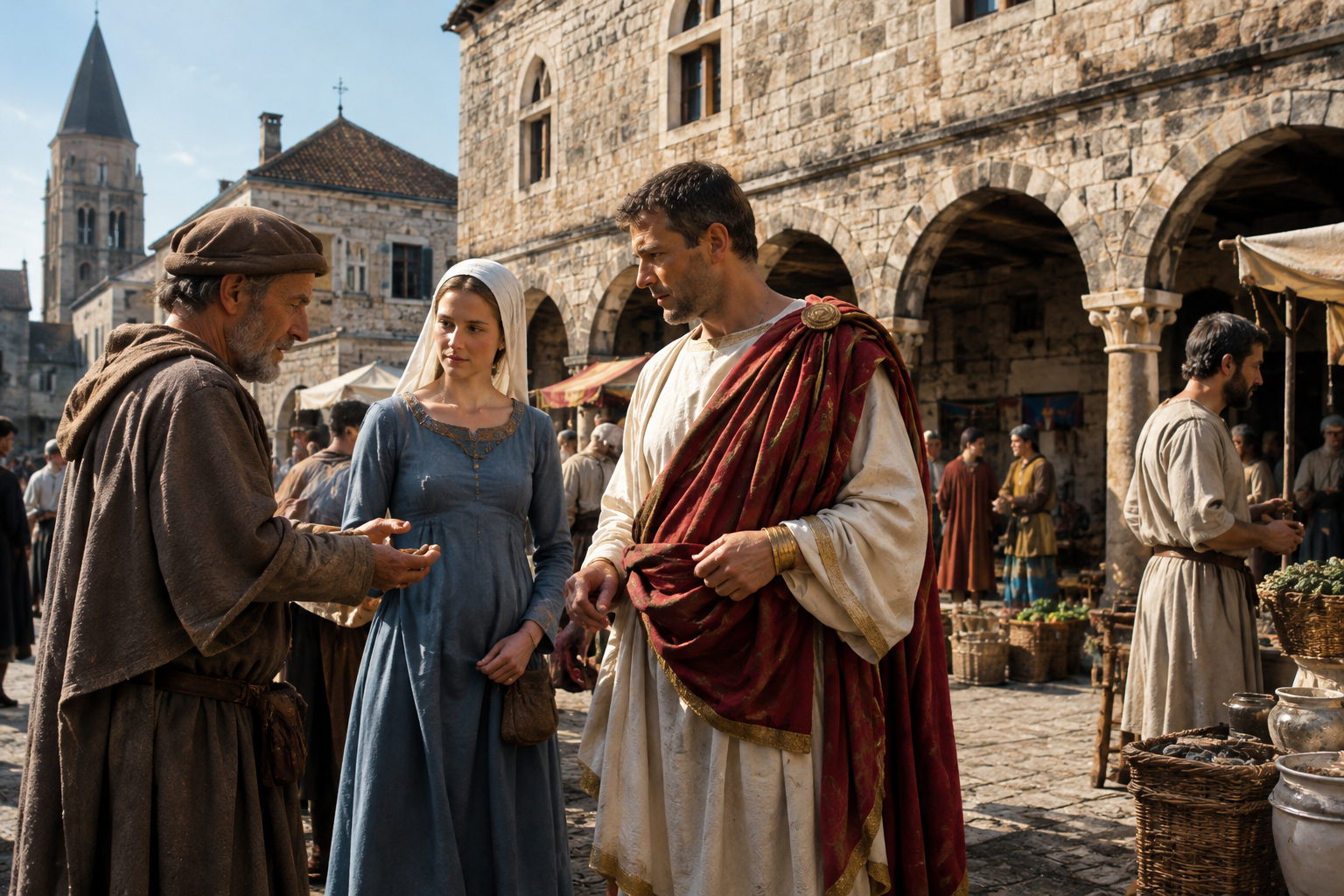
At Sint-Truiden in medieval Belgium, one excavated individual stands out less because of spectacle than because of context. Sample ST2269, dated to about 1095 AD from the Groenmarkt area, belongs to a growing body of evidence for how busy, connected, and surprisingly mixed medieval towns could be. In paternal-line terms, this individual has been associated here with the very specific Y-DNA branch J2a1a1a2b2a3b1a1b1a2.
That long string of letters and numbers needs a little unpacking. It is a fine-grained branch within the wider haplogroup J2, a major paternal lineage with deep roots in western Eurasia and a long history in the Mediterranean and Near East. Y-DNA tracks only one line of descent, from father to father, so it does not define a person's whole ancestry or identity. But when a branch like this appears in both late Roman Dalmatia and high medieval Belgium, it gives us a useful historical clue: some paternal lines moved through Europe's urban and imperial worlds in ways that written sources only partly capture.
Sint-Truiden was not a remote village accidentally caught by archaeology. It was an important religious and commercial center in the medieval Low Countries, shaped by abbey power, markets, and regional exchange. Sample ST2269 comes from that urbanizing world, where burial grounds and settlement layers can reveal not just local continuity but the traffic of people into and through a town.
Research on the site's ancient DNA has helped frame Sint-Truiden as a place where medieval population history was tied to urban growth rather than simple isolation. An ancient DNA study examining these burials is linked here: https://genomebiology.biomedcentral.com/articles/10.1186/s13059-025-03580-z. Without over-claiming for one man, ST2269 shows that a paternal branch usually discussed in broader Mediterranean terms could also be present in a thriving town of inland northwestern Europe by the late 11th century.
That matters because medieval towns were engines of demographic change. Traders, clergy, craftsmen, laborers, and migrants could all leave descendants, and the genetic record of a cemetery may preserve the outcome of those movements long after charters and chronicles fall silent. A lineage such as J2a1a1a2b2a3b1a1b1a2 in Sint-Truiden does not tell us exactly where one man's paternal ancestors came from in the preceding centuries, but it does fit a broader picture of Europe as a network rather than a patchwork of sealed populations.
The other ancient individual linked to this haplogroup is much earlier and comes from a very different political world. Sample I34297, dated to around 400 AD, was recovered from Hvar Radosevic Palace in Croatia and is classified as Late Imperial Roman. Here the setting is not a medieval market town but the Adriatic zone of the late Roman Empire, where coastal settlements, military movement, trade, and administrative links tied Dalmatia into a larger Mediterranean system.
Late Roman Dalmatia is exactly the sort of landscape where a J2-derived paternal line is historically plausible without any need for romantic embellishment. The Roman world moved people constantly: soldiers, merchants, sailors, officials, enslaved people, and families of every sort. One burial cannot identify which route brought this lineage to Hvar, but the find reminds us that Adriatic communities in late antiquity were not marginal backwaters. They were plugged into imperial circuits reaching across the sea.
Archaeological and bioanthropological discussion of the Hvar-Radošević material is represented by research published on the site here: https://link.springer.com/article/10.1007/s12520-024-02050-0. The crucial point for this haplogroup article is not that I34297 can be turned into a grand historical mascot, but that it places this paternal branch in the eastern Adriatic at the end of Roman rule in the West.
Put those two samples side by side and the pattern becomes interesting. One man lived in late Roman Croatia around 400 AD; another turns up in medieval Belgium roughly seven centuries later. That is not a straight genealogical chain, and it would be irresponsible to imply one. But it does show that the paternal line represented by J2a1a1a2b2a3b1a1b1a2, or a closely related reported placement, was present in two quite different European settings connected by commerce, institutions, and migration.
The bridge between them is history itself: the Mediterranean sea-lanes of empire, the Christian networks that linked coasts and inland towns, and the later commercial worlds of medieval Europe. The Roman Empire had already made the Adriatic a corridor of movement. After Rome's western structures changed and fragmented, movement did not stop; it shifted form. Ports, monasteries, markets, and courts continued to draw people over long distances.
This is where a fine-scale Y-DNA branch becomes useful. The broad haplogroup J2 has a long and complex history, but the article's specific branch is much narrower. With only two ancient examples supplied here, it would be rash to assign that exact subclade a single homeland or one dramatic migration. What we can say is simpler and better: the paternal line had reached both the Adriatic Roman sphere and the medieval Low Countries, showing how some family lines participated in the great connective tissue of European history.
There is a temptation, whenever a haplogroup appears in an ancient sample, to pin it to a named people as if labels from chronicles and labels from chromosomes were the same thing. They are not. I34297 was buried in a late Roman context in Croatia; ST2269 in a medieval Belgian one. Those are archaeological and historical settings, not tribal surnames in disguise.
Yet these settings do tell us something real. Both are places where institutions concentrated strangers: the Roman imperial order in Dalmatia, and the urban-religious framework of a medieval town in the Low Countries. That makes this haplogroup's evidence feel less like a tale of one isolated origin and more like a record of repeated participation in connected societies.
That wider perspective also helps explain why paternal lineages can appear far from where modern expectations might place them. Ancient DNA has repeatedly shown that Roman and medieval populations included mobility at many scales, from regional marriage patterns to long-distance relocations. A branch found in one cemetery need not represent a mass migration, but neither should it be forced into a story of permanent local rootedness.
For anyone researching J2a1a1a2b2a3b1a1b1a2 today, the strongest lesson from these ancient samples is caution combined with historical imagination. This is not evidence for a single dynasty, a single ethnicity, or an automatic claim to one famous civilization. It is evidence that one direct paternal line was present in the late Roman Adriatic and later in medieval northwestern Europe.
That combination may especially interest people whose family history points toward the Mediterranean, the Balkans, or old urban centers farther north. It suggests that the branch belongs comfortably in the worlds created by trade, empire, church organization, and medieval town life. In other words, this is a haplogroup seen not on the edge of history, but in places where people, goods, and ideas were crossing paths.
Croatia's shifting paternal lines
With just two ancient men, this is a modest archive. But modest archives can still be eloquent. In sample I34297 from late Roman Hvar and sample ST2269 from medieval Sint-Truiden, J2a1a1a2b2a3b1a1b1a2 appears in the sort of places where European history was continually being remade: an Adriatic province of empire and a flourishing town of the High Middle Ages. For descendants tracing this paternal line today, that is the most responsible and intriguing suggestion of all: your branch belongs to the long human traffic that linked Roman seas to medieval streets.



Comments