Haplogroup J2a1a1a2b2a1a1c2b1

– 5 min read


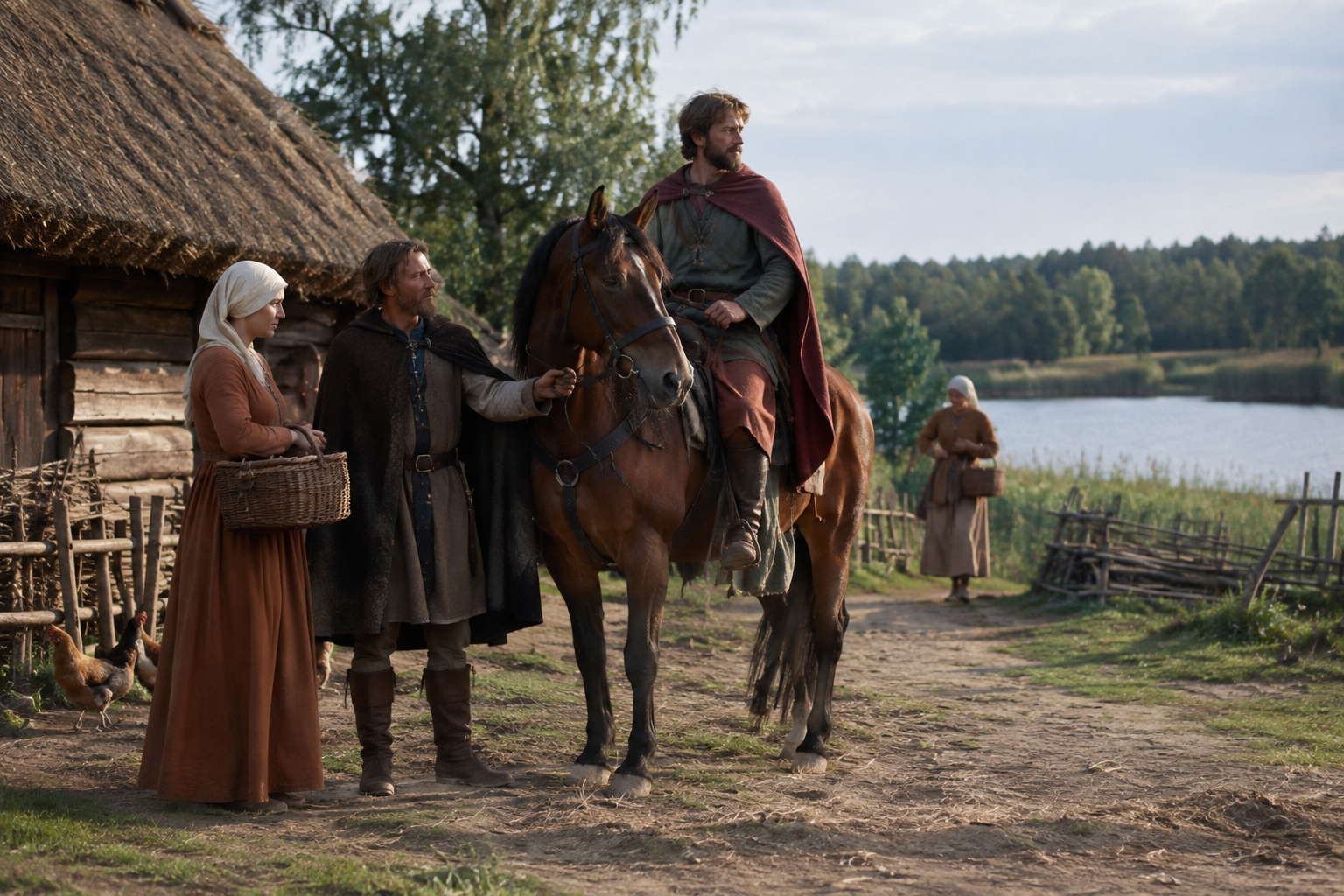
In the Piast-era landscape of Silesia, one of the most interesting genetic clues comes not from a king in a cathedral tomb, but from an ordinary medieval individual: PCA0548, dated to around AD 1100 from Milicz in southwestern Poland. That date places him in the world of the early Polish state, when frontier woodlands, church networks, ducal power, and expanding settlement were reshaping the region. His reported paternal line is associated here with J2a1a1a2b2a1a1c2b1, a very narrow branch within the wider haplogroup J2.
That narrowness matters. Y-DNA follows one direct paternal line only - father to son across generations - so it does not describe a person's whole ancestry, language, or social identity. But when a lineage that is more often discussed in relation to southeastern Europe or the eastern Mediterranean appears in medieval Silesia, it immediately raises a better historical question than any grand migration myth: how did one paternal line like this become part of the male population of Piast Poland?
Milicz sat in a region that was anything but isolated. Silesia in the 11th and 12th centuries belonged to a growing political world tied into the Piast realm, the Holy Roman Empire, Bohemia, church reform, trade routes, and the movement of craftsmen, clergy, warriors, and settlers. In that setting, a Y-chromosome lineage such as J2a1a1a2b2a1a1c2b1 need not be treated as exotic in a dramatic sense; it is better understood as evidence that medieval Central Europe was already peopled by lines with quite varied deeper histories.
The individual PCA0548 is especially useful because he anchors that point in a real place and time. We are not dealing here with a vague modern distribution map or a romantic claim about ancient princes. We have a medieval man in Silesia whose paternal line contributes to the growing picture of Piast-period diversity.
The wider haplogroup J2 has a long prehistoric and historic presence across parts of West Asia, the Caucasus, the Mediterranean, and southeastern Europe. But that broad background should not be lazily pasted onto this exact subclade. J2a1a1a2b2a1a1c2b1 is a much more specific terminal label, and without a securely documented series of ancient samples for that precise branch, it would be careless to assign it a neat one-route origin story.
What can be said more safely is that lineages within J2 often turn up in populations shaped by farming expansions, classical-era mobility, medieval commerce, and later political integration. In a place like Silesia, all those long processes matter more than any single dramatic invasion. Medieval Poland was not built by one biological type. It was a political and cultural formation drawing people from several neighboring and more distant backgrounds into one historical frame.
This is why one sample can be revealing without being overburdened. PCA0548 does not prove that a whole local community shared this paternal line, nor that he personally migrated from far away. But he does show that by around AD 1100, a lineage placed in this fine-grained branch was present in Piast-era society.
To understand why that matters, it helps to remember what Silesia was becoming in the 11th and 12th centuries. This was a borderland in the productive sense of the word: not simply an edge, but a zone of contact. Rivers linked it north and south; political alliances and rivalries linked it west and east. Christian institutions were expanding, and so were the mechanisms that moved people - service, marriage, patronage, warfare, landholding, and trade.
In that sort of world, paternal lines could travel quietly. A man bearing a J2-derived lineage might have arrived recently, or his ancestors may have been in Central Europe for generations by the time of PCA0548. The archaeological lesson is not that Silesia was unusual for having mixture, but that medieval communities often preserve exactly this sort of accumulated complexity when ancient DNA gives us the chance to see it.
A broader ancient DNA study of the region's past, published in Scientific Reports, helped establish just how informative medieval and earlier genomes can be for reconstructing population structure in Polish lands. For readers tracing paternal ancestry, the important point is not a single headline claim, but the steady accumulation of cases showing that Central Europe's history was made through both continuity and movement.
Southwest Poland in Transition
There is a tendency, when confronted with a very precise haplogroup label, to want a very precise historical identity in return. But archaeology is usually more interesting than that. A sample like PCA0548 matters because it restores scale. He was one man in a medieval community, living at a moment when Silesia was being folded into larger political and ecclesiastical systems. His Y-DNA is one surviving thread from that world.
That thread becomes more meaningful when placed alongside other early medieval genetic work from Central and western Europe. Again and again, those studies show that post-Roman and medieval societies were neither sealed off nor endlessly uprooted. They were locally rooted, yet open to repeated small-scale arrivals and family lines from different backgrounds. That is the kind of historical setting in which a branch like J2a1a1a2b2a1a1c2b1 can appear in Piast Poland without requiring fantasy genealogies.
Because PCA0548 lived in the Piast era, it is tempting to leap straight from chronology to dynasty. That is exactly the sort of leap worth resisting. Living under Piast rule does not make an individual a dynast, a courtier, or a close biological relative of ruling elites. Ancient DNA is at its best when it helps us reconstruct populations and connections, not when it is forced into decorative tales of royal descent.
Even so, Piast-period finds are historically powerful because they put real bodies back into the making of the Polish realm. States are often written from the top down, through rulers and bishops. Genetics has a habit of dragging us back to the ground: to villages, burial communities, and the ordinary men and women whose lives made those states possible. PCA0548 belongs to that more democratic history.
The most responsible reading of J2a1a1a2b2a1a1c2b1 in this case is also the most interesting one. It places a very specific paternal lineage in Milicz, Silesia, around AD 1100, inside the lived reality of Piast Poland. That does not reduce the lineage to one ethnicity or one migration event. Instead, it suggests that the medieval Polish world already contained paternal lines shaped by much wider currents of European history.
For someone researching this haplogroup today, the lesson is not that one medieval burial solves the family story. It is that your direct paternal line can appear in places where written history would never have led you to look - and that even a single well-placed ancient sample can turn an abstract haplogroup into part of a real historical landscape.


Comments