Haplogroup J2a1a1a2b1b

– 6 min read


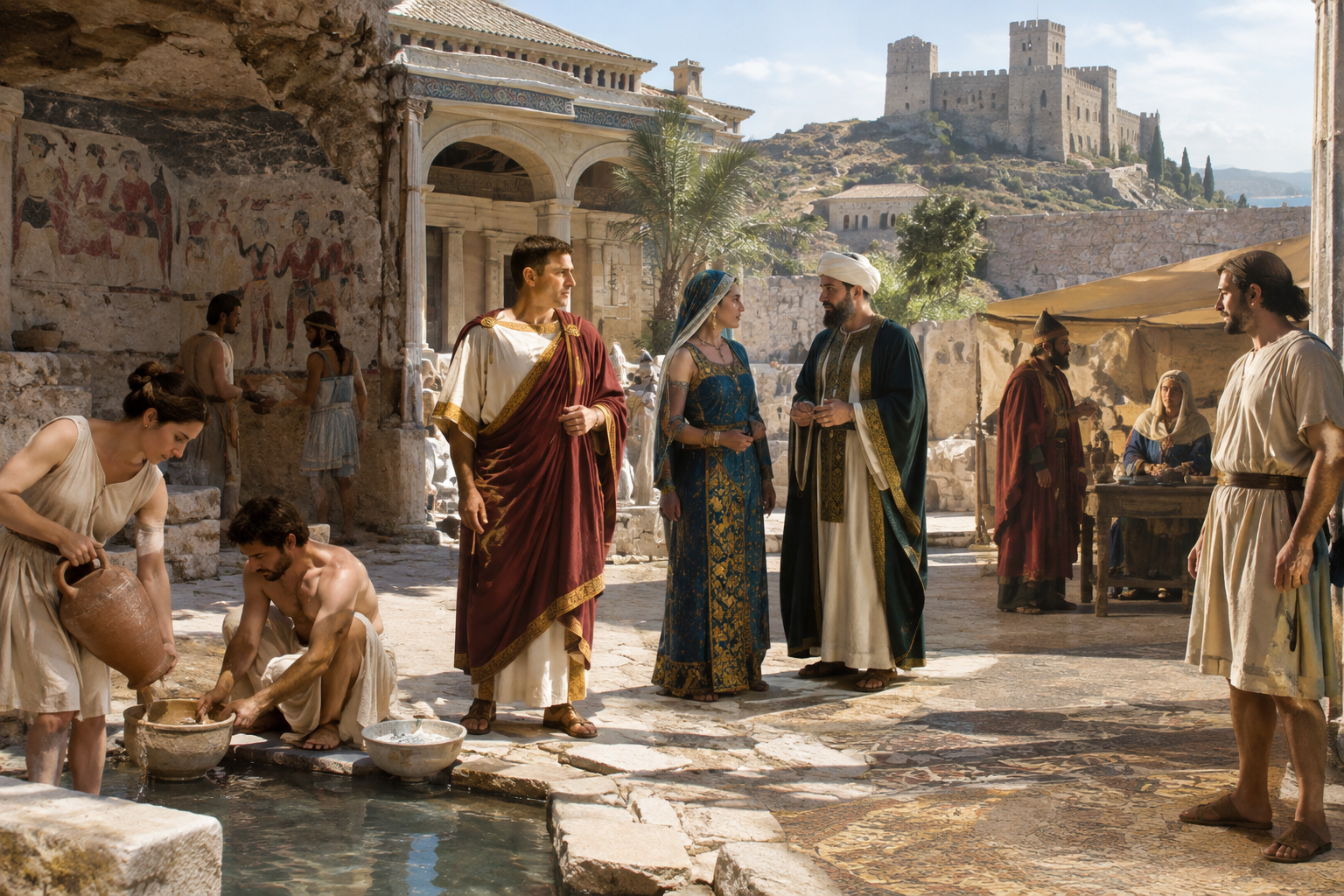
Some Y-chromosome lineages announce themselves with a bang: a famous royal burial, a celebrated migration, a neat tie to one people or one kingdom. Haplogroup J2a1a1a2b1b is more interesting precisely because it refuses to behave so tidily. It sits within the wider J2 branch, a paternal lineage long associated in broad terms with parts of the eastern Mediterranean and Near East, and it appears in the ancient DNA record in places that remind us how connected the Mediterranean world really was: Bronze Age Crete, Roman Italy, Roman Dalmatia, and medieval Islamic Spain.
That matters because Y-DNA traces one very particular line: the direct paternal chain from father to son to son again. It does not describe a person's total ancestry, culture, language, or identity. But when a lineage like J2a1a1a2b1b turns up across centuries of burials, it gives us a sharply focused way to follow male-line continuity, movement, and mixture through the old highways of sea trade, empire, and settlement.
For a subclade this specific, caution is essential. We should not simply pour the entire history of broad haplogroup J2 into J2a1a1a2b1b as if nothing changed along the branches. Still, the broader setting is clear enough. J2 lineages are widely discussed in connection with prehistoric and historic populations of the eastern Mediterranean, Anatolia, the Aegean, and neighboring regions. They appear often enough in studies of early farming dispersals and later Mediterranean societies to make them central to debates about how people moved around this world.
What is striking here is not a single march of conquest, but repeated appearance in maritime and urban settings. That suggests a history bound up with connectivity: islands, ports, coastal plains, and imperial routes. If you want a simple picture, imagine not one arrow on a map, but a web of harbors, market towns, military stations, and family lines that kept moving, settling, and reappearing in new historical settings.
Explore Prehistoric Aegean DNA
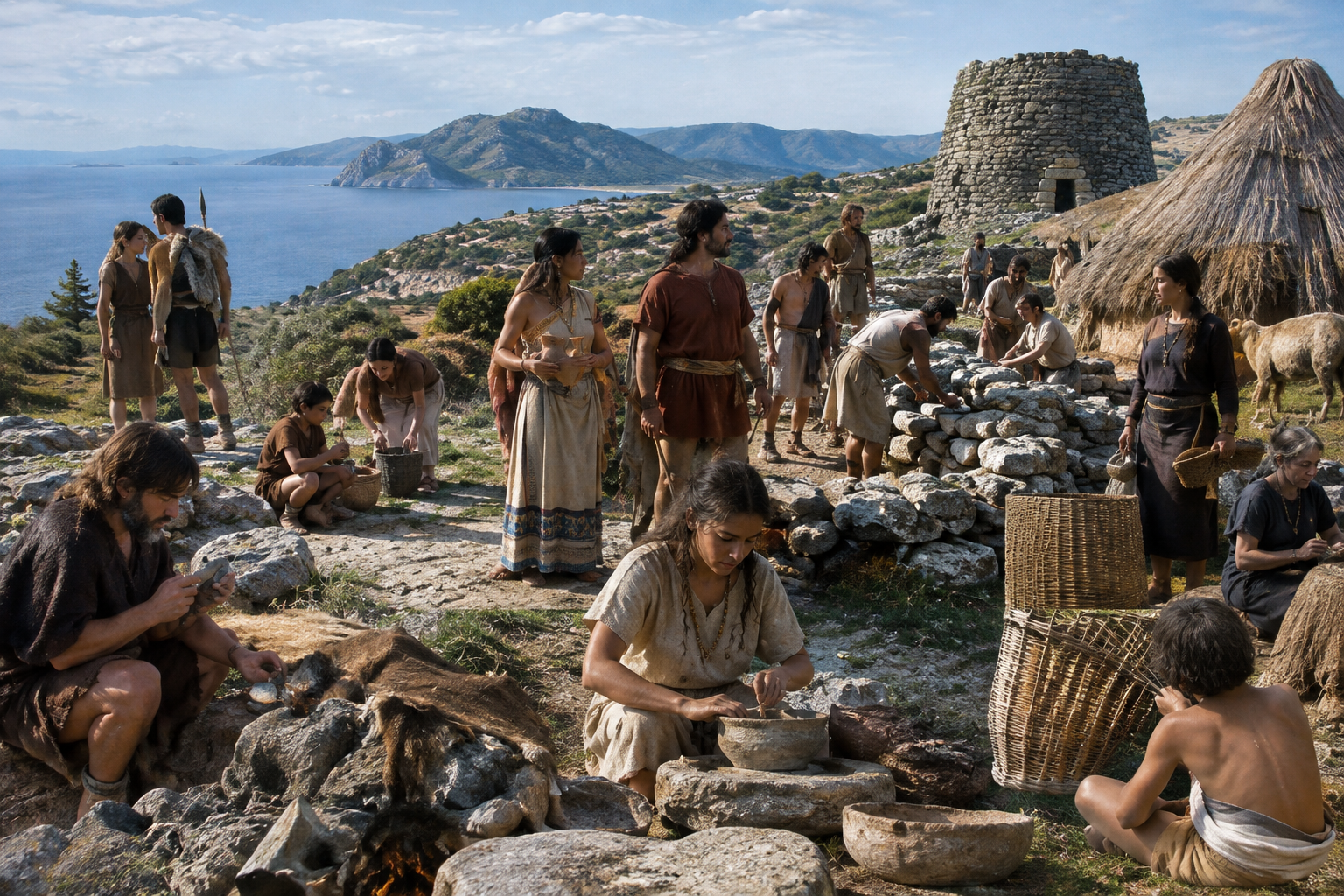
The oldest supplied evidence comes from Crete, and it is hard to ask for a more evocative setting. Four individuals from Hagios Charalambos Cave, dated to 1900 BC, are listed here: HGC031, HGC037, HGC018, and HGC024. This is Minoan Crete, a world of palaces, seaborne exchange, local cult, and communities already tied into larger eastern Mediterranean networks.
Now, one should not leap from these four men to grand claims about "the Minoan Y chromosome" as though a whole civilization could be reduced to a single paternal branch. But these samples do show that this lineage, or a closely relevant branch in this paternal cluster, had a foothold in Bronze Age Crete. That immediately gives J2a1a1a2b1b a deep Mediterranean antiquity in the ancient DNA record supplied here.
And Crete matters for another reason. It was never isolated in the romantic sense people sometimes imagine. Minoan society was island-based, yes, but outward-looking. If a paternal lineage is present there in 1900 BC, we are looking at a world already shaped by circulation across sea lanes rather than by neat ethnic compartments.
Readers interested in the broader background of how farming and early populations spread through this region may also enjoy the community article on Neolithic Expansion in the Aegean, which helps frame the older demographic setting behind later Aegean lineages.
Read About Aegean Neolithic Expansion
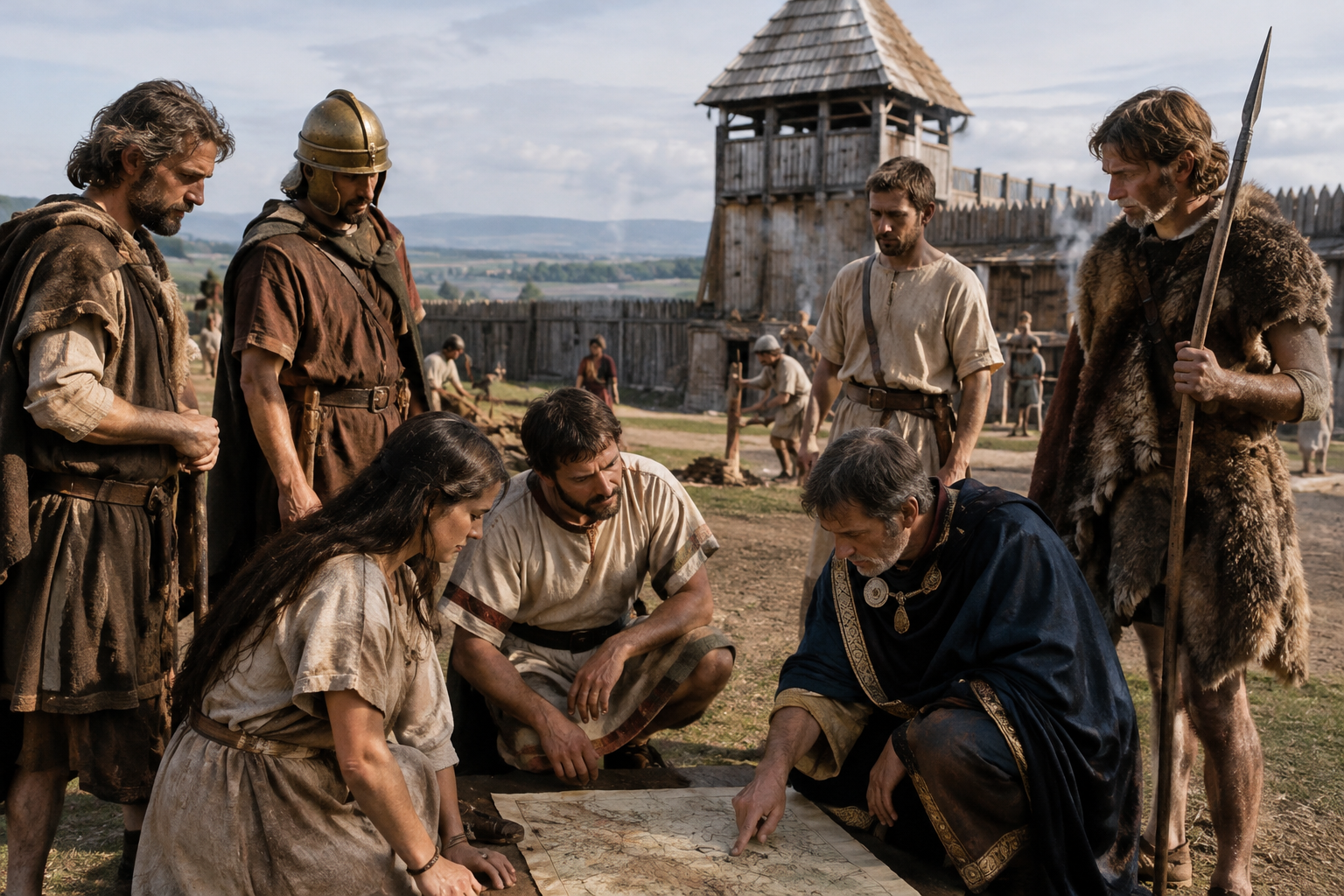
Then the story jumps forward into the Roman world, and here the pattern becomes wonderfully Roman in the truest sense: messy, mobile, and multilingual. At San Ercolano in central Roman Italy, sample R117 is dated to 100 AD. From Tarquinii in Italy comes TAQ021, dated to 343 AD. And on the eastern Adriatic, from Late Imperial Roman Croatia Hvar Radosevic Palace, comes I33809, dated to 400 AD.
This is not the picture of a lineage tied to one local village and staying put. Instead, it appears in the orbit of Roman Italy and in Roman Dalmatia, a reminder that the empire linked the peninsula, the Adriatic, and the eastern Mediterranean through administration, trade, military service, slavery, family formation, and ordinary migration. Men carrying related paternal lines could arrive in a place for any number of reasons: posted there in service, drawn by commerce, born into a provincial family already settled for generations, or descended from earlier migrants whose origins had long since faded from memory.
That is one of the great lessons of ancient DNA. Written sources give us emperors, governors, and generals. Burials like R117, TAQ021, and I33809 give us the population underneath the texts: men whose paternal lines connect Italy, the Adriatic, and the larger Mediterranean world without needing to belong to any single famous family.
Discover Roman Dalmatia at Hvar
By the medieval period, the lineage appears at the far western end of the Mediterranean. Two especially intriguing samples are listed from around 1050 AD: I12514 from the Palace-Castle of Betxi Castellon Spain Taifa of Valencia, and I12515 from Spaniard Cordoba Caliphate.
These are marvellous anchors because they place the lineage in the world of al-Andalus, where castles, courts, rural estates, towns, and frontier politics sat alongside intense cultural and biological mixture. The palace-castle setting at Betxi is a particularly vivid reminder that fortified places were not only military structures. They were also households, political centers, and places where lineages became part of local history.
Again, scientific caution first: a medieval man in a castle context is not proof of descent from some named lord, still less proof that a modern tester with a related haplogroup descends from that exact individual. But geographically and historically, these Iberian samples show how a paternal branch with older eastern Mediterranean roots could become part of the western Islamic Mediterranean as well.
That wider Iberian context is worth exploring through the community article on Roman and post-Roman genetic change in Spain, because medieval Iberia did not emerge from nowhere; it inherited layers of earlier movement and settlement.
Explore Roman Hispania's Genetic Legacy
The supplied noble-family field is blank, which is actually a useful discipline. It stops us doing the thing people are often tempted to do with haplogroups: attaching them too quickly to a grand surname, a coat of arms, or a ruined keep and calling the matter settled. We do, however, have one explicit fortified setting in the evidence itself: the Palace-Castle of Betxi in Castellon, in the Taifa of Valencia.
That lets us make an important historical point. Castles preserve memory differently from DNA. A castle tells us who ruled, who defended, who administered, who displayed power in stone. Y-DNA tells us about one paternal line carried by one man buried in or associated with that historical landscape. Sometimes those stories overlap. Just as often, they run alongside one another without ever becoming the same story.
So if you carry J2a1a1a2b1b today, the right historical question is not, "Which noble house does this prove I belong to?" It is something more interesting: in what worlds did this paternal line travel, settle, and survive? In this case, the answer runs from Bronze Age Crete to Roman Italy and Dalmatia, and onward to medieval Iberia. That is already a substantial human history.
For readers curious about how medieval Iberia could contain such varied ancestry within a single political landscape, the community article on diverse origins in early medieval Madrid offers an excellent parallel.
See Medieval Iberia's Diverse Origins
What makes J2a1a1a2b1b historically interesting is not that it belongs neatly to one modern people. It is that it appears in places shaped by contact: Minoan cave burials, Roman towns, Adriatic provinces, and Islamic Spain. That pattern fits a Mediterranean history made less by purity than by movement.
Ancient DNA is particularly good at showing this. Traditional genealogy often reaches only as far as written records allow, and noble genealogies can give the illusion of fixed lines and fixed identities. Archaeogenetics cuts across that by recovering paternal branches from men who lived long before surnames or who never entered written history at all. Yet it also has limits. Sharing a haplogroup does not prove direct descent from an ancient sample, and it certainly does not prove membership in a royal or noble line.
Still, the value is enormous. A lineage like J2a1a1a2b1b can place your paternal ancestry in a real historical arena: the Aegean, the Roman Mediterranean, the Adriatic, and Iberia. That is not a fairy tale. It is the kind of grounded, cumulative history that ancient DNA does best.
If you want to see whether your own DNA shows links to ancient individuals, historical populations, and deep paternal stories like these, MyTrueAncestry can help you explore those connections. The results may not prove that you descend from a Minoan cave burial, a Roman townsman, or a man from a Valencian castle, but they can offer a fascinating window into the worlds your ancestors once inhabited.
Comments