Haplogroup J2a1a1a2b

– 5 min read


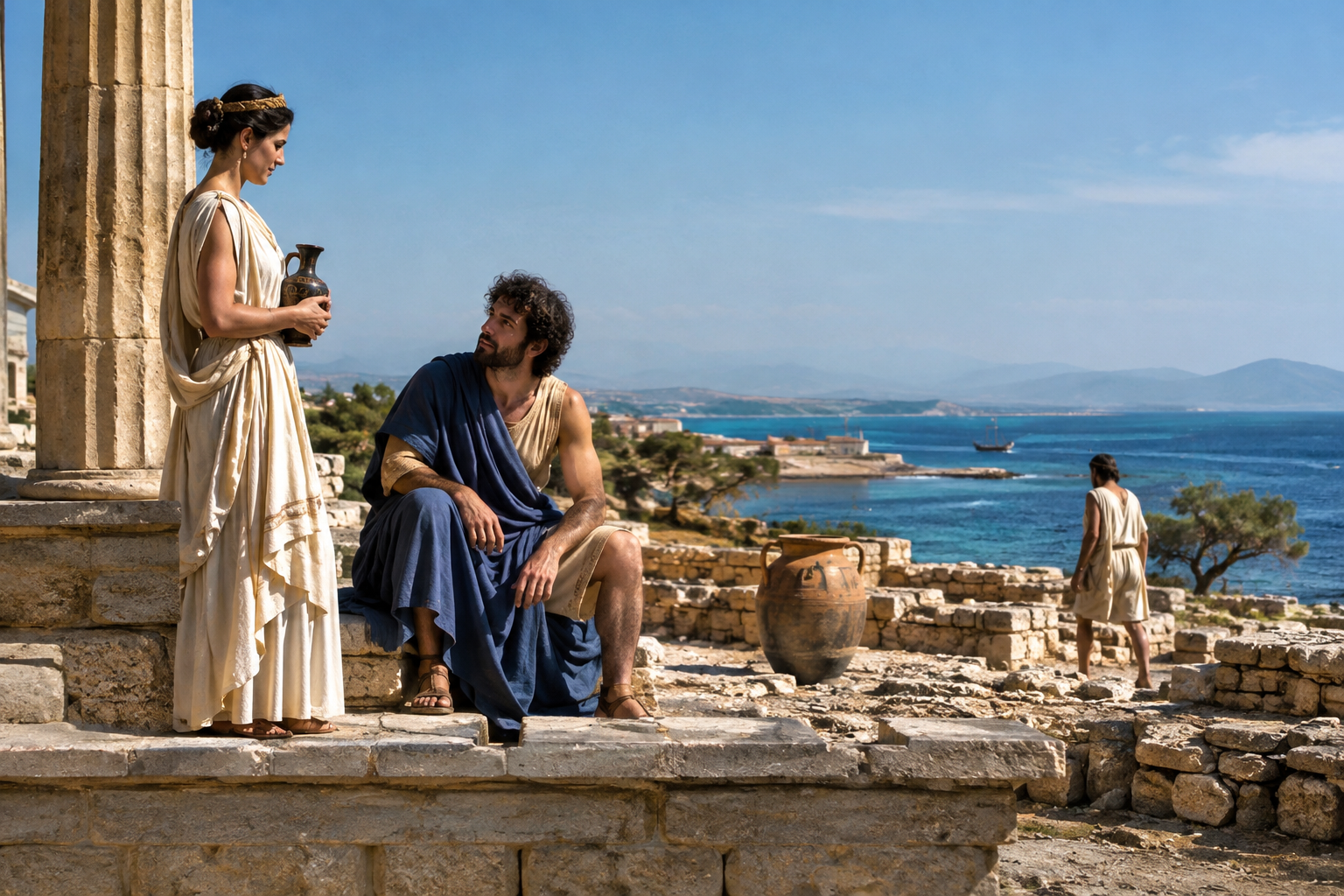
At Empuries on the Catalan coast, archaeologists recovered the remains of a man dated to around 290 BC and identified in ancient-DNA work as sample I8208. Empuries was no obscure village. It began as a Greek colonial foundation and later became one of the best-known contact zones in northeastern Iberia, a place where Mediterranean traders, settlers, and local communities met face to face. That makes I8208 especially interesting for anyone looking at the Y-DNA haplogroup J2a1a1a2b.
This is not because one skeleton can stand for a whole people. It cannot. But a direct paternal lineage found in a Greco-era burial at Empuries immediately places this branch in a world of harbours, mixed communities, and movement across the sea. Y-DNA traces one paternal line only, not a person's entire ancestry, yet in the archaeology of the ancient Mediterranean even that narrow thread can be revealing.
Empuries, ancient Emporion, was founded by Greeks from Massalia and developed into a trading settlement on the northeast Iberian shore. By the late first millennium BC it sat inside a densely connected Mediterranean network. Goods moved through it, certainly, but so did people: merchants, sailors, craftsmen, families, and soldiers, some local and some foreign-born. A male lineage such as J2a1a1a2b appearing here fits that broader archaeological picture of mobility without allowing us to flatten the site into a simple colony of migrants.
The date matters. Around 290 BC, Empuries belonged to the Hellenistic age, when Greek-speaking communities remained active across the western Mediterranean but did so within local landscapes already shaped by Iberian societies. The man labelled I8208 was living in that entangled world, not in a neat ethnic box. That is precisely why his paternal lineage is useful: it reminds us that coastal Iberia was plugged into long-distance networks well before the Roman Empire fully reordered the peninsula.
A landmark ancient-genome study on Mediterranean population history, published in Science, helped establish just how much movement and mixture characterized the classical world. Even where the archaeology has long shown trade and colonization, genetics has sharpened the picture by showing that population movement was often real and personal, not merely commercial.
J2a1a1a2b is a very specific branch within the wider Y-haplogroup J2, a paternal lineage that has often appeared in studies connected with the eastern and central Mediterranean, the Aegean, Anatolia, and parts of the Near East and southern Europe. That broader context is helpful, but one must be careful here. The ancient sample from Empuries does not give us licence to assign the entire deep history of J2 to this exact subclade, nor does it let us declare the man "Greek" by blood in any simple sense.
What we can say more safely is that a branch placed here under J2a1a1a2b appears in a western Mediterranean port with strong Greek associations in the centuries before Roman domination of Iberia. That is historically plausible and archaeologically interesting. Ports are where lineages travel, settle, and become local. Over generations, what began as an immigrant paternal line may cease to look foreign at all in cultural terms.
It is also worth remembering that a haplogroup is not a language, citizenship, or self-identity. A man carrying J2a1a1a2b at Empuries may have spoken Greek, Iberian, another local language, or more than one. The archaeology of emporia, trading towns by definition, is full of such layered identities.
Empuries makes best sense when seen as part of a larger western Mediterranean corridor. Greek settlers had established communities far beyond the Aegean, while Phoenician and later Punic networks linked Iberia with North Africa and the Levant. Then Roman expansion drew these already connected zones into a still bigger political world. A paternal lineage turning up in northeastern Iberia during the Greco-era therefore belongs to a much larger story of seaways rather than frontiers.
That does not mean every J2-related lineage in Iberia arrived with one single migration event. Ancient DNA has been steadily teaching the opposite lesson: similar broad lineages can enter a region through different episodes, from prehistoric farmers to Iron Age mobility to classical colonization and imperial-era relocation. With I8208, the striking thing is not some fantasy of a lone eastern voyager. It is that the sample comes from exactly the sort of place where repeated arrivals would be expected.
For MyTrueAncestry users, this is often the crucial shift in perspective. A haplogroup match to an ancient coastal individual does not necessarily point to one dramatic founding ancestor. More often it points to a setting: maritime exchange, settlement, and the patient accumulation of family lines in places where cultures overlapped.
It is easy to dismiss a one-sample signal as too slight to be meaningful. But archaeology often advances through precisely such fixed points. I8208 anchors J2a1a1a2b, or an associated reported branch at that resolution, in a documented Greco-era context in Iberia. That is valuable because it gives the lineage a historically legible setting rather than leaving it floating in a modern frequency map.
Empuries is especially good at this because the site already carries historical weight. It was one of the principal gateways through which Mediterranean habits, goods, and institutions entered northeastern Iberia. A paternal lineage found there is not just "somewhere in Spain." It is attached to one of the ancient peninsula's most internationally connected settlements.
And the date, around 290 BC, places the sample before the full Roman transformation of Hispania. So this is evidence for Mediterranean-connected paternal diversity in Iberia during the Hellenistic horizon, not merely as an imperial Roman after-effect. That distinction matters if one is trying to understand whether a paternal branch may have western Mediterranean roots of some antiquity.
One of the most persistent public misunderstandings about Greek colonial sites is that they were straightforward replicas of the Aegean planted abroad. The archaeology has been telling us for years that this is much too tidy. Colonial ports could contain newcomers from several Mediterranean regions alongside local populations, intermarrying and adapting over time. Genetics has not overturned that picture; it has made it more concrete.
That is why a lineage like J2a1a1a2b at Empuries should be read as evidence of connectivity rather than purity. It belongs to a world in which families crossed the sea, but also one in which those families became embedded in new local societies. The man represented by I8208 was not a symbol. He was a person living in a settlement where categories such as Greek, Iberian, and later Roman were constantly being negotiated in daily life.
Comparable questions arise elsewhere in the Greek world and its colonial orbit: how much continuity linked colony and metropolis, and how much did local mixing transform those communities? That wider issue sits behind many recent archaeogenetic studies of the Mediterranean.
If your paternal line falls under J2a1a1a2b, the Empuries evidence offers one solid historical insight: this branch, or a closely reported lineage placed at that level, appears in a real Mediterranean contact-zone in Iberia by the Hellenistic period. That does not prove descent from a Greek colonist, nor does it rule out later movements. But it does place your haplogroup in the sort of seaborne, urban, mixed world that shaped the ancient western Mediterranean long before modern nations existed.
In other words, the most interesting thing about J2a1a1a2b here is not grandeur but placement. It is a lineage found at a harbour of encounter, where ancestry, trade, and settlement met on the edge of Iberia.

Comments