Haplogroup J1a2b1b
– 4 min read


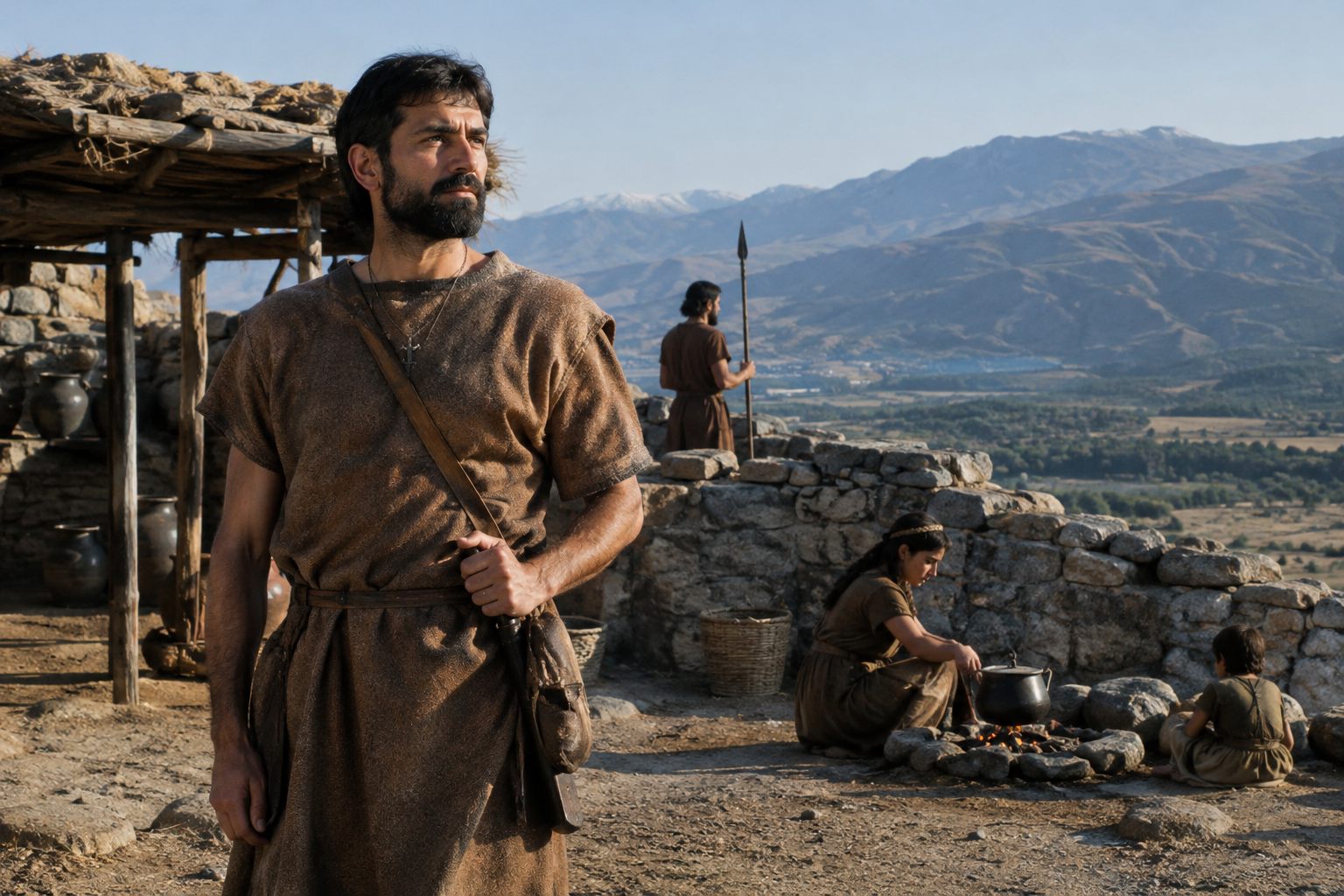
At Ginchi in the Caucasus, one Late Bronze Age man stands out not because we know his name, but because we know just enough to place him in a very old human landscape. Sample GTK001, dated here to around 2000 BC from Ginchi, Gatyn-Kale, carries the Y-DNA haplogroup J1a2b1b. That is a narrow paternal branch, and in practical terms it means one direct male line traced through fathers, grandfathers, and so on, rather than a person's whole ancestry.
This matters because the Caucasus was never some quiet genetic backwater. It was a mountainous hinge between the steppe, the Near East, and the Caspian world. A lineage like J1a2b1b appearing in a Bronze Age individual from this region places that paternal branch in one of Eurasia's most historically connected zones, long before written dynasties or medieval surnames. A broader ancient DNA study of the Caucasus and neighboring regions, published in Nature, helps frame just how deep and regionally layered those connections could be.
The most secure place to begin is with the evidence we actually have: one ancient individual, GTK001, from Ginchi Gatyn-Kale, assigned to J1a2b1b and dated to about 2000 BC. Even that concise record is revealing. It places this paternal line in the eastern Caucasus during the Bronze Age, when communities in the region were living amid expanding exchange networks linking highland valleys, lowland corridors, and wider worlds beyond the mountains.
Archaeology has long shown that the Caucasus was full of movement, but not movement of just one sort. There were local continuities, neighboring contacts, and occasional long-distance intrusions. Ancient DNA has sharpened that picture: people in the region often belonged to populations with mixed ancestries and complex histories, rather than neat and isolated tribes. So when we find J1a2b1b in GTK001, the important point is not to force a grand migration tale from one skeleton, but to recognize that this paternal branch was already present in a crossroads society of the Bronze Age Caucasus.
South Caucasus Genomic History
It is worth being precise here. J1a2b1b is not the same thing as the whole of haplogroup J1. The larger J1 family has a broad and complicated history across West Asia and nearby regions, but you cannot simply pour that entire map into one fine-grained branch and call it solved. A subclade article has to stay close to the evidence.
For GTK001, what we can say is modest but meaningful: a direct paternal line belonging to J1a2b1b, or reported at that level in this context, appears in the Caucasus in the Bronze Age. That does not make every later J1 lineage in the region descended from him, and it certainly does not turn one burial into an ethnic label. What it does offer is a fixed point. For members of this haplogroup today, GTK001 is a reminder that at least one branch of their paternal story was already established in the Caucasian world four thousand years ago.
The Caucasus has a habit of being described as a wall of mountains. It is that, of course, but it is also a set of routes: passes, valleys, and cultural thresholds. Bronze Age communities here dealt with both separation and contact. Highland life could preserve local traditions, yet metal, ideas, and people still moved.
That is exactly why a lineage such as J1a2b1b is historically interesting in this setting. The paternal line of GTK001 belonged to a region where human groups were not sealed off from one another. Instead, the Caucasus repeatedly absorbed influences from the south and east while also maintaining distinctive local populations. In genetic terms, it is often a place where continuity and admixture sit side by side rather than cancel each other out.
This is one reason Caucasus finds matter so much for family historians. They do not simply point to one destination on a map. They point to an old contact zone, where paternal lines could persist across generations even as languages, alliances, and material culture changed around them.
Readers sometimes expect ancient DNA to deliver instant dynasties: many graves, a reconstructed pedigree, perhaps a dramatic royal claim. Real evidence is usually less theatrical and more useful. A single well-placed ancient sample can establish that a paternal branch existed in a specific region and period, which is often the first solid anchor for understanding a haplogroup's older geography.
GTK001 does exactly that. He gives J1a2b1b a documented Bronze Age foothold in the Caucasus. That foothold matters because later history in the wider Near Eastern and Caucasian worlds involved repeated episodes of state formation, pastoral mobility, warfare, trade, and language shift. Without ancient anchor points, it is too easy to project modern distributions backward and assume they have always looked the same.
In other words, this is not a glamorous data point. It is a stubborn one. And stubborn data are often the best sort in archaeogenetics.
The broader significance of a Caucasus Bronze Age J1a2b1b sample becomes clearer when set against neighboring regions. West Asia and the lands around the Caucasus saw long-term population interaction across Iran, Mesopotamia, eastern Anatolia, and the steppe margins. Ancient DNA keeps showing that these were not separate historical stages neatly lined up on a classroom chart, but overlapping human worlds.
That does not let us claim a specific route for GTK001 or a tidy homeland for the subclade. It does, however, make the Caucasus a plausible and important theater in the deeper history of this lineage. If your paternal line belongs to J1a2b1b, a Bronze Age Caucasus connection is not a decorative detail. It places your direct male ancestry in one of the major interface zones of ancient Eurasia.
For now, J1a2b1b is best approached through caution and context rather than sweeping claims. The clearest ancient evidence here is GTK001 from Ginchi Gatyn-Kale, around 2000 BC, showing that this paternal branch was present in the Late Bronze Age Caucasus. That does not identify a tribe, a language, or a famous family. But it does place the lineage in a historically important region where mountain communities and long-distance connections met.
For someone researching this haplogroup today, that is the real value: not fantasy pedigrees, but a genuine ancient foothold. J1a2b1b reaches back into the Bronze Age Caucasus, where the direct paternal line of one man, preserved as GTK001, now helps illuminate the deeper background of living descendants.
Comments