Haplogroup J1a2b
– 5 min read


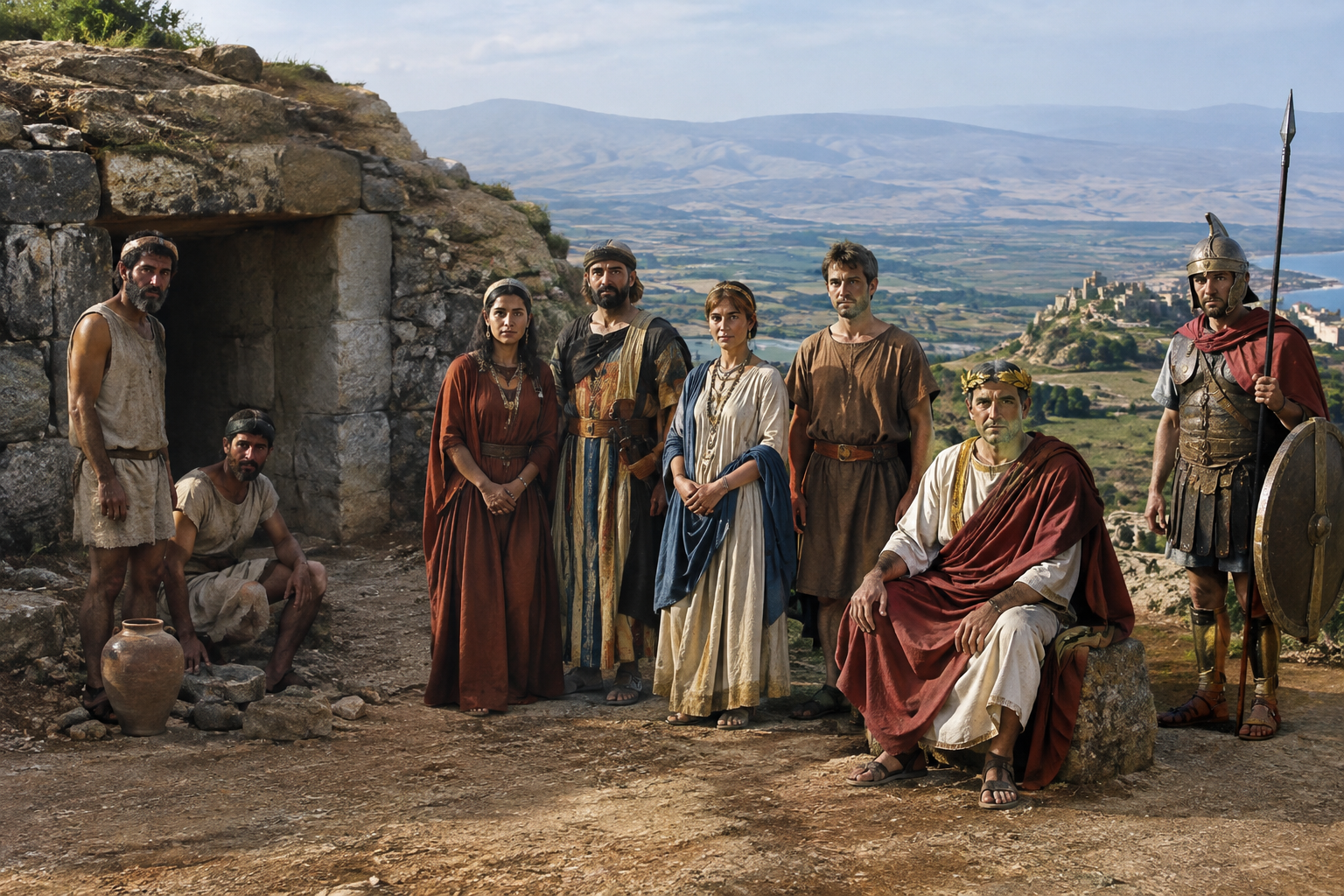
There is something particularly arresting about finding the same paternal line in a Bronze Age crypt in the Caucasus, in Canaanite burials at Megiddo, in Bronze Age Anatolia, and then again in a Roman-era individual on the western Mediterranean coast. Haplogroup J1a2b belongs to that sort of story: not a tale of one people marching neatly from A to B, but of male lineages appearing across some of the busiest corridors of the ancient Near East and Mediterranean world.
Like all Y-DNA haplogroups, J1a2b traces only one narrow line of ancestry: a direct paternal line from father to son across many generations. It does not describe a person's whole ancestry, culture, language, or identity. But as a historical tool, it is immensely useful. It can show where certain paternal branches were present, how widely they spread, and how archaeology and genetics together complicate the old habit of imagining ancient populations as tidy and isolated.
J1a2b sits within the wider Y-chromosome haplogroup J, a major lineage long associated with parts of the Near East and neighboring regions. For a branch as specific as J1a2b, caution matters. We should not simply lift the whole history of broad haplogroup J1 and paste it onto this narrower subclade. What the evidence here does suggest is that J1a2b was present in several interconnected zones of the Bronze Age world: the Caucasus, Anatolia, and the Levant, and later in the wider Mediterranean.
That distribution alone is historically revealing. These were not marginal places. They were crossroads of trade, diplomacy, war, and migration. Bronze Age Anatolia linked inner Asia Minor with the Aegean and Syria. The southern Caucasus connected steppe-facing highlands with the civilizations to the south. Megiddo stood in one of the best-known strategic positions in the Levant, controlling routes through northern Canaan. If a paternal lineage appears in all three, it belongs in the discussion of long-term human movement across the ancient Near East.
Ancient DNA has changed the way we tell this story. Older accounts often relied on later texts, modern distributions, or assumptions about language and identity. Genetics does not replace archaeology, but it does force us to see how much population history lay behind the written record.
The earliest supplied evidence comes from the Caucasus Burial Crypt samples GIN001 and GIN008, both dated to 1950 BC. Even in those brief labels, there is a great deal to ponder. Burial crypts in the Caucasus evoke communities rooted in mountain landscapes, but hardly cut off from the outside world. This region was one of the great interfaces between steppe, plateau, and Near Eastern lowlands. The appearance of J1a2b here places the lineage in a landscape where mobility and local continuity often sat side by side.
Then we move south to Megiddo, with a cluster of Late Bronze Age Canaanite individuals dated to 1725 BC: I8187, I10093, and I10264, along with the Late Bronze Age Outlier Canaanite Megiddo sample I10106. Megiddo is one of those sites whose name seems to carry centuries of historical freight. But before later empires and biblical associations, it was already an important urban center in Canaan. The presence of this paternal lineage in multiple men there hints that J1a2b was not some isolated arrival but part of the male-line landscape of the city and its region.
The word outlier attached to I10106 is especially interesting. In archaeogenetics, outliers often remind us that cities gathered people from elsewhere, whether through trade, marriage, movement of specialists, warfare, or elite connections. It does not automatically mean foreigner in a simple sense. It means that the genetics do not fit neatly into the local average, which is often the most historically illuminating thing of all.
Another key data point is I2495, labeled Anatolia Bronze Age Year:1625 BC. That puts J1a2b in yet another major center of ancient interaction. Anatolia was never merely a bridge between east and west; it was a world of its own, full of regional powers, local identities, and shifting political networks. A lineage found there and also in the Levant and Caucasus begins to look less like a local curiosity and more like part of a broader Near Eastern paternal horizon.
Read the South Caucasus DNA Story
The later sample I8205, from Roman-Era Emporion Year:200 BC, opens another chapter. Emporion, on the Iberian coast, was a place of contact par excellence: Greek, Iberian, and later Roman. A J1a2b-associated paternal line here does not prove a single, traceable chain from one Bronze Age man to one Roman-era man. That would be far too strong. But it does show that this branch, or a closely related one, had become part of the mobile human landscape of the Mediterranean.
And of course that makes historical sense. By the Roman period, the Mediterranean had for centuries been full of merchants, soldiers, settlers, enslaved people, administrators, sailors, and families moving across sea lanes that connected Anatolia, the Levant, North Africa, Italy, and Iberia. What looks surprising on a modern map was often quite ordinary in antiquity.
So J1a2b appears, in the evidence supplied here, not as the badge of one narrowly bounded ethnicity but as a paternal lineage present in some of the most connected regions of the ancient world. That is a more interesting conclusion anyway.
Discover Roman Hispania's DNA Legacy
The supplied noble-family field is empty here, and that absence is worth stating plainly. It means we should not invent aristocratic associations, castles, or dynastic claims for J1a2b. Too often, genetic storytelling is spoiled by the temptation to leap from an ancient haplogroup to a medieval house and then on to a famous surname, as if history were a straight line of titled fathers and sons. It almost never is.
Still, the broader historical lesson remains important. Noble families and their castles preserve regional memory in stone: who held land, who fought whom, who married into which dynasty, who left records. Ancient DNA preserves something rather different: a fragment of biological continuity or movement that may cut across social class, political change, and even language. The two kinds of evidence are complementary precisely because they are not the same.
A Y-DNA lineage like J1a2b may persist for millennia in a region without allowing us to identify a direct connection to any later noble family. Medieval genealogies begin late, are often selective, and usually concern elites. Ancient DNA samples, by contrast, may come from people whose names are lost but whose place in the population history of a region was no less real.
See How Y-DNA Tests Historical Paternity
What, then, does J1a2b reveal? First, it points toward deep roots in the interconnected worlds of the ancient Near East. Second, it appears across multiple important Bronze Age settings: the Caucasus, Canaan, and Anatolia. Third, its appearance in Roman-era Emporion shows how paternal lines associated with the eastern Mediterranean and Near East could also turn up far to the west in later antiquity.
Just as importantly, J1a2b reminds us how careful good historical genetics must be. Shared haplogroups do not prove close kinship. Ancient samples are not automatically direct ancestors of modern testers. And no haplogroup, on its own, can tell you your ethnicity, your culture, or your claim to a castle. What it can do is place your direct paternal line into a very old human map.
For some testers, that map may lead toward the Bronze Age cities of the Levant. For others, toward Anatolian uplands or Caucasus valleys. For others still, toward the cosmopolitan harbors of the Roman Mediterranean. That is the pleasure of this kind of evidence: it enlarges family history beyond surnames and parish registers, without pretending to answer every question.
If you want to explore how ancient DNA compares with your own results, MyTrueAncestry can help place your ancestry in conversation with real archaeological discoveries, from Bronze Age burials to later historical populations. Those matches can offer remarkable historical perspective, even when they do not prove direct descent from any specific ancient individual or noble line.
Comments