Haplogroup J1a2a2a
– 5 min read


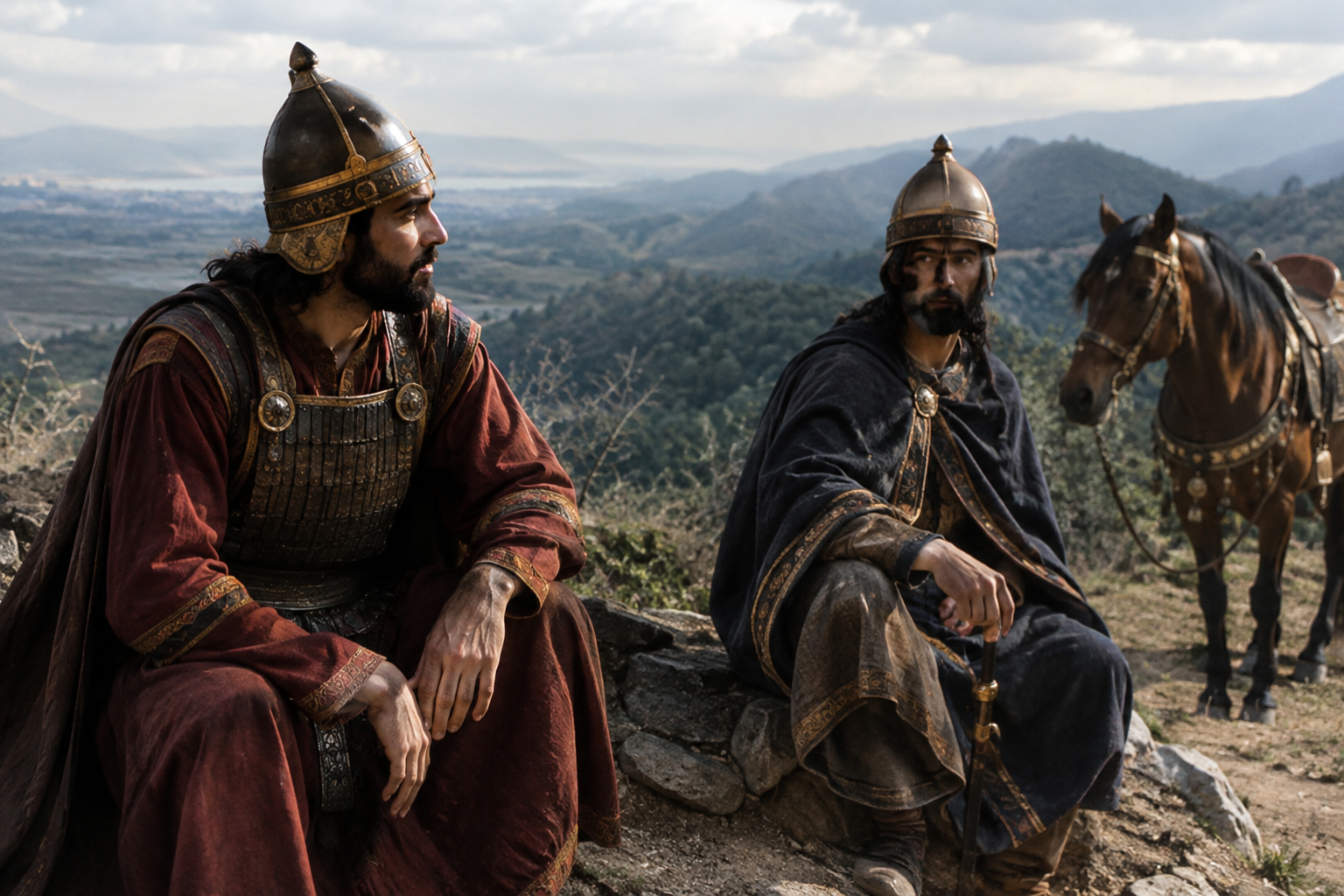
At Liarsang-Bon in Mazandaran, on the southern side of the Caspian Sea, two ancient male samples dated to around 150 BC stand out for anyone interested in haplogroup J1a2a2a: IRN23 and IRN23b. They belong to the world of the Parthian Empire, a period when northern Iran was not some remote fringe but part of a busy corridor linking the Iranian plateau, the Caucasus, Central Asia, and the wider Near East.
That matters because J1a2a2a is a very specific paternal branch, not a vague label for all of western Asia. Y-DNA traces one direct male line only, father to son across many generations, so a find like Liarsang-Bon does not describe the whole ancestry of these men. But it does give us something precious: a securely ancient appearance of this paternal line in a historically important region of Iran.
The Liarsang-Bon evidence is modest in number but unusually useful in context. Two related sample labels from the same site and approximate date, IRN23 and IRN23b, place this paternal branch in northern Iran during the Parthian era. Even without embellishing the graves with details not in evidence, that alone is historically interesting. Mazandaran was a zone of contact between upland and lowland Iran, between Caspian-facing communities and the inland political structures of larger empires.
The Parthian period is especially important for interpreting such a lineage. Parthian rule did not erase local populations; rather, it sat over a landscape of regional identities, old settlement patterns, and long-lived family lines. A paternal branch found here may reflect continuity in the region, mobility into it, or both. What it certainly shows is that J1a2a2a, or a directly associated paternal placement reported for these individuals, was present in northern Iran by the late Iron Age to early historic period.
A genetic study of ancient individuals from northern Iran has helped bring exactly this kind of evidence into focus, linking archaeological contexts with genome data rather than treating lineages as abstract labels alone. For the broader research setting around these Iranian burials, see this ancient DNA study.
There is a temptation with any J-lineage to leap straight into sweeping stories about deserts, tribes, or famous dynasties. That would be a mistake here. The useful fact is narrower and more archaeological: northern Iran often preserves long-term local population histories while also recording episodes of exchange and movement across neighboring regions.
Mazandaran sits beside the Caspian but is tied to the Iranian plateau by mountain routes and political history. In antiquity, that made it a place where paternal lines could persist over centuries even as languages, imperial loyalties, and material culture shifted. If your own paternal line falls under J1a2a2a, Liarsang-Bon does not prove that your recent ancestors came from Parthian Iran, but it does place this branch within an ancient Iranian setting that is historically plausible and archaeologically grounded.
This is one of the quiet strengths of ancient DNA. Grand empires tend to dominate textbooks, yet Y-DNA often brings us back to the smaller scale: actual men living in actual regions, carrying lineages through political change. The Parthians ruled widely, but IRN23 and IRN23b were not "the Parthian Y-haplogroup." They were individuals from one northern Iranian landscape, and that is exactly why they are valuable.
When two male samples from the same place and period turn up in association with the same branch, the immediate question is whether we are glimpsing a broader regional pattern rather than an isolated case. Caution is needed: two individuals are not a census, and nearby burials are not automatically close relatives. Still, IRN23 and IRN23b strengthen the case that this paternal line had a real foothold in the Liarsang-Bon community or in the local population from which that community drew.
That repeated appearance matters more than a single stray result would. Ancient DNA studies regularly remind us that one individual can represent migration, marriage, military service, or simple chance. A second occurrence at the same site makes the pattern harder to dismiss as accidental. Even so, it is best read as site-level evidence for presence, not as proof of a ruling lineage or exclusive local ancestry.
There is another point worth stressing. The article haplogroup here is J1a2a2a, a fine-grained paternal label. In ancient DNA, the exact depth of assignment can vary depending on preservation and coverage. Where the underlying study or reporting ties these men to this branch, that association is useful; but good history keeps the distinction clear between a broad J1 background and this narrower subclade.
One of the most misleading habits in popular ancestry writing is to imagine ancient empires as genetically uniform blocks. Parthian Iran was nothing of the sort. It contained older Iranian populations, connections to steppe-facing regions, exchanges with Mesopotamia, and routes eastward toward Central Asia. A paternal branch found in Mazandaran should therefore be read in a world of layered interactions, not a sealed ethnic box.
That is especially relevant for J-lineages, which today appear across large parts of the Near East and neighboring regions. The presence of J1a2a2a in northern Iran in the Parthian period does not mean the branch "belongs" only there. Rather, it gives us a documented ancient anchor point. Archaeology works best when it replaces vague homeland talk with dated, located evidence.
For readers following the wider genetic history of Iran and its neighbors, that broader regional framing is often more useful than any one sample. Northern Iran repeatedly appears in ancient DNA as a zone where continuity and connectivity meet. Liarsang-Bon fits that pattern neatly: a local burial context set inside a much larger historical world.
If you belong to J1a2a2a today, the Liarsang-Bon samples offer something more concrete than a map shaded in modern frequencies. They show that this paternal line, or a very closely associated placement, was already present in northern Iran around 150 BC, in the time of the Parthian Empire. That is a real historical foothold.
What it does not do is collapse your whole ancestry into one ancient identity. Y-DNA follows only one paternal thread out of thousands of ancestors alive at the same time. Still, for paternal-line research, these Iranian finds are significant because they place J1a2a2a in a region famous for continuity, exchange, and deep historical depth.
Iranian paternal ancestry study
The strongest insight from J1a2a2a so far is not a romantic dynasty or a sweeping migration slogan, but a pair of ancient men from Liarsang-Bon: IRN23 and IRN23b, living in northern Iran under Parthian rule. Their value lies in being specific. They show this paternal branch in a real place, at a real historical moment, in a region where local continuity and long-distance connections were both part of everyday history.






Comments