Haplogroup J1a2a
– 5 min read


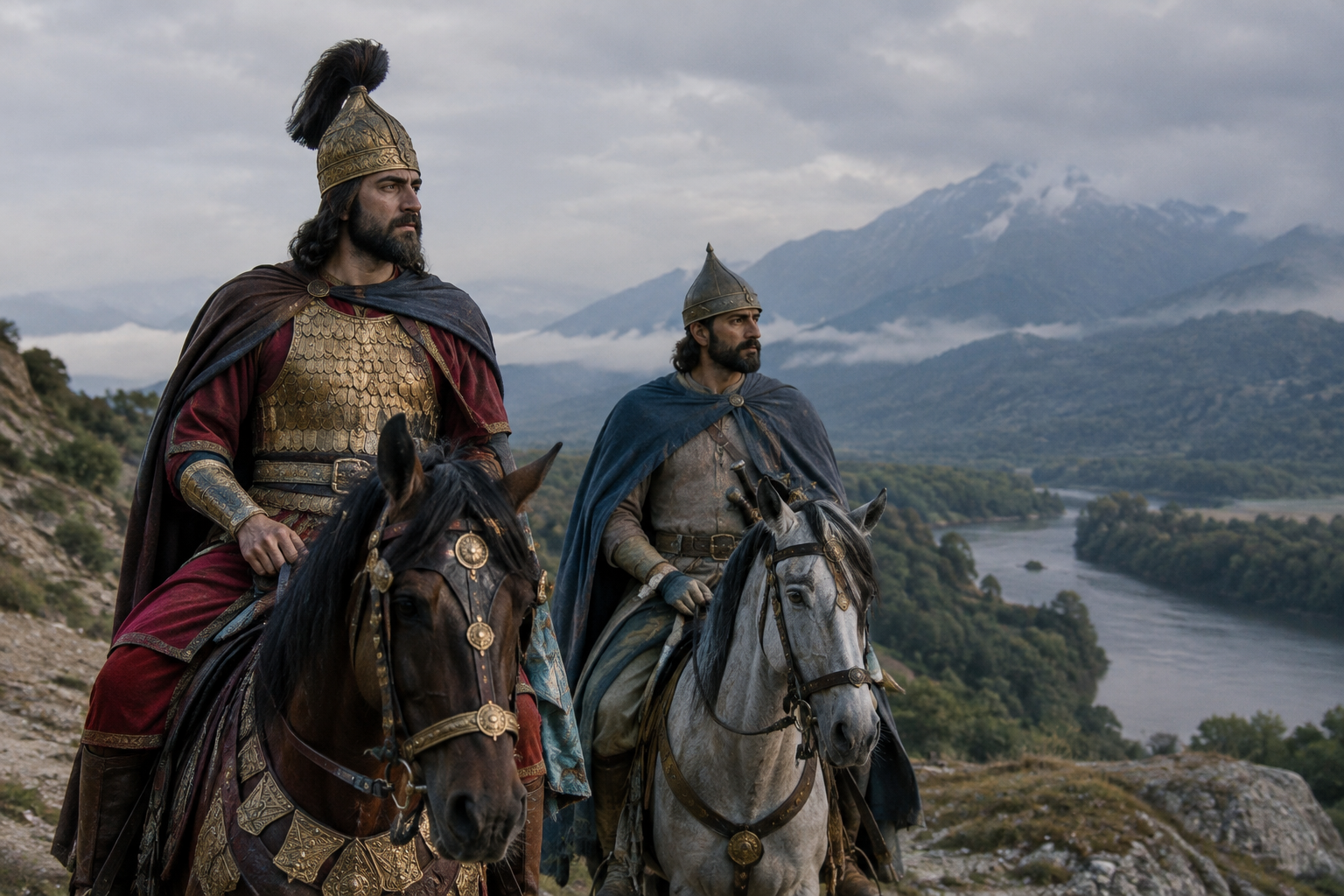
At Liarsang-Bon in Mazandaran, on the southern side of the Caspian, two men dated to around 150 BC stand out for anyone interested in haplogroup J1a2a. They are recorded as IRN25 and IRN25b, both from the Parthian period in northern Iran. That may sound like a small piece of evidence, and in one sense it is. But in ancient DNA, a pair of matching paternal lines from the same place and period can be unusually revealing: it hints at local continuity, family presence, or at least a recurring male lineage within one regional community.
For J1a2a, this matters because the haplogroup is not appearing here as an abstract modern label but in a concrete archaeological setting. These two Liarsang-Bon individuals place the branch in the world of Parthian Iran, in a region that sat between mountain corridors, lowland farming zones, and the trade routes running around the Caspian basin. Y-DNA tracks one direct paternal line only, not a person's total ancestry, but that single line can still anchor a family history very firmly in place.
Mazandaran has always been a historically awkward, interesting strip of country: boxed in by the Alborz mountains to the south and the Caspian Sea to the north, never quite peripheral and never entirely easy to absorb into imperial neatness. In the Parthian age, northern Iran was not a remote backwater. It was part of a politically connected landscape linking the Iranian plateau, the Caucasus, Central Asia, and the wider Near East.
The two ancient men from Liarsang-Bon, IRN25 and IRN25b, are therefore valuable not because they let us tell a melodramatic tale, but because they show J1a2a present in an actual community in this strategically important region. When the same haplogroup branch turns up twice at one site and in the same broad period, the sensible reading is not instant dynasty-building, but a real local foothold. That is already significant.
A wider ancient DNA study of northern Iranian populations helps frame why this matters. Research on long-term genetic history in the region has emphasized both continuity and change across many centuries, rather than a simple succession of total replacements. For readers wanting the broader archaeological-genetic background, see this study of the northern Iranian plateau.
It is worth being precise. The article haplogroup is J1a2a, which is a narrower branch within the broader J1 paternal family. Broad J1 has a deep history across parts of the Near East, but one should not lazily pour all of that large-scale story into every smaller descendant branch. What the Liarsang-Bon evidence gives us securely is a Parthian-period appearance of J1a2a in northern Iran, not a complete map of the branch's entire origin and spread.
That distinction matters because ancient DNA can tempt people into over-reading labels. A man with J1a2a in Parthian Mazandaran was not simply "a haplogroup walking about". He was a person living in a particular community, under a particular political order, speaking whatever language or languages were current around him, and sharing most of his ancestry with many other people who may not have carried the same Y-line at all. Haplogroups are powerful clues, but they are only one line in a much larger human record.
Single ancient Y-DNA finds are useful, but they can be hard to interpret. One individual might represent a newcomer, an outlier, or simply a lineage that happened to be sampled once. Two men from the same site and date range, both associated with J1a2a, change the feel of the evidence. They suggest that this was not a purely accidental presence.
That does not prove IRN25 and IRN25b were close relatives. They may have been; they may not. But the pairing does make it easier to picture J1a2a as part of the male population in this Parthian-era Caspian setting. In archaeological terms, repetition is often what turns an isolated curiosity into a plausible local pattern.
This is especially important in Iran, where the historical landscape is full of movement but also strong regional persistence. Mountain barriers, fertile valleys, coastal zones, and old political centers could all preserve local lineages even while empires rose and fell overhead. J1a2a at Liarsang-Bon fits that sort of world rather well: not an exotic intrusion for its own sake, but a paternal line embedded in a region with deep human continuity.
The Parthian Empire is often described through its kings, cavalry, and rivalry with Rome. Yet much of its real substance lay in local societies like those of northern Iran. Mazandaran was one of those places where imperial history met stubborn geography. The Caspian corridor connected people, but the Alborz range also encouraged strong regional identities and long-lasting local populations.
That makes Liarsang-Bon an excellent setting for thinking about paternal ancestry. A Y-line such as J1a2a could persist through generations in a local male network while the political map changed around it. Empires do not erase family lines overnight. Indeed, one of the most important lessons from archaeogenetics is how often local biological continuity sits beneath major cultural and political transformation.
Readers interested in how Iranian ancient DNA is used to reconstruct identity from fragmentary remains may also enjoy the following discussion:
Because the evidence here is tightly focused, the responsible approach is to stay close to what it can really support. J1a2a was present in northern Iran by the Parthian period, and present strongly enough at Liarsang-Bon to appear in two sampled men. That gives the branch an ancient foothold in a region central to Iranian history.
It also places J1a2a in a setting that was culturally mixed without being chaotic in some vague cinematic sense. Northern Iran in this era sat within networks of trade, military movement, and regional exchange. Lineages could spread, persist, and reappear over centuries through ordinary social life: inheritance, household continuity, marriage patterns, and local demographic survival. Ancient DNA is at its best when it lets us see that sort of grounded history.
For a modern tester with J1a2a, the appeal of this evidence is straightforward. It does not promise descent from one named ancient man, and it does not turn a haplogroup into an ethnicity. What it does offer is something more solid: proof that this paternal branch belonged to real men living in Parthian northern Iran, in one of the most historically important landscapes of the ancient Iranian world.
The most distinctive thing about J1a2a in the present evidence is not vast geographic drama but firm archaeological placement. At Liarsang-Bon, IRN25 and IRN25b show this paternal line in Parthian Mazandaran around 150 BC, giving it a tangible place in the history of northern Iran. If J1a2a is part of your own paternal ancestry, that is a meaningful clue: your direct male line belongs to a branch that was already established in the Caspian-Iranian world more than two millennia ago.

Comments