Haplogroup IJK
– 5 min read


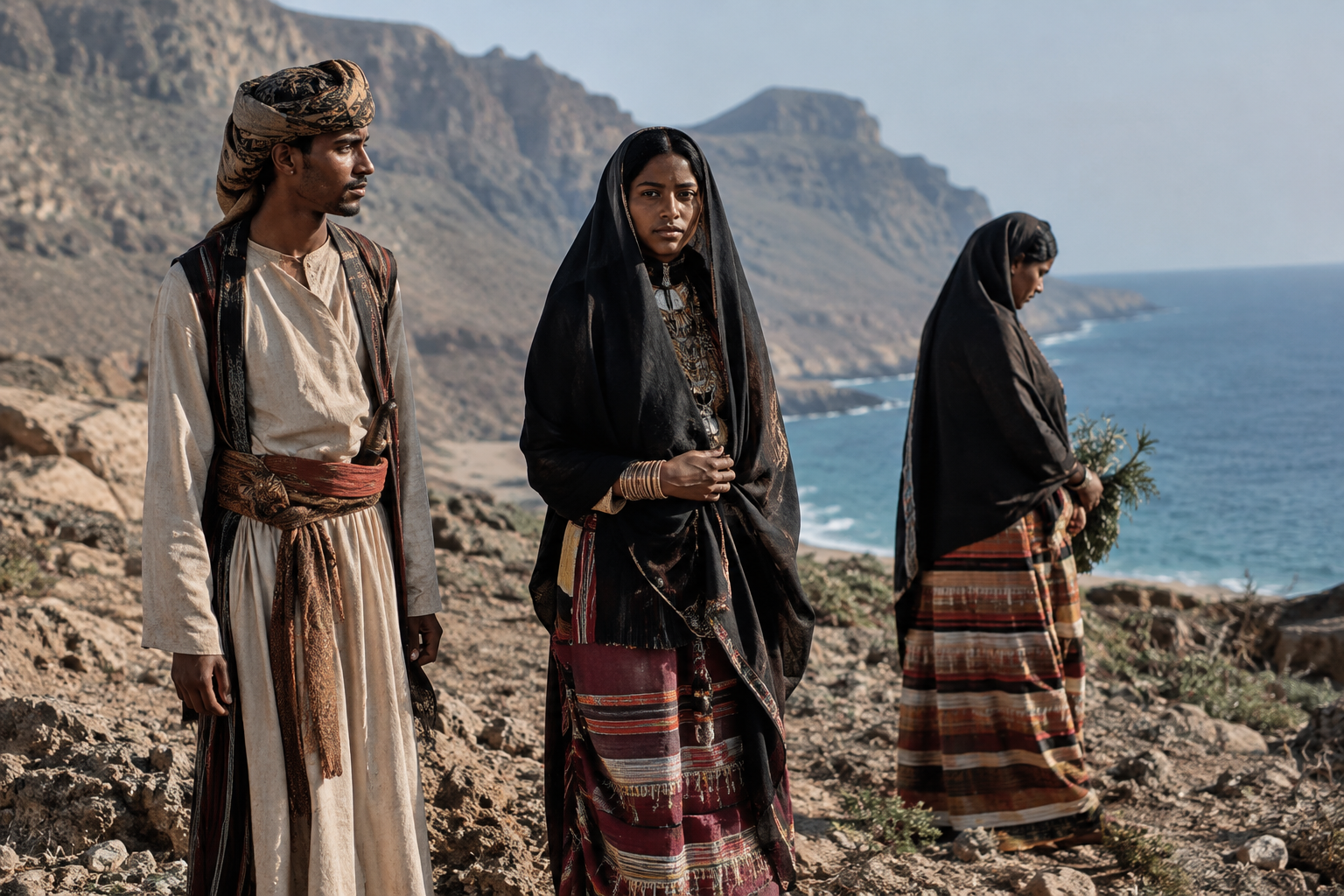
One of the more intriguing entries attached to haplogroup IJK is not a prehistoric cave burial or a famous royal tomb, but a man from Soqotra: I21110, dated to around AD 900 and described as coming from Momi, Zaflah, Yemen. That matters because Soqotra sits in a remarkable position, just off the Horn of Africa at the mouth of the Gulf of Aden, a place long tied into Red Sea and Indian Ocean traffic. A Y-chromosome assignment at the broad level of IJK in such a setting is a reminder that paternal lineages are sometimes most interesting not when they are narrow and tidy, but when they survive in records as very old, high-level branches that open larger historical questions.
IJK is one of those big, foundational Y-DNA lineages in the story of Eurasian paternal ancestry. It is best understood as a deep ancestral branch from which several major later lineages descend. In practical family-history terms, that means an ancient or medieval sample reported only as IJK is telling us something real about paternal placement, but not enough to collapse that person into one later regional narrative. Y-DNA tracks one direct male line only; it does not sum up a person's whole ancestry, language, culture, or identity.
Soqotra has always had a slightly outsized historical importance for an island that many readers could miss on a map. Classical writers knew of it, sailors crossed near it, and merchants moving between Arabia, East Africa, and South Asia worked within the same maritime world. By around AD 900, when sample I21110 lived, the island belonged to a lively zone of exchange shaped by trade, faith, and movement rather than isolation alone.
That makes the broad IJK classification worth pausing over. A deeply ancestral Y-chromosome label in medieval Soqotra may reflect the limits of present resolution, preservation, or reporting, but it also fits the island's role as a meeting ground. Ports and islands in this region often preserve people whose ancestry cannot be reduced to a single neat continental box. The archaeology of seaways rarely behaves so obediently.
An ancient DNA study of southern Arabia and adjacent regions, including medieval contexts relevant to this world, has helped underline just how mobile and mixed these coastal societies could be: research on the region's ancient population history. Without overstating the case for one man, I21110 belongs in that broader conversation about the Arabian Sea as a corridor of connection.
Arabian and Iranian genetic context
It is tempting to treat only fine-grained subclades as meaningful, but that would be a mistake. A broad assignment such as IJK tells us that the paternal line belongs within one of the great macro-branches that came to dominate much of Eurasia and, through later dispersals, many connected regions beyond it. In other words, this is not a local tribal badge. It is a very old signpost planted deep in human prehistory.
That is precisely why caution is needed. IJK itself is not a medieval ethnicity, not a South Arabian ethnic label, and not proof of a direct migration from any one famous homeland. It is better read as evidence that the paternal ancestry of this Soqotran individual sits within a lineage whose later descendant branches became widespread across western, central, and southern Eurasia. The historical interest lies in the combination of deep paternal antiquity and a medieval island setting shaped by commerce.
The southern Arabian world has often been described through empires, religions, and trade routes, but ancient DNA is steadily showing how untidy the human reality was on the ground. Communities around the Red Sea and Arabian Sea were not static blocks waiting for historians to label them. They were made up of individuals and families whose ancestors may have arrived by land, by sea, or through generations of local mixing.
Soqotra is especially good at exposing that complexity. Its language, ecology, and maritime position all mark it out as distinctive, yet distinctive does not mean sealed off. A man like I21110, living around AD 900 and carrying a paternal lineage reported at the level of IJK, fits a landscape where ancestry could be locally rooted and broadly connected at the same time.
Medieval island genetic diversity
There is another reason this haplogroup deserves a different sort of article. IJK is not mainly a lineage of one kingdom, one migration, or one archaeological culture. It belongs to the much deeper structure of Y-chromosome history, long before medieval Yemen, before classical Arabia, and indeed before most of the named peoples who populate written history. Many famous later paternal branches ultimately sit beneath this older node.
For that reason, an IJK result often points researchers away from easy storytelling and toward phylogeny: the branching structure of the human paternal tree. When an ancient sample remains at this high level of classification, it can indicate that we are seeing only part of the picture. Sometimes further sequencing eventually places such men on a narrower branch; sometimes the evidence remains broad. Either way, the responsible historical move is not to invent a more specific identity than the data can bear.
That approach mirrors a larger lesson in archaeogenetics. Ancient DNA is most illuminating when paired with place, date, and archaeological context. Here, the context is not a grand burial but a strategic island within medieval exchange networks. The lineage is deep; the setting is historical; the combination is what gives the sample its character.
North Africa and Arabian population history
Ancient DNA from islands often forces historians to think less in straight lines and more in webs. Soqotra was linked to Yemen, certainly, but also to shipping that touched East Africa, the western Indian Ocean, and lands farther east. A medieval individual from this environment does not need an ornate tomb to be important. His significance lies in demonstrating that even a high-level Y-DNA assignment can illuminate the human geography of a maritime crossroads.
There is also a useful methodological point here. Because I21110 is reported simply as IJK, the sample resists the familiar urge to map one haplogroup neatly onto one modern population. Instead it asks a better question: how do very old paternal lineages appear within historically mobile communities? That is exactly the sort of question islands like Soqotra are good at answering.
How archaeogenetics changed history
The clearest takeaway from haplogroup IJK, in this case, is not a claim about dynasty or tribe but about depth. Sample I21110 from medieval Soqotra shows a direct paternal line placed within one of the great ancestral trunks of Eurasian Y-DNA, found in a region where merchants, migrants, and local communities met across the sea. For anyone exploring this haplogroup today, that is the real historical value: not a ready-made identity, but a link between very deep paternal ancestry and the lived complexity of a medieval Indian Ocean world.
Comments