Haplogroup IJ

– 5 min read


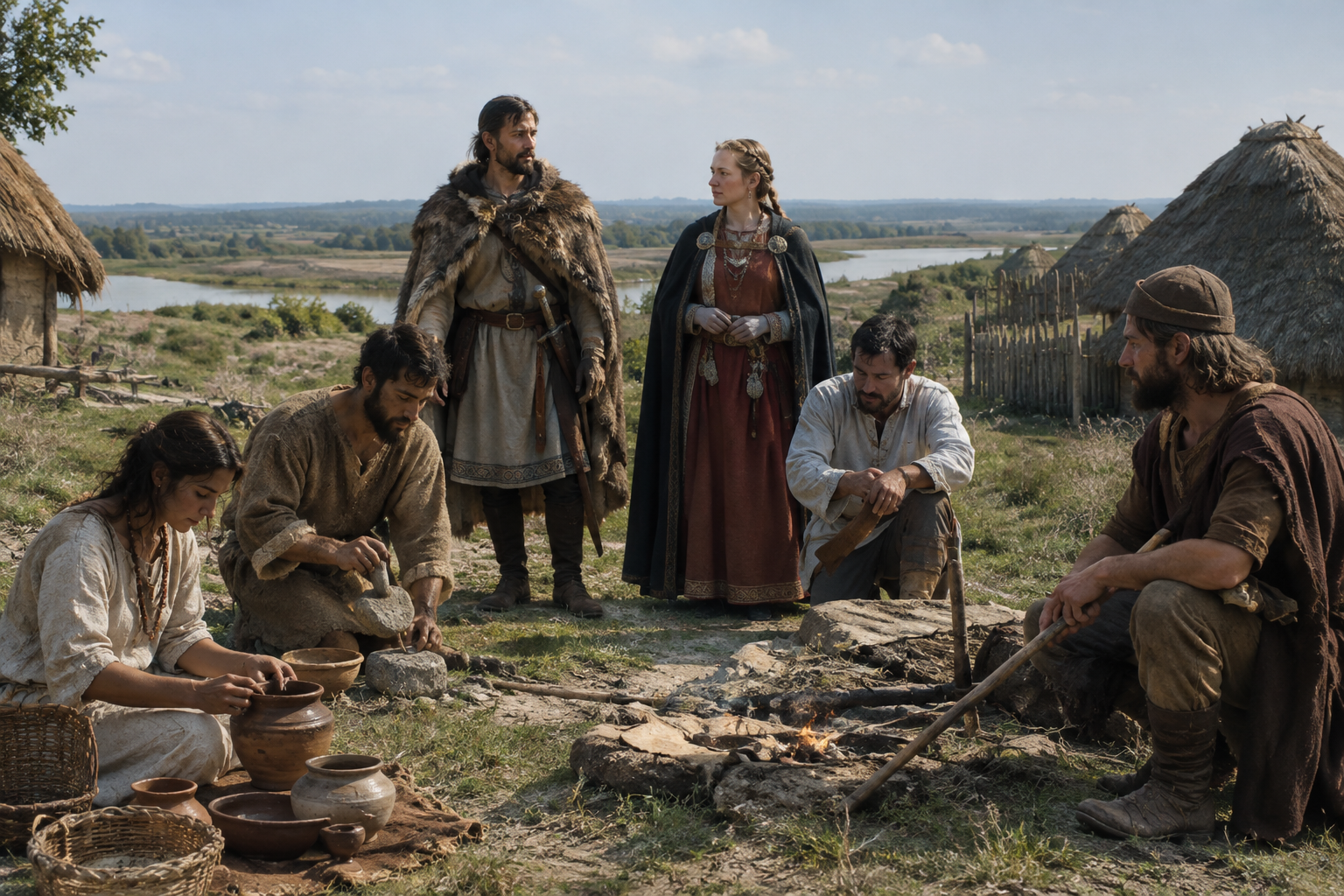
At Scarbantia-Hegyko in western Hungary, two men buried in the Longobard period around AD 525, identified as HMU018 and HMU020, carry an unusually broad label in Y-DNA terms: IJ. That may sound almost too large to be useful, but in fact it is exactly what makes them interesting. In a frontier world formed after the collapse of Roman power, even a high-level paternal assignment can show how old male lineages persisted inside communities that were anything but simple.
Haplogroup IJ is not a recent ethnic badge. It is a deep ancestral branch in the Y-chromosome tree, ancestral to better-known later lineages such as I and J. Y-DNA traces one direct paternal line only, so it never sums up a whole person's ancestry, language, or identity. Still, when IJ appears in ancient burials scattered across Neolithic river settlements, Bronze Age communities, and early medieval cemeteries, it offers a useful reminder: some paternal lines sit so far back in the tree that their real historical value lies in where and when they turn up archaeologically.
The Hungarian Longobard-period samples are the clearest place to start because they belong to a recognisable historical setting. Scarbantia, on the western edge of the Carpathian Basin, stood in a landscape that had once been Roman Pannonia and later became one of the zones where incoming and local groups met, mixed, and buried their dead under new political conditions. HMU018 and HMU020, both dated to about AD 525, come from that moment of post-imperial reorganisation.
A third Hungarian sample, GHD013 from Arrabona-Gyirmot Barbaricum, dated around AD 550, points in the same general direction. These are not enough men to define a population, still less a "Longobard haplogroup." But taken together they show that an IJ-level paternal lineage was present in communities associated with the Longobard horizon in Pannonia. That matters because the migration-period world was not built from neat tribal blocks. Archaeology and ancient DNA increasingly show mixed local histories, overlapping identities, and communities formed through movement, alliance, and inheritance rather than through one simple biological origin.
Research on post-Roman populations in the region has helped underline that complexity, including ancient DNA work on the Little Hungarian Plain that places such cemeteries in a wider setting of mobility and social change.
Most readers encounter Y-DNA through finer-grained lineages: branches that can be linked, cautiously, to later regional patterns. IJ is different because it sits much higher up the tree. If a sample is reported only as IJ, that usually means the usable evidence supports placement on this broad ancestral branch, but not a narrower downstream lineage with confidence. That is not a failure. It is simply the limit of what can responsibly be said.
And that limit is historically revealing. A broad assignment often appears in difficult ancient material, older excavations, or cases where preservation or sequencing depth did not permit a more refined call. The result is a kind of genetic silhouette rather than a portrait. Yet silhouettes matter in archaeology. They can still map presence across time, especially when several examples appear in very different periods of southeastern and central Europe.
The deepest time depth in this small IJ set comes from the Neolithic. Sample I6354 from Malak Preslavets in Bulgaria, dated to around 5600 BC, belongs to the age when farming communities were well established along the Lower Danube. Malak Preslavets has become important in ancient DNA because it sits in a contact zone: riverine, fertile, and connected to wider movements of early farmers as well as to older forager populations of the Balkans.
That context is precisely why an IJ-level paternal assignment is worth noticing. It places this broad lineage in one of the earliest documented farming landscapes of southeastern Europe. Not as a mythic founder, and not as proof of any single migration route, but as one paternal thread inside the mosaic of the Neolithic Balkans.
A second early case, I18827 from Gornja Vrba in Croatia, dated to around 4500 BC, shows IJ still present farther west in a later Neolithic setting. By this stage the first spread of farming was long over. Communities were more regionally distinct, and the paternal landscape was already diverse. The value of Gornja Vrba is that it extends the archaeological range of IJ beyond a single river corridor and into the broader Adriatic-Balkan world.
For the Neolithic and later prehistory of the region, broader syntheses of southeastern European genomes have been especially important, including research on population history in the North Pontic and nearby zones, which helps frame how long-connected these landscapes were.
Then there is I25523, from Kutvolgyi-dulo, Zamardi, Hungary, dated to around 1000 BC. This is a very different world from the Neolithic villages of the Balkans or the early medieval cemeteries of Pannonia. By the Late Bronze Age, the Carpathian Basin was tied into large exchange networks, changing metalwork traditions, and shifting local identities that archaeologists track through settlement patterns and funerary customs rather than through any one stable people-name.
What I25523 adds is continuity of presence at the scale of the broad paternal tree. Not continuity of a family, not continuity of a tribe, but continuity of the branch itself appearing again in the same broad macro-region across millennia. That is the sort of pattern ancient DNA is very good at revealing when handled carefully. The landscape changes, the archaeological cultures change, and yet some very old paternal branches remain detectable.
Late Bronze Age Central Europe
If we line the samples up in order - I6354 in Neolithic Bulgaria, I18827 in Neolithic Croatia, I25523 in Bronze Age Hungary, then HMU018, HMU020, and GHD013 in Longobard-period Hungary - the striking feature is not a clean dynastic chain. It is endurance through very different archaeological worlds. The Danube basin, the western Balkans, and the Carpathian Basin repeatedly show that paternal history in Europe was layered, with very ancient branches surviving inside populations that later acquired new cultural labels.
That is especially relevant in the early medieval centuries. Historical names such as Longobard describe political and cultural formations, not genetically uniform breeding populations. The three Hungarian migration-period cases fit well with that broader picture: communities of mixed origin in which older European paternal lines could appear alongside other lineages.
Mixed Origins in Late Antique Bulgaria
For someone exploring haplogroup IJ today, the lesson from these ancient finds is modest but meaningful. This is a very deep paternal branch, and when ancient men are reported only at that level, the important evidence often lies in the archaeology around them rather than in a neat modern label. In the present case, IJ appears in early farming communities of the Balkans, in a Bronze Age Hungarian context, and in Longobard-period Pannonia - a pattern that speaks less of one marching people than of long survival within Europe's changing human landscape.
That is a very MyTrueAncestry sort of insight: your paternal line may connect not to a single dramatic episode, but to a lineage old enough to have passed through many different worlds before history gave those worlds their names.






Comments