Haplogroup I2c

– 4 min read


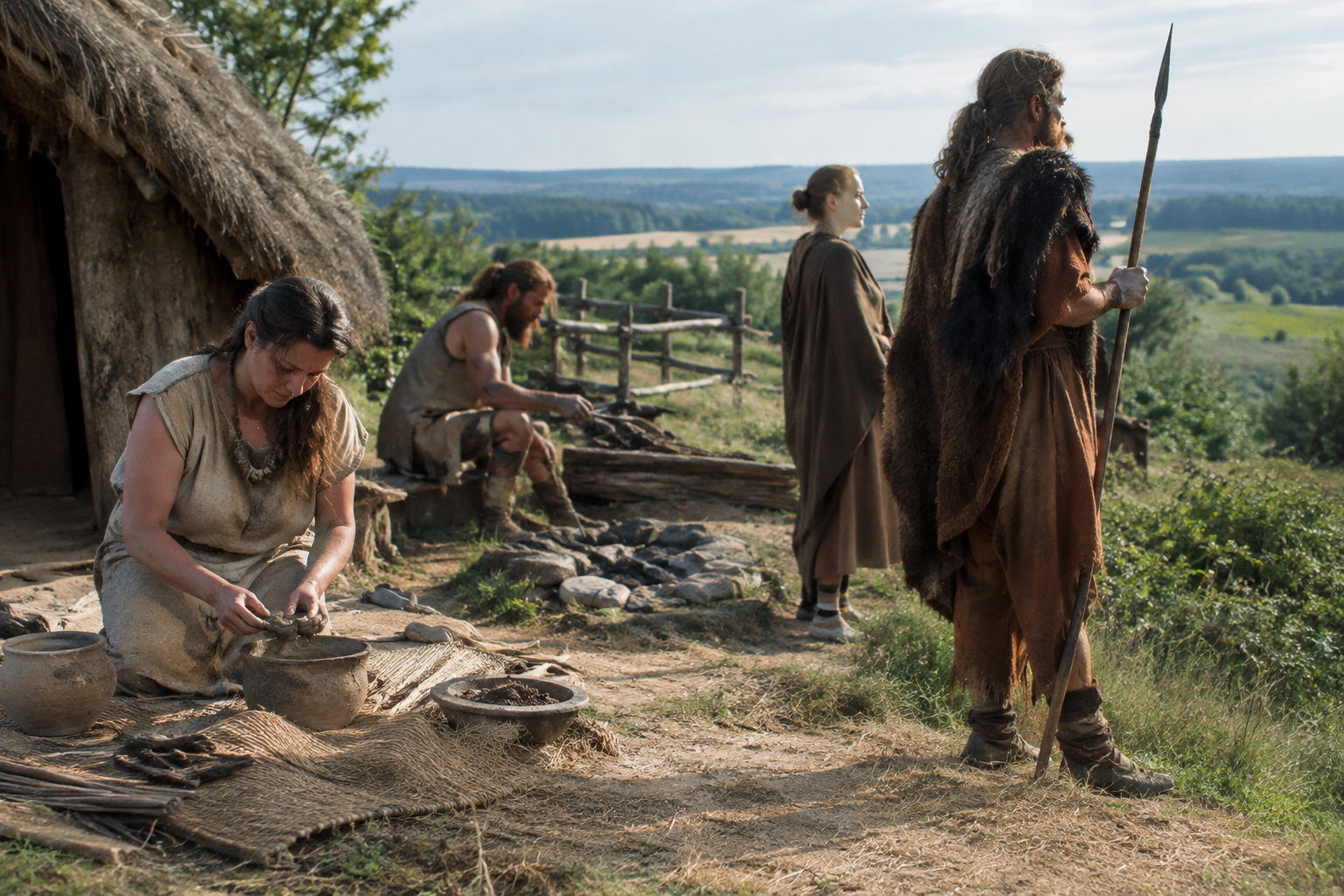
At Altendorf in Baden-Wuerttemberg, one man dated to around 3050 BC carries a small but telling piece of Europe's paternal history. He is known in the record as AD186, and he is associated here with Y-DNA haplogroup I2c. That matters because I2c is not one of the lineages that usually dominates popular discussion of later European prehistory. Instead, it appears here in a very early farming landscape, in the long Neolithic after agriculture had already transformed central Europe.
A second appearance, nearly a thousand years later, comes from Drasenhofen in Austria, where DSH020, dated to around 2000 BC, is likewise associated with I2c. Two samples do not give us a dynasty, a tribe, or a grand migration map all by themselves. But they do give us something more solid and often more interesting: a glimpse of paternal continuity and survival across major cultural change in central Europe, from late Neolithic communities into the Bronze Age.
Y-DNA tracks one line only: father to son, along a single paternal chain. That makes it powerful, but also narrow. A man assigned to I2c was not "nothing but I2c"; he also had thousands of other ancestors, and his language, culture, and social identity cannot be read straight off a haplogroup label.
Even so, paternal lineages are historically useful because they show how some male lines persisted, disappeared, or spread within changing societies. In the case of I2c, the evidence supplied here points to a branch present in prehistoric central Europe, with one occurrence in Neolithic southwestern Germany and another in Bronze Age northeastern Austria. That is not enough to claim a single unbroken family line between them, but it is enough to show that this branch belonged to real communities living through two very different archaeological worlds.
The earlier of the two samples, AD186 from Altendorf, belongs to a period when central Europe had long ceased to be a frontier of first contact between farmers and foragers. By about 3050 BC, farming villages, cultivated fields, domestic animals, and established settlement networks were already part of the landscape. The fascination of a lineage like I2c in this setting is that it reminds us that Neolithic Europe was never genetically simple.
By the late Neolithic, communities in regions like Baden-Wuerttemberg were the product of generations of interaction. Earlier hunter-gatherer paternal lines had not simply vanished everywhere, and incoming farming ancestry had not produced one uniform social bloc. The men buried in these communities could carry lineages with deeper roots in Europe alongside lineages associated with later demographic expansions. An ancient DNA study examining broad regional population change in Europe, available at this research preprint, helps frame exactly that larger picture of mixture and local persistence.
So AD186 is valuable not because he can be turned into a mythic founder, but because he sits in the lived reality of late Neolithic Europe: a settled agricultural society in which older paternal diversity still had a place.
By the time we reach DSH020 from Drasenhofen, the setting has changed dramatically. This is Bronze Age Austria, not Neolithic Germany. Metals, new burial customs, shifting exchange networks, and the long aftermath of steppe-related expansions had reshaped much of central Europe. Yet an I2c-associated paternal line is still there.
That point is easy to miss because Bronze Age narratives are often told in very sweeping terms, with attention fixed on major ancestry shifts and the rise of more standardized archaeological cultures. But real populations are never replaced like a coat of paint. They are reworked unevenly, locally, and over time. A lineage like I2c appearing in Drasenhofen suggests that beneath the large-scale demographic changes, some paternal branches endured and were absorbed into Bronze Age societies rather than erased by them.
Drasenhofen is especially intriguing because research on the cemetery has drawn attention to its early Bronze Age context and to the presence of plague among some of the dead. A study connected with these burials can be found here. Without overstating what that proves for any one man, it places DSH020 in a world where disease, mobility, and social change were all part of the human story.
In other words, the I2c line in Drasenhofen was not surviving in a quiet backwater untouched by history. It was present in a period of profound transformation.
One sample can be a curiosity. Two samples, separated by place and by roughly a millennium, begin to show pattern. The pattern here is modest but important: I2c appears in central Europe before and after the transition into the Bronze Age.
That does not mean I2c was common everywhere, nor that every later carrier of the branch descends from these particular men. What it does suggest is that I2c belonged to the mosaic of paternal lines that made up prehistoric central European populations. Some of those lines were associated with deep European ancestry; some expanded with farming; some spread with later movements from the steppe. The archaeology and genetics of the third and second millennia BC show that these strands mixed repeatedly rather than replacing each other in one clean stroke.
Seen in that light, AD186 and DSH020 are not isolated curiosities at all. They are exactly the sort of finds that stop prehistory from becoming too tidy. They remind us that lineages can persist quietly across major cultural thresholds.
It is tempting to label prehistoric regions too neatly: Neolithic farmers here, Bronze Age newcomers there, and so on. But the evidence from ancient DNA has been steadily undermining those old simplifications. Central Europe, especially, was a zone of long-term layering. People moved in, mixed, married locally, adopted new practices, and buried their dead under changing customs while still carrying older family lines.
I2c fits that messier, more convincing history rather well. Its appearance in Baden-Wuerttemberg and Austria hints at a paternal branch that was not extinguished by the social and genetic upheavals between 3050 BC and 2000 BC. That is precisely the kind of continuity that matters for family history: not a fantasy of purity, but survival through change.
If your paternal line falls under I2c, these ancient cases offer a careful kind of connection. They place this branch in prehistoric central Europe in both a late Neolithic and a Bronze Age setting. That does not identify your surname's origin, your nearest ancient ancestor, or any royal pedigree. It does something better grounded than that: it shows that your direct paternal line belongs to a lineage already present among real communities navigating the enormous social changes of prehistoric Europe.
AD186 at Altendorf and DSH020 at Drasenhofen make I2c visible at two different moments in that long story. Not dominant, not mythical, but durable.
Comments