Haplogroup I2a1b2
– 5 min read


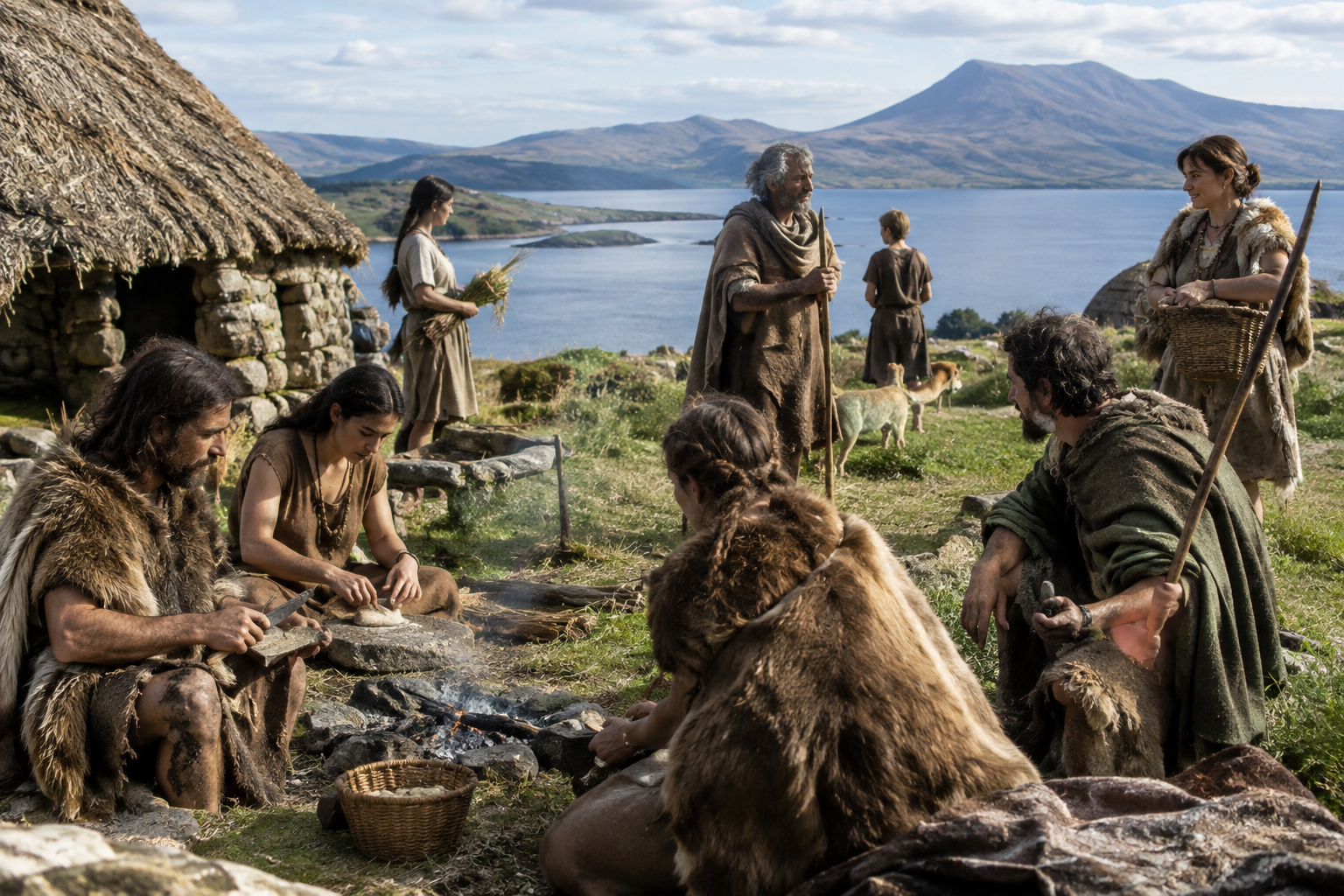
Some Y-chromosome lineages turn up in exactly the places that make archaeologists sit up a little straighter. I2a1b2 is one of them. It belongs to the wider haplogroup I, one of the old European paternal branches, and its story appears again and again in ancient DNA from the western and central Mediterranean, Atlantic Europe, and the islands and peninsulas that so often preserve deep local histories.
That does not mean a simple, single tale of one "people." Y-DNA traces only one direct paternal line: father to son to son across the generations. It is powerful for reconstructing lineages, but it is only one thread in a much larger ancestry. Even so, when a branch like I2a1b2 shows up in Mesolithic France, early Italy, Neolithic Scotland, Chalcolithic Romania, Bronze Age England, and Copper Age Sardinia, it begins to look less like a footnote and more like a durable feature of Europe's prehistoric male landscape.
Within the Y-chromosome tree, I2a1b2 sits inside the broader I2 family, a lineage often associated in ancient DNA research with long-standing European paternal ancestry. The wider I2 story reaches deep into prehistoric Europe, especially among hunter-gatherers, but caution is important here: the full history of broad I2 should not automatically be pasted onto this narrower branch. What the evidence does suggest is that I2a1b2 and closely related lines were present across multiple regions during the long transition from foraging to farming.
That transition matters. Europe's Neolithic was not a simple replacement of foragers by incoming farmers. Ancient DNA has shown a much messier process of encounter, mixing, persistence, and regional variation. Some paternal lines expanded with farming communities; others survived locally and were folded into new societies. I2a1b2 appears to belong to this complicated world, where old European male lines could endure inside entirely new cultural settings.
Explore the Neolithic Expansion
One of the most striking early finds is R11, from Grotta Continenza Neolithic Italy, dated 9900 BC. Even without over-interpreting a single individual, this sample places the lineage's story in the Italian peninsula at an exceptionally early point. Grotta Continenza belongs to that fascinating world in which caves were not simply shelters, but places of memory, burial, and continuity. A paternal lineage present there hints at very deep local roots in southern Europe.
Then there is PER3123 from Les Perrats Mesolithic France, dated 7110 BC. Mesolithic France was still a world of hunters, fishers, and small-scale communities long before the great walled castles and titled families of later centuries. Yet these are precisely the kinds of ancient men whose Y-chromosome lineages could, in broad genetic terms, persist into much later populations. Not as named ancestors in a family tree we can reconstruct, but as part of the durable paternal background of Europe.
The southeastern edge of the picture is represented by I7126 from Chalcolithic Romania Bodrogkeresztur Urziceni, dated 5180 BC. This is important because it shows the lineage in the Carpathian and lower Danube world during the Copper Age, a region central to debates about prehistoric mobility, exchange, and shifting social structures. Here, I2a1b2 appears not on Europe's Atlantic fringe but in a continental corridor linking the Balkans, the steppe margins, and central Europe.
On the far northwestern edge, three samples from Neolithic Scotland Strathglebe Isle of Skye Year:3500 BC - KD026_1, KD026_2, and KD026 - bring the lineage into the Hebridean world. Skye is exactly the sort of place where archaeology and genetics make a marvelous pair: island landscapes, chambered tombs, kinship networks, and communities that were both locally rooted and connected across sea routes. These men are not "proto-clansmen" in any simplistic sense, but they show that paternal lines within this branch had reached, or persisted in, the Atlantic fringe by the later Neolithic.
Read about Neolithic Scotland kinship
Later prehistory adds yet more range. I19859 from Bronze Age Rowbarrow Wiltshire England, dated 1453 BC, places the lineage in southern Britain during the age of barrows, metalwork, and increasingly stratified communities. SUC009 from Late Copper Age Monte Claro Sardinia, dated 1700 BC, shows it in Sardinia, another island where local continuity and external contact constantly overlap. Sardinia is especially interesting because island settings often preserve lineages that become blurred or diluted elsewhere, while still participating in wider Mediterranean exchange.
Taken together, these finds do not give us a straight arrow from one homeland to one destination. What they reveal instead is a paternal branch repeatedly found in real communities across a broad arc of Europe over thousands of years.
Discover ancient DNA from Italian islands
What, then, happened between these prehistoric burials and the later historical world? In one sense, almost everything changed: languages shifted, farming intensified, kingdoms rose, empires came and went, Christianity transformed ritual life, and castles appeared where once there had been tombs, caves, and barrows. In another sense, the underlying population history of many regions remained partly local. Ancient DNA often shows that while cultures and elites changed, not every paternal layer was wiped away.
I2a1b2 fits neatly into that lesson. It appears in places that later became deeply historical regions: Atlantic Scotland, southern Britain, Mediterranean Italy and Sardinia, and the Danubian zone. That does not allow us to label it "Celtic," "Roman," "Scottish," or any other single identity. Haplogroups are older than most of those categories, and they moved through many different cultural worlds. But it does mean that this paternal line participated in the making of those later populations.
For readers interested in the bigger British picture, the Rowbarrow and Skye samples sit against a backdrop of repeated migration and continuity in the islands of Britain. Ancient paternal lines survived there through enormous cultural change.
The supplied noble-family field is empty here, and that absence is worth saying plainly rather than dressing up. We do not have a documented set of associated dynasties, clans, or castles to attach specifically to I2a1b2 in this article. That may feel like a disappointment, but in fact it is a useful reminder of how genetics and history work on different scales.
Ancient DNA can reveal that a paternal branch was present in Neolithic Skye or Bronze Age Wiltshire. Medieval genealogy can tell us who held a castle, founded a priory, or fought for a crown. But between those two kinds of evidence there is usually a great gap. Without explicit documentary or genetic support, it would be irresponsible to claim that any later noble family descended in direct paternal line from KD026, I19859, or SUC009.
Still, the historical imagination is not wasted here. If later castles rose on Skye, in Wiltshire, across Sardinia, or in the Carpathian world, they stood in landscapes already inhabited for millennia by communities among whom lineages like I2a1b2 had circulated. Castles preserve the memory of medieval power; ancient DNA preserves the memory of much older populations. The two do not prove one another, but together they thicken the history of place.
The story of I2a1b2 is not one of a vanished tribe or a single conquering people. It is the story of continuity through change. The branch appears in hunter-gatherer settings, in early and later farming communities, in island societies, and in Bronze Age burial landscapes. That breadth is precisely what makes it historically interesting.
For anyone who carries I2a1b2 today, the real value is not in claiming a castle or attaching oneself to a grand ethnic label. It is in seeing how one paternal line can connect to Europe's deep archaeological record: caves in Italy, Mesolithic France, Chalcolithic Romania, Neolithic Skye, Bronze Age Wiltshire, and Copper Age Sardinia. These are not proofs of direct descent from named ancient men, but they are vivid context for understanding where a paternal lineage has appeared across time.
If you enjoy following those deep connections between archaeology, genetics, and the long history of European populations, MyTrueAncestry offers many other paths into the evidence, from prehistoric islands to Neolithic tombs and later historical communities.
Upload your DNA to MyTrueAncestry to discover whether your results show similarities to ancient individuals such as R11, PER3123, I7126, KD026, or I19859. These matches can offer remarkable insight into the ancient populations connected to your ancestry, while not necessarily proving direct descent or membership in any historical family line.






Comments