Haplogroup I2a1b1b1a
– 5 min read


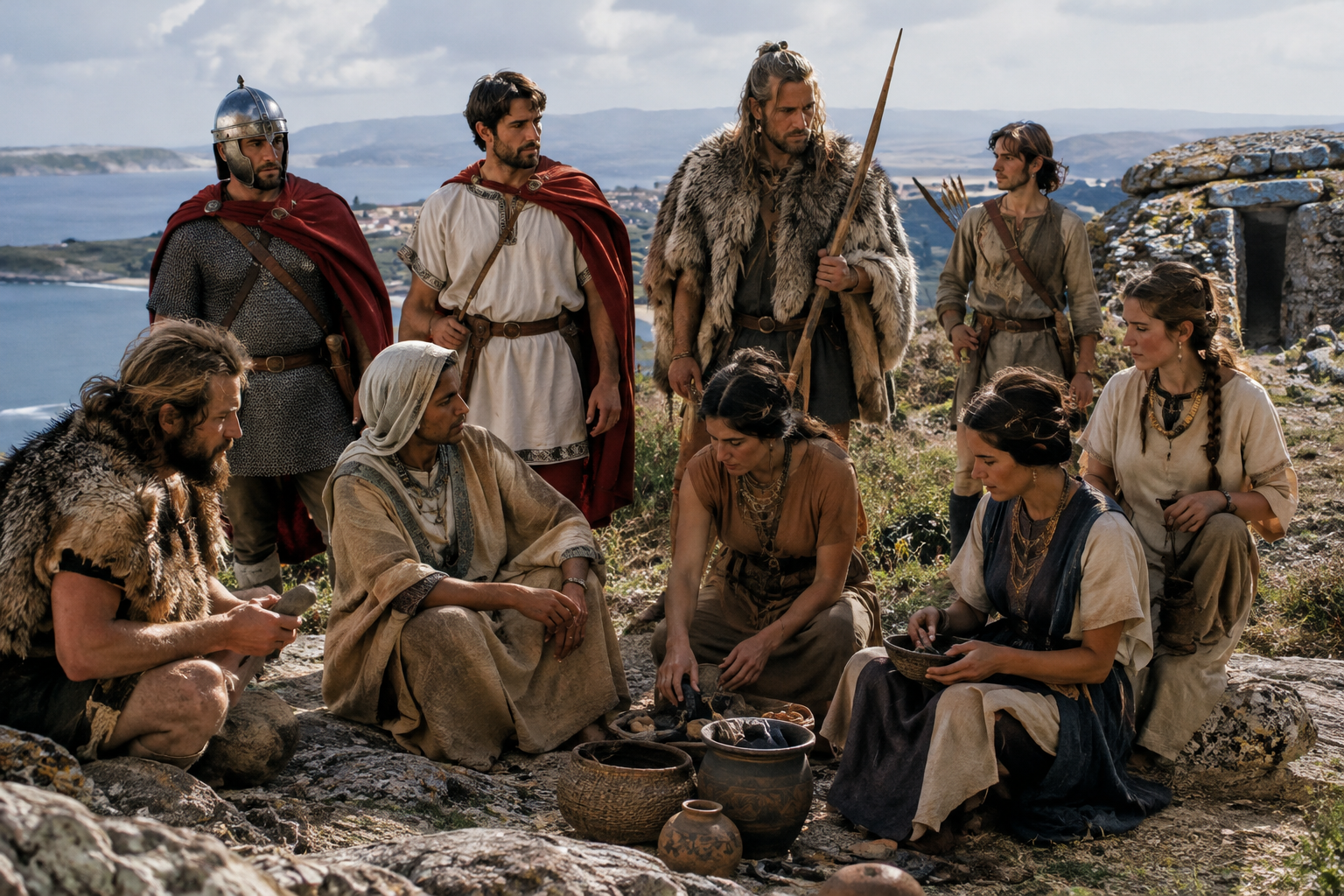
Some Y-DNA haplogroups appear in just the sort of places that make historians sit up. Haplogroup I2a1b1b1a is one of them. It turns up in early farming contexts, in Iron Age Central Europe, in Roman-period mobility, in Viking Age Scandinavia, and strikingly in prehistoric Sardinia. That is not the neat story of a single "people." It is a reminder that paternal lineages can persist through enormous cultural change while the worlds around them are transformed by farming, trade, conquest, and migration.
As always, a Y-DNA haplogroup traces only one line of descent: the direct paternal line from father to son and so on, back into the past. It does not describe a person's whole ancestry, identity, or culture. But because the Y chromosome can be tracked through ancient remains, it gives us a rare way to follow one thread of male-line history across archaeology, landscape, and time. With I2a1b1b1a, that thread leads from Neolithic graves to Roman towns, from Bohemia to Norway, and across the long human story of the Mediterranean islands.
This haplogroup belongs within the wider Y-DNA haplogroup I, one of the major old European paternal lineages. Broadly speaking, branches of haplogroup I are deeply associated with prehistoric Europe, though individual subclades had very different later histories. That distinction matters. We should not simply lift the whole history of haplogroup I, or even all of I2, and paste it onto the much narrower branch I2a1b1b1a.
What the supplied ancient evidence does support is a pattern of geographic breadth and long-term survival. We see this lineage, or lineages classified within this branching neighborhood, in Central Europe and Sardinia from the 5th and 4th millennia BC onward, and later in contexts shaped by Iron Age societies, the Roman world, and Viking Age mobility. In other words, this is a paternal line that seems to have been present in several important historical zones of Europe for a very long time.
For readers interested in the bigger background to early European population change, MyTrueAncestry has a useful companion piece on the farming transition:
Explore the Neolithic Expansion
One of the most revealing samples here is I7187, from Baalberge Makotrasy, Central Bohemian Region, Czechia, dated to 4094 BC. That places this paternal line in the world of early farming communities in Central Europe. Already, then, I2a1b1b1a is part of a continent being reorganized by settlement, cultivation, new burial customs, and shifting social networks. Ancient DNA does not tell us what language this man spoke or how he thought of himself, but it does place his paternal ancestry inside that formative Neolithic landscape.
Then the story veers south. I15946, from Anghelu Ruju, Sardinia, dated to 4000 BC, shows this lineage present on the island in the Neolithic. Anghelu Ruju is one of those archaeological names that deserves to be better known: a major prehistoric funerary complex, carved into the rock, preserving the dead of a world far older than Carthage or Rome. The presence of this haplogroup there suggests that branches of this paternal ancestry were part of the settlement history of Sardinia at a very early stage.
Even more intriguing are the Sardinian Copper Age samples SUC003 and SUC007, both from Porto Torres and both dated to 2100 BC. Now we are no longer dealing with a single isolated appearance, but with repeated evidence across time. Add to that ORC004 from Nuragic Interior Sardinia, dated to 1180 BC, and ISC001 from Nuragic S'Iscia e sas Piras Sardinia, dated to 1000 BC, and a picture begins to emerge of remarkable paternal continuity on the island across several millennia.
That does not mean every Sardinian man belonged to this line, nor that later Sardinians descend directly from these exact individuals. But it does show that this branch was present from the Neolithic into the Nuragic age, surviving through major technological and social change.
Readers who want to dig further into island archaeology and genetics will find this especially relevant:
Discover Ancient Italian Island DNA
The Central European side of the story continues with 1970, listed as Iron Age Czech Prague and dated to 100 BC. Between I7187 in Neolithic Bohemia and 1970 in Iron Age Prague lies an immense span of time, but also a tantalizing regional continuity. Of course, continuity in place does not prove continuity of one unbroken local community; populations mix, expand, and reorganize constantly. Still, to find this paternal signal in Bohemia across very different archaeological eras is precisely the sort of pattern ancient DNA is designed to notice.
Then comes R10667 from Roman Era Wels, Austria, dated to 217 AD. Roman towns are superb places to see how misleading simple ethnic labels can be. A man buried in a Roman context may have local ancestry, immigrant ancestry, military connections, or some mixture of all three. Wels, ancient Ovilava, was tied into imperial administration, commerce, and movement across the Danube world. A lineage like I2a1b1b1a appearing there fits a Europe in motion rather than a map of neat biological tribes.
If Roman mobility interests you, this related article expands the wider picture:
Explore Roman to Early Medieval Italy
Perhaps the most arresting sample in the set is CGG107041, described as Viking Age Gallic Outsider Norway Southwest Klepp and dated to 799 AD. The label itself is suggestive: "Gallic Outsider." Even before one begins to interpret the Y-DNA, the burial context points to movement across cultural frontiers. Viking Age Norway was not a sealed Scandinavian box. It was tied into raiding, trade, slavery, marriage exchange, pilgrimage, and mercenary service from the British Isles to the Frankish world and beyond.
So here again, I2a1b1b1a refuses to behave like a badge of one people. Instead, it appears in a world where identities were made through encounter. The same paternal branch that shows up in prehistoric Sardinia and Iron Age Central Europe also turns up in Viking Age Norway in an individual marked as an outsider. That is exactly why ancient DNA is so useful: it unsettles tidy historical myths.
For a wider look at this mobile Scandinavian world, see:
In this case, the supplied field for associated noble families and castles is effectively empty. That is worth stating plainly. We should not invent dynasties, castles, or heraldic connections where no supporting material has been provided.
Still, the absence itself makes an important historical point. Noble houses and castles belong to the written and architectural record of the medieval and early modern world. Y-DNA belongs to a much longer and stranger archive, one preserved in bone. Sometimes those archives meet neatly, especially where royal or noble remains have been tested. More often they do not. A haplogroup can be ancient, regionally persistent, and historically interesting without being safely attachable to any specific later noble surname.
That is why genetic history and documentary genealogy must be kept in balance. Shared membership in a broad haplogroup does not prove descent from a particular house, any more than living near a castle proves one inherited the lordship. What genetics can do is show that paternal lines moved through the same regions where later lordships, marches, and kingdoms were built.
For readers interested in how ancient DNA and dynastic history can sometimes be compared more directly, this is a useful parallel case:
Read About the Royal Premyslid Dynasty
What, then, does haplogroup I2a1b1b1a reveal? First, that one paternal line can persist through radically different archaeological worlds: Neolithic farmers in Bohemia, prehistoric Sardinian communities, Iron Age populations, Roman provincial life, and Viking Age mobility. Second, that Y-DNA works best when treated as context, not destiny. It can illuminate movement, continuity, and connection, but it does not hand us ready-made ethnic labels or noble pedigrees.
For MyTrueAncestry users, that is part of the fascination. A haplogroup like I2a1b1b1a is not a slogan about who you are. It is a clue about one line among many in your ancestry, and about the deep historical landscapes in which that line once appeared. It links graves in Czechia, Austria, Norway, and Sardinia into a single, evidence-based conversation about Europe's past.
If you have tested your DNA, MyTrueAncestry can help you explore whether your results show connections to ancient individuals, populations, and archaeological cultures like those discussed here. Those matches can offer extraordinary historical perspective, even though they do not by themselves prove direct descent from any specific ancient person or later noble family.






Comments