Haplogroup I2a1b1a2b1a1a1
– 5 min read


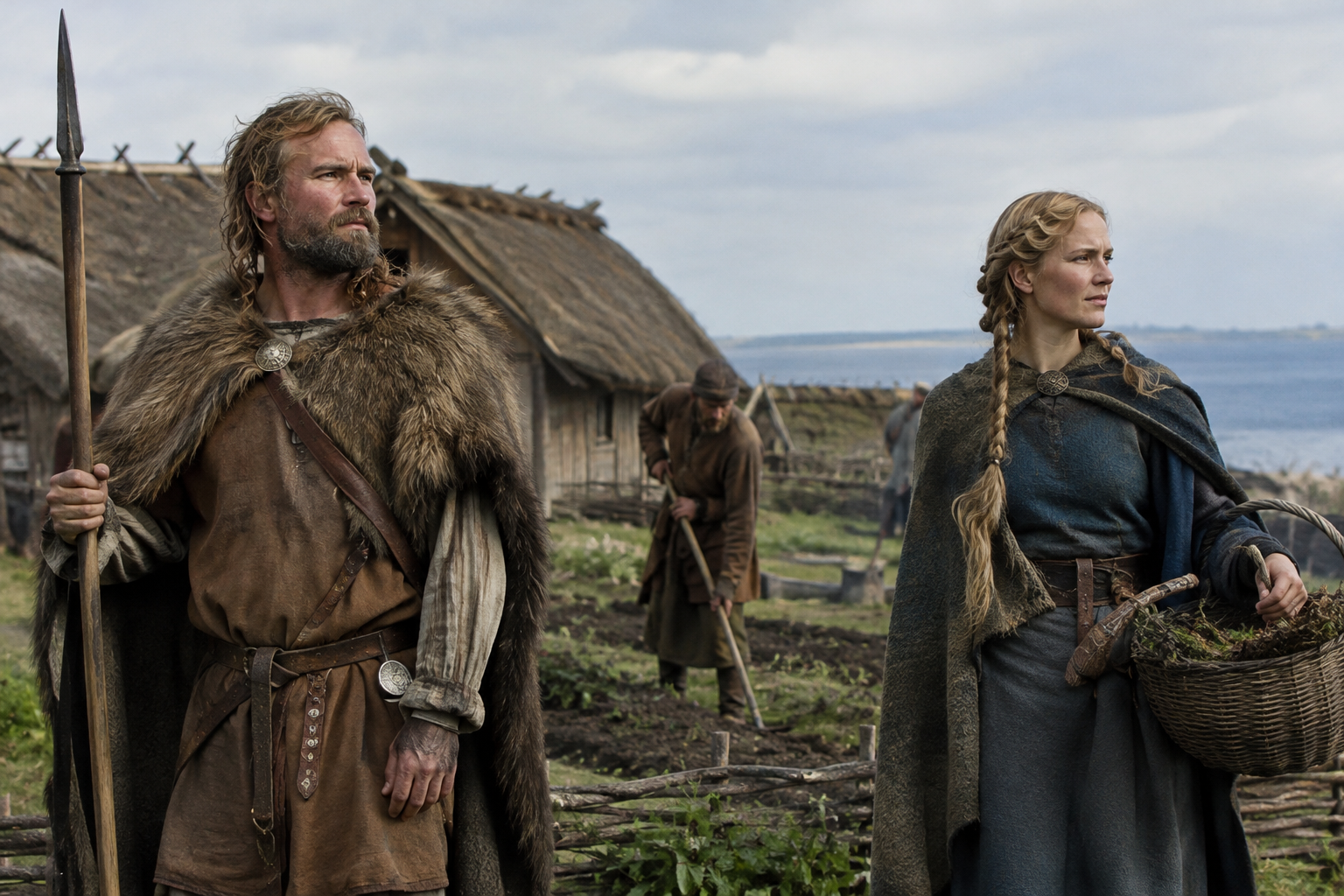
At Kirkebjerggaard on Sjaelland, an ancient male dated to around AD 375 appears in the record as CGG107422 and is associated here with the Y-DNA haplogroup I2a1b1a2b1a1a1. That is an intriguingly early point for this line in southern Scandinavia: not the Viking Age of popular imagination, but the centuries just before it, when Denmark stood in the shifting world of the Late Roman Iron Age and the beginning of the Migration Period.
A second appearance comes several centuries later on Oland, where sample VK332, dated around AD 858, places the same paternal branch in a recognisably Viking-Age setting in eastern Sweden. Taken together, these two finds do not give us a full history of I2a1b1a2b1a1a1, and Y-DNA traces only one direct male line rather than a person's whole ancestry. But they do give us something better than a grand myth: two firm archaeological footholds in Scandinavia, separated by time, and both worth taking seriously.
The Danish sample is the more arresting starting point because it sits earlier than many readers might expect. Around AD 375, Sjaelland was not a marginal backwater but part of a connected northern world shaped by exchange, local power, and the political tremors coming from the Roman frontier far to the south. A man carrying a line associated with I2a1b1a2b1a1a1 was living there in precisely that unsettled age.
What matters here is not romance but chronology. This is evidence that the branch was present in Denmark well before the famous overseas expansions of the ninth to eleventh centuries. It cautions against treating every Scandinavian paternal lineage as though it only became historically meaningful with longships, raiding, or saga heroes. Some lines were already embedded in local communities centuries earlier.
A genetic study examining ancient individuals from Denmark and neighbouring regions has helped widen this earlier Scandinavian picture, even when individual branch labels in public summaries can be more precise than the broader published discussion: https://www.biorxiv.org/content/10.1101/2025.02.28.640770v1. For this article, the secure point is modest but important: CGG107422 anchors the haplogroup in Late Iron Age Denmark.
The label I2a1b1a2b1a1a1 is a very narrow paternal classification, one twig on a much larger Y-chromosome tree. That distinction matters. Broader I haplogroups have deep roots in Europe, but it would be careless to transfer every ancient movement or regional pattern known for haplogroup I as a whole onto this exact subclade.
So the responsible reading is quite specific. The evidence here shows that a direct paternal line assigned to this branch, or reported as belonging within it, appears in southern Scandinavia by late antiquity and is seen again in Viking-Age Sweden. That is a Scandinavian archaeological pattern, not proof of a single tribe, language group, dynasty, or continuous local male family over five centuries.
It is also worth separating lineage from identity. A man buried in Denmark around AD 375 was part of a real local society shaped by custom, status, and ancestry from many forebears. His Y-DNA tells us about one father-to-son line only, but even that one line can be historically valuable when it turns up in well-dated contexts.
The later sample, VK332, comes from Oland and is dated around AD 858. That date places it squarely in the Viking Age, but Oland is especially interesting because it was not simply "Viking" in a generic sense. The island sat in the Baltic sphere, tied into movement, trade, and regional competition linking Sweden with Gotland, the eastern Baltic, and routes beyond.
For I2a1b1a2b1a1a1, VK332 shows that the lineage was not confined to one Danish appearance in late antiquity. By the ninth century it turns up again in a different Scandinavian region, in a period when mobility across the Baltic is archaeologically unmistakable. That does not mean the individual on Oland descended directly from the man at Kirkebjerggaard, only that the same paternal branch had a durable place in the Scandinavian north.
An ancient DNA study of Viking-Age populations provides the broader research backdrop for why such finds matter in Oland and nearby regions: https://www.biorxiv.org/content/10.1101/703405v1. Even without turning one sample into a sweeping migration tale, VK332 fits a historical landscape in which Scandinavian communities were regionally connected and genetically varied.
These two samples are separated by nearly five centuries, and that gap is part of the interest. The earlier man belongs to the world before the classic Viking Age; the later one belongs to it fully. In between came the transformations of the Migration Period, the Merovingian centuries, and the gradual emergence of the political and maritime networks that later made Scandinavian history so visible in written sources.
Seen in that long view, I2a1b1a2b1a1a1 looks less like a sudden Viking-age arrival and more like one of the paternal lines already circulating within Scandinavian populations before the age of expansion. That is a much subtler story, but also a more convincing one. Ancient DNA often works like this: it trims away heroic simplifications and leaves us with patient, local continuities interrupted by wider historical change.
There is also a regional contrast worth noticing. Sjaelland faces the Danish straits and the continental gateway; Oland belongs to the Baltic side of Scandinavia. A lineage appearing in both areas suggests breadth within the north, though not necessarily high frequency. Two samples cannot measure prevalence, but they can show distribution across meaningful historical landscapes.
There is a temptation, when the evidence is limited, either to say too much or too little. Too much would mean inventing a tribal badge for the haplogroup, or claiming a neat route from one excavated man to another. Too little would mean missing the point that securely dated ancient samples, however few, are exactly what make paternal history testable.
CGG107422 and VK332 show this branch in two real archaeological settings in Scandinavia, one in Late Iron Age Denmark and one in Viking-Age Sweden. That alone already places the lineage inside the lived history of the north rather than in the abstract space of modern surname projects and genetic maps. For descendants today, that can be more meaningful than a grand but unsupported origin story.
The most distinctive thing we can say about I2a1b1a2b1a1a1 from the evidence here is that it is already present in southern Scandinavia by around AD 375 and still visible in the Viking-Age Baltic world by around AD 858. That is not a royal pedigree or a saga claim. It is something better grounded: a paternal line with attested roots in the archaeological record of Denmark and Sweden across a long stretch of the first millennium AD.
For someone researching this haplogroup today, that suggests a direct male-line history plausibly tied to the Scandinavian north, and specifically to communities living there both before and during the Viking Age. As ever, the next ancient sample may sharpen the picture. But even now, these two men are enough to place the branch in a real historical landscape.






Comments