Haplogroup I2a1b1a2a1

– 5 min read


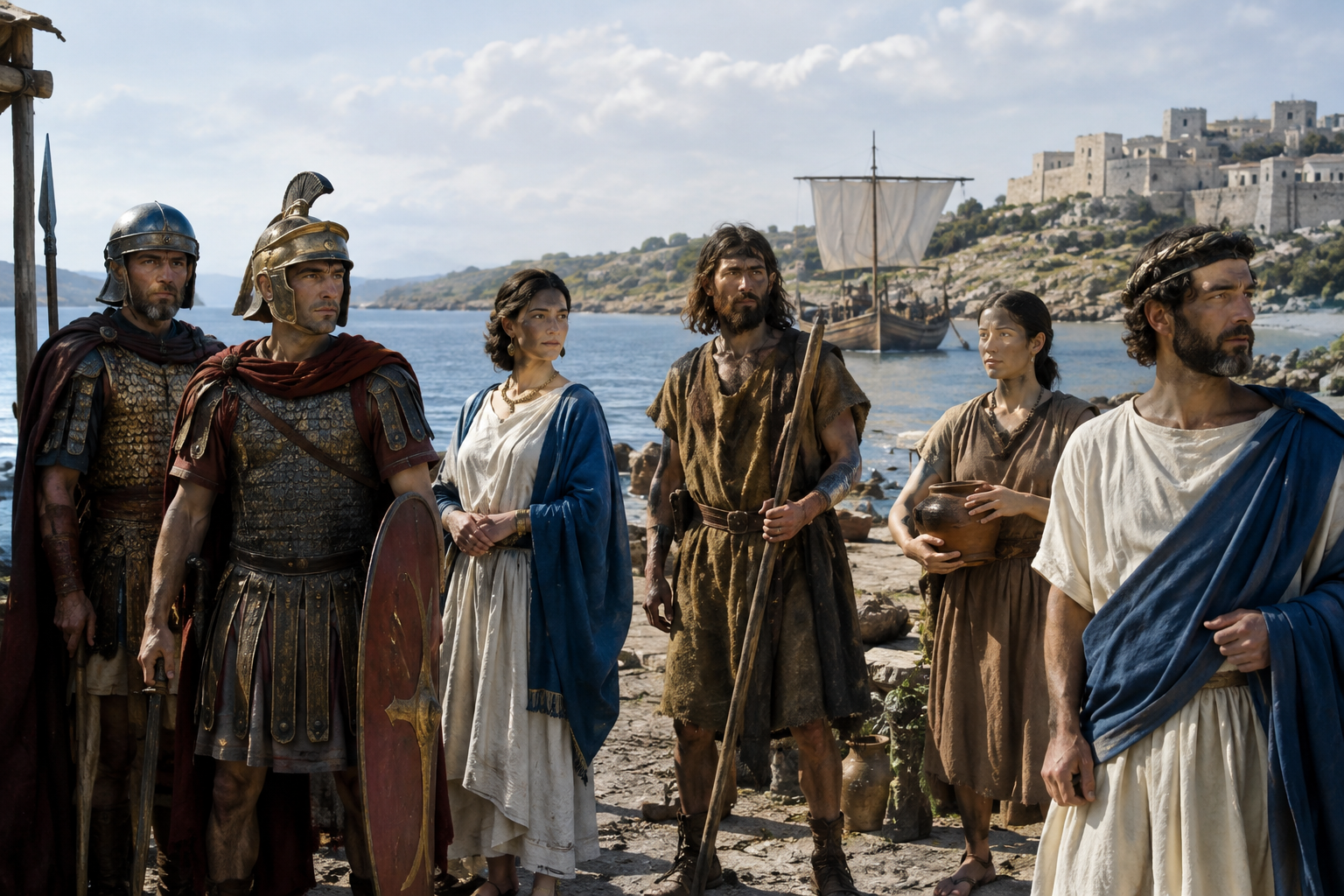
At Aquae Calidae on the Black Sea coast of modern Bulgaria, a Late Roman grave linked to a Gothic community produced one of the clearest signposts in this set of evidence: sample I40571, dated around AD 350. On its own, that may sound like a single technical detail. But once you place it beside other ancient men associated with the Y-DNA branch I2a1b1a2a1, a more interesting picture appears: this is not a lineage confined to one tribe, one kingdom, or one migration story, but one turning up in several connected worlds around the Balkans, the Aegean, and the wider eastern Mediterranean.
That matters because Y-DNA follows one direct paternal line only. It does not tell us a man's whole ancestry, language, or identity. What it can do, when archaeology and context are good enough, is show that one paternal branch could persist through very different historical settings: Bronze Age communities in Bosnia, people on the Aegean coast of Anatolia, a person in Carthaginian-era Sicily, and later men moving through the Roman and Gothic frontier zone.
The most arresting case here is I40571, described as a Late Roman Gothic grave from Aquae Calidae in Bulgaria, around AD 350. This is precisely the kind of find that unsettles older, simpler ideas about "the Goths" as a single, biologically uniform people. Archaeology has long shown that Gothic communities near the Roman frontier were made up of shifting groups, local recruits, and families with mixed backgrounds. Ancient DNA has been reinforcing that point rather than simplifying it.
A recent ancient-DNA study of Gothic-period burials in Bulgaria, available as research on Late Antique Bulgaria, helps frame the significance of such graves. Even without stretching beyond what the sample record gives us, the broader lesson is clear enough: a paternal line associated here with I2a1b1a2a1 appears inside a community labelled Gothic by its archaeological setting, not as proof of some pure "Gothic bloodline", but as evidence that Gothic society on Rome's edge was genetically varied and historically entangled.
Gothic communities in Late Antique Bulgaria
That is the proper historical scale for reading a haplogroup like this one. A branch can appear in a Gothic grave without having originated with Goths, just as it can appear in Roman territory without being "Roman" in any ethnic sense. The Roman frontier was full of soldiers, settlers, dependants, captives, merchants, and families who had crossed several cultural boundaries before they were buried.
Another important data point is OSIJ004, a Roman-period warrior from Mursa in modern Croatia, dated to around AD 260 during the so-called Third Century Crisis. Mursa sat in a crucial corridor of the middle Danube world, where imperial armies, local populations, and incoming groups repeatedly collided and mixed. A man associated with I2a1b1a2a1 in this setting suggests that the branch was already present in the military and frontier population of the western Balkans before the better-known Gothic phase represented at Aquae Calidae.
This is a useful corrective to the temptation to read everything backwards from late antique ethnonyms. The Mursa evidence points instead to continuity and circulation in a region where paternal lines could endure across changing political labels. One century a man is buried in a Roman military environment; another appears in a Gothic-associated cemetery further east. The Y-line is one thread running through different historical fabrics.
The broader setting of this Croatian evidence fits well with MyTrueAncestry's discussion of long-term paternal change and continuity in the region.
Croatia's shifting paternal lineages
If we step much further back, sample I19561 from Klakar in Bosnia-Herzegovina, dated around 1500 BC, gives this branch a notably older Balkan presence. This is perhaps the most important chronological anchor in the whole group. It shows that a lineage associated with I2a1b1a2a1 was present in the western Balkans in the Bronze Age, long before Roman administration, Gothic movements, or the literary ethnographies of late antiquity.
That does not mean a straight, documented father-to-son chain from Bronze Age Bosnia to late Roman Bulgaria. Ancient DNA rarely allows that kind of grand genealogical leap. But it does let us say something more disciplined and more interesting: this paternal branch belonged to the human background of the Balkans early enough that later appearances in Roman and post-Roman contexts need not be treated as sudden arrivals from nowhere.
The Balkans are especially important for understanding this because they were never a sealed zone. They were a crossroads between the Danube basin, the Aegean, the Adriatic, and Anatolia. A lineage with a Bronze Age foothold there could later appear in soldiers, townsmen, frontier communities, or mobile groups without requiring a single dramatic migration event to explain every case.
Two earlier Mediterranean samples widen the picture further. I5737, from Izmir in Aegean Anatolia, is dated to the Early Bronze Age, around 1960 BC. I7648, from Mozia in western Sicily, belongs to a Carthaginian-era context around 400 BC. Together they suggest that the paternal background represented by this branch was not purely inland or exclusively Balkan in some narrow sense. It also touched the maritime worlds of the Aegean and central Mediterranean.
Mozia is especially revealing because western Sicily was one of antiquity's great contact zones, where Phoenician, Greek, local Sicilian, and later wider Mediterranean influences overlapped. A genetic study of the ancient Italian islands, published in research on island populations in the Mediterranean, underlines just how mixed these island communities could be across time. In that setting, finding a paternal branch like I2a1b1a2a1 is less a tidy ethnic badge than a reminder that ports and colonies were full of people whose family histories reached in several directions at once.
Ancient Italian islands and DNA
The Anatolian case matters for a related reason. The Aegean coast was never marginal to European prehistory; it was one of the main corridors through which people, goods, and ideas moved. If this branch appears there in the early second millennium BC, then later western Balkan and central Mediterranean appearances become easier to understand as part of a connected zone rather than isolated curiosities.
One more sample sharpens that coastal picture: I3311, an Ancient Dorian individual from Halikarnassos on the Aegean coast, dated around 177 BC. Halikarnassos was a thoroughly cosmopolitan place by the Hellenistic period, with Greek civic life layered over older Anatolian histories and long maritime connections. A paternal lineage associated with I2a1b1a2a1 in this setting again resists any lazy habit of assigning one branch to one people.
Instead, the evidence points to a lineage moving through communities that were linguistically, politically, and socially different, yet tied together by the geography of the eastern Mediterranean. Bronze Age Anatolia, Hellenistic coastal cities, Punic-era Sicily, Roman military Croatia, and Gothic-period Bulgaria do not form a single dynasty. They form a historical map of contact.
Greek-speaking communities and genetic history
For someone researching I2a1b1a2a1, the most responsible takeaway is not a grand claim of belonging to Goths, Dorians, or any other single named people. It is something subtler and, frankly, more historical: this paternal line appears in ancient men from the Balkans and adjacent Mediterranean worlds over a very long period, from the Bronze Age into late antiquity. In other words, it looks less like a brief episode and more like one of the enduring male lines carried through the crowded, mobile societies of southeastern Europe and the eastern Mediterranean.






Comments