Haplogroup I2a1b1a1b1a1

– 5 min read


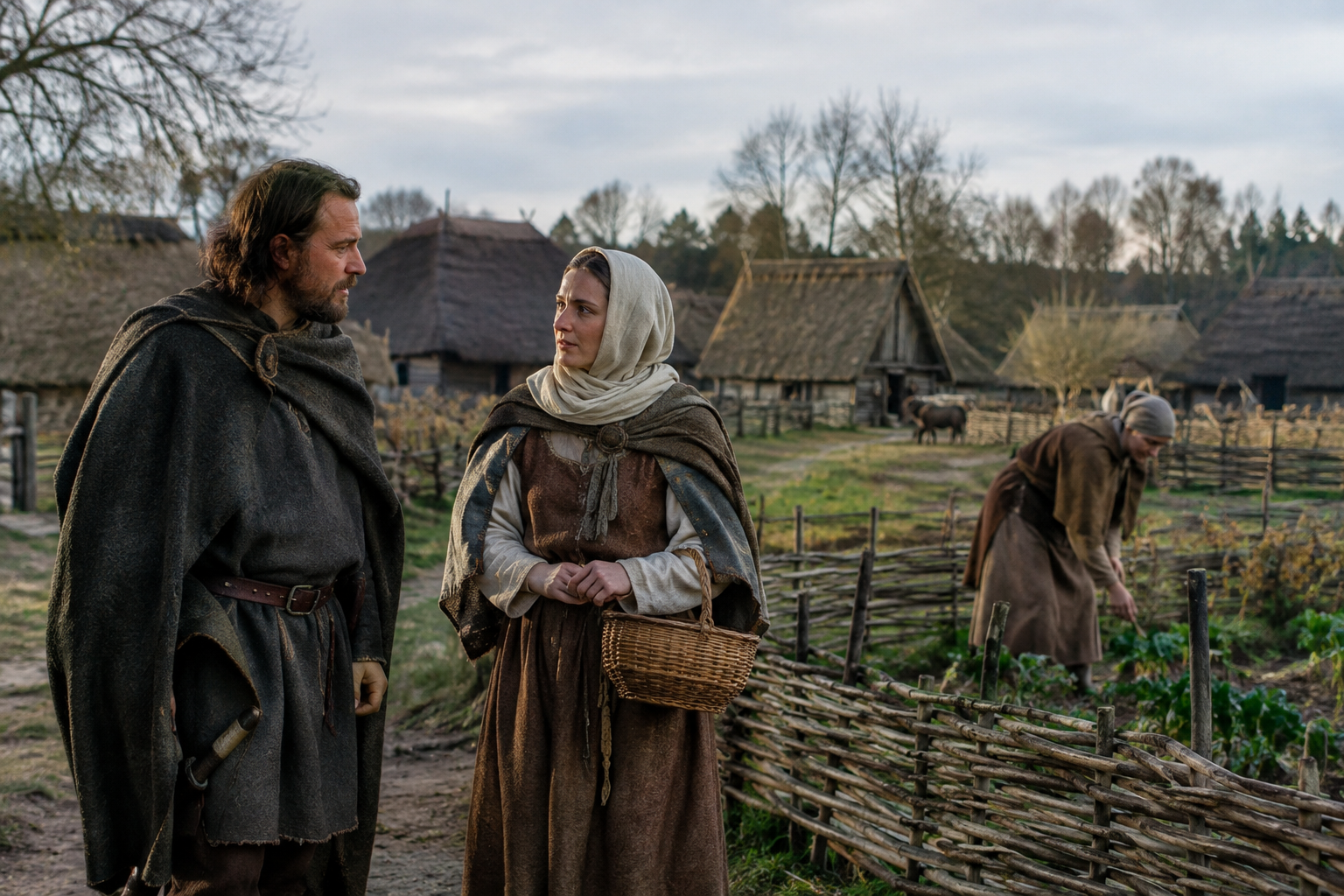
At Steuden in Sachsen-Anhalt, one medieval man offers a small but very telling glimpse into the history of Y-DNA haplogroup I2a1b1a1b1a1. The individual identified as SDN037, dated to around AD 1050 and described as a Western Slav settler, belongs to a world that was anything but neatly bounded by later national labels. In the 11th century, this was a frontier landscape in central Germany where language, settlement, and political control were still being worked out on the ground.
That is what makes this lineage interesting here. Not because one burial can stand for an entire people - it cannot - but because a direct paternal line like Y-DNA preserves one narrow thread through a much broader human story. In the case of I2a1b1a1b1a1, the evidence presently attached to this article is not a sweeping gallery of ancient elites or famous dynasties. It is something archaeologically better: a securely contextualized medieval individual from a region where Slavic-speaking communities were part of the making of eastern Germany.
Steuden lies in a part of Germany shaped by the long contact zone between German-speaking polities and West Slavic communities. Early and high medieval written sources often describe these lands through the ambitions of rulers, bishops, and margraves, but ancient DNA gives us a different scale of history. It brings us down from dynasties and border campaigns to actual buried people.
Sample SDN037 belongs to that local human record. The label "Western Slav settler" matters because it places the individual within the medieval Slavic world west of the Elbe, the sphere often associated with groups known in Latin and German sources as Wends. Those communities were not temporary visitors. They founded villages, farmed, married, traded, converted, resisted, and adapted. By about AD 1050, they were part of the everyday population history of the region.
The genetic context behind this burial sits within a growing body of archaeogenetic work on medieval central Europe, including research connected with the project record at https://www.ebi.ac.uk/ena/browser/view/PRJEB81250. Even where the public-facing summary is brief, the importance is clear enough: this is a medieval paternal line found not on the distant edge of Europe, but in a heavily contested and culturally mixed heartland.
The full haplogroup label here, I2a1b1a1b1a1, is a very specific branch within the wider Y-DNA haplogroup I, one of the long-established paternal lineages of Europe. That wider family has deep prehistoric roots on the continent, but one must be careful not to pour the whole prehistory of haplogroup I into this much narrower sub-branch. A terminal or near-terminal label identifies a fine twig on a large tree, not the entire tree itself.
What Y-DNA can do is trace one direct male line: father to father to father. It does not define a person's whole ancestry, language, or identity. A man buried as part of a Western Slav medieval community may carry a lineage with older and wider European depth, just as his autosomal ancestry, kinship ties, and cultural life could reflect many generations of local mixture. That is entirely normal. Medieval communities were made from such entanglements.
So the significance of SDN037 is not that he "proves" an ethnic essence. Rather, he demonstrates that this branch was present among Slavic-associated settlers in central Germany during the 11th century. For genealogists, that is exactly the sort of evidence that matters: not grand slogans, but a securely dated occurrence in a real historical setting.
It is worth pausing over the date. Around AD 1050, Saxony-Anhalt was not an empty march waiting to be civilized by one side or another, as older nationalist histories liked to imagine. It was a lived-in zone of villages, churches, fortified places, cultivated fields, tribute networks, and overlapping loyalties. Slavic-speaking populations had occupied much of the Elbe-Saale region for centuries by then, while political integration into the expanding structures of the Holy Roman Empire was ongoing and uneven.
This matters for how we read a lineage like I2a1b1a1b1a1. A paternal branch found in such a setting may speak less of one dramatic migration event than of population persistence inside a contact region. Men carrying this line could have been part of families established locally for generations before burial, even if the cultural label attached to the cemetery reflects a still-recognizable Western Slavic identity.
Archaeology across eastern and central Germany has repeatedly shown that medieval frontiers are rarely simple lines. Material culture, burial practice, settlement names, and written labels often overlap awkwardly. Ancient DNA adds yet another layer, showing that communities in these regions were made up of real people whose family histories were sometimes local, sometimes mobile, and often both at once.
Germanic Languages and Genomics
Readers sometimes assume that one sample is too little to say anything useful. In one sense, that is true: one burial cannot define the frequency or ultimate origin of I2a1b1a1b1a1 across all medieval Slavs, all Germans, or all Europeans. But archaeology often advances through precisely such modest certainties. A single individual, well placed in time and context, can anchor a branch to a particular historical landscape.
SDN037 does that for this haplogroup. He places the branch in medieval Steuden, in a Western Slav-associated context, around the mid-11th century. That is already a meaningful fact. For descendants exploring their own Y-line today, the value lies in this kind of fixed point: an attested presence in the borderlands of central Europe, during a period of settlement expansion, political negotiation, and cultural coexistence.
This is also a good reminder that some of the most informative ancient DNA does not come from kings. It comes from ordinary people buried in ordinary communities. Their lineages are often the better guide to how populations actually worked.
The Steuden individual also fits a broader picture emerging from medieval paleogenomics: central Europe was full of mixed local histories. Across towns, villages, and cemeteries, researchers are finding that medieval populations do not sort themselves into the tidy ethnic boxes favored by older chronicles. Instead, paternal lines, maternal lines, and genome-wide ancestry often reveal continuity mixed with movement, and local rootedness mixed with new arrivals.
That makes the western Slavic dimension of SDN037 especially interesting. In popular history, the medieval Slavs west of the Elbe can be flattened into a prelude to later German expansion. But from the archaeological point of view they were historical actors in their own right, and from the genetic point of view they were part of the enduring human fabric of the region. A branch like I2a1b1a1b1a1 appearing here is entirely consistent with that more grounded, less triumphalist account of the Middle Ages.
For I2a1b1a1b1a1, the clearest ancient clue here is not a legend, a castle, or a royal pedigree. It is SDN037, a man buried in medieval Steuden around AD 1050, in a Western Slav settler context in what is now Sachsen-Anhalt. That places this paternal branch within the lived history of the central European Slavic-German frontier, where communities endured, mixed, and changed without losing their local reality.
If this is your haplogroup, the best historical reading is a sober and interesting one: your direct paternal line is compatible with the medieval populations of central Europe's contact zones, where Slavic-associated communities formed part of the landscape for centuries. That is not a complete family history - no Y-line ever is - but it is a genuine historical foothold.

Comments