Haplogroup I2a1b1a1a1b1

– 5 min read


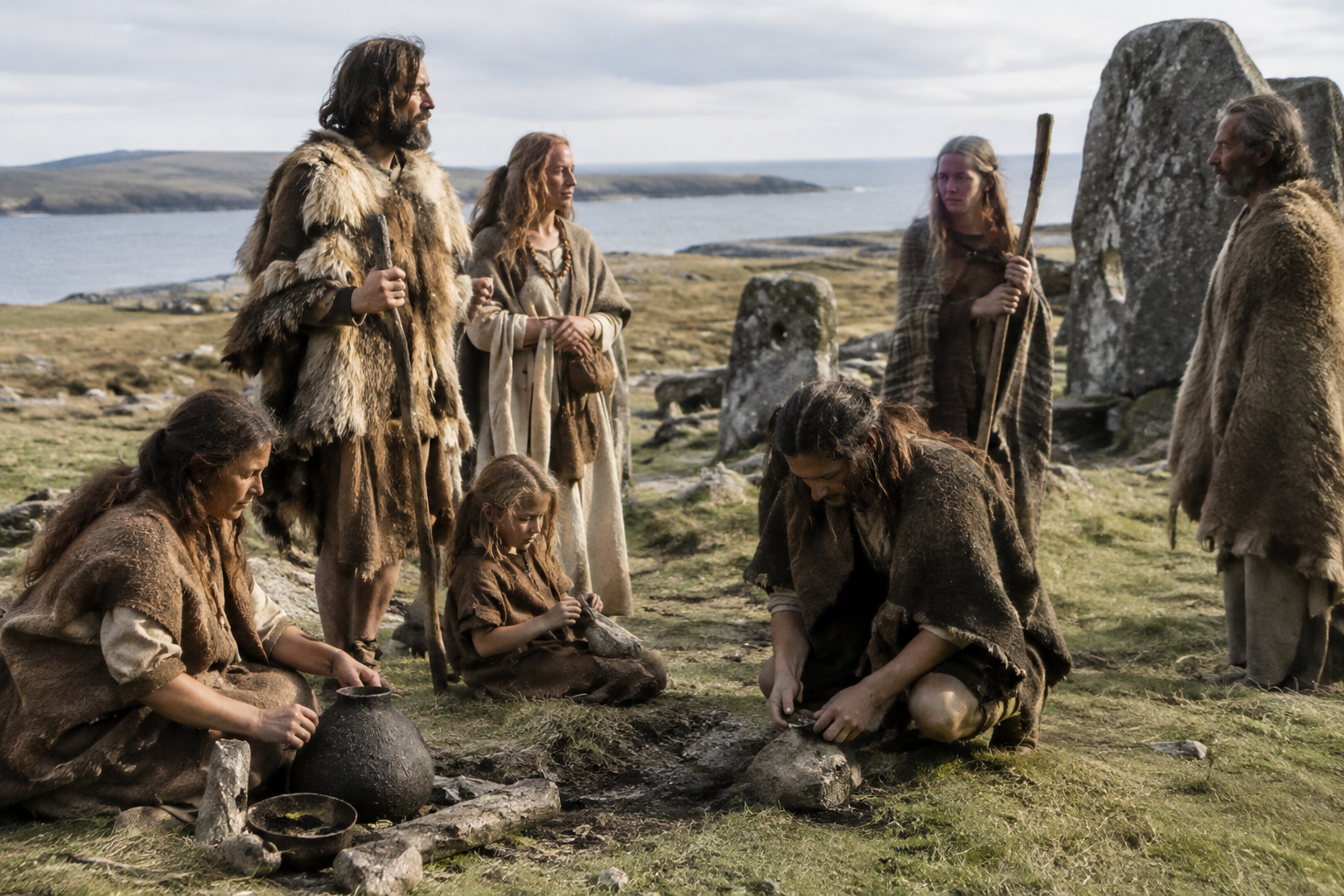
At Monkton Up Wimborne in Dorset, a Neolithic family burial dated to around 3225 BC preserves one of the clearest early appearances in this set of evidence for the Y-DNA line I2a1b1a1a1b1: sample muw001. That matters because this is not an isolated wanderer from some vague prehistoric map. It is a man buried in southern Britain during the age of monuments, farming villages, and carefully maintained ancestral places.
Once you place muw001 beside related finds from Orkney, western Scotland, and Neolithic Ireland, a more interesting picture emerges. Haplogroup I2a1b1a1a1b1 appears here not as the badge of a single tribe or later nation, but as part of a paternal thread running through communities on the Atlantic edge of Neolithic Britain and Ireland. Y-DNA, of course, tracks only one direct male line, not a person's whole ancestry, but even that narrow line can be historically revealing when it recurs in meaningful archaeological settings.
The Dorset sample muw001 stands at the useful intersection of genetics and social archaeology. A "family burial" context immediately tells us that this was not simply a biological individual detached from community, but someone placed among others in a setting that likely expressed kinship, memory, and continuity. In Neolithic Britain, burial places were often as much about the living as the dead: claims to land, ancestry, and belonging could be built into the landscape itself.
For a lineage like I2a1b1a1a1b1, this is a better starting point than grand migration stories. The evidence here is concrete and local. We are looking at a paternal branch present in a settled farming world of southern England, where descent and burial were already being materially organized.
A wider ancient DNA study of Neolithic and Bronze Age Britain, published in Nature, helped establish just how dramatically the islands changed with the arrival of farming and later with Beaker-associated populations. That larger framework matters because lineages such as I2 did not vanish neatly at a single moment; some persisted, sometimes quietly, within changing populations and social systems.
Neolithic Tomb Reuse in Britain
If Dorset gives us a southern anchor, Orkney gives us a northern one. Sample I2933, dated to around 2927 BC at Isbister in Orkney, belongs to a region that has become central to discussions of Neolithic kinship, monument building, and island communities. Orkney in this period was no backwater. It was one of the most archaeologically distinctive zones in northwestern Europe, dense with chambered tombs, settlements, and ceremonial architecture.
The significance of I2933 is not that one man can stand for all Orcadian society; plainly he cannot. It is that the same broad paternal line appears in a place where ancestry and tomb use were socially important and where communities were deeply connected across sea routes. The old habit of treating islands as isolated is quite misleading here. Neolithic Orkney was maritime, networked, and fully entangled with developments elsewhere in Britain and beyond.
That makes I2a1b1a1a1b1 in Orkney especially intriguing. Rather than suggesting remoteness, it may point to the durability of certain paternal lines inside communities that were both locally rooted and outward-looking.
Neolithic Kinship in Northern Scotland
Another important piece comes from I3135 at Distillery Cave, Oban, in Argyll and Bute, dated to about 3450 BC. Western Scotland is crucial for understanding how people, goods, and ideas moved through the seaways linking Ireland, the Hebrides, and the mainland. A cave burial context is archaeologically different from the formal family setting at Monkton Up Wimborne or the tomb-rich world of Orkney, and that difference is useful.
It reminds us that one paternal lineage could exist across varied burial practices and landscapes. We should not expect a haplogroup to map neatly onto a single ritual tradition. What matters is the recurrence of this line in communities spread across the Irish Sea zone and Atlantic façade during the Neolithic.
Research infrastructure connected with these ancient genomes, including material associated with PRJEB111359, has helped broaden the comparative picture for prehistoric Britain and Ireland. Even without forcing every sample into a single narrative, the cumulative pattern is plain enough: this branch is showing up in early farming contexts at several points around the western and northern coasts.
The Irish evidence sharpens the story further. Three samples in this set - CAK531 from Neolithic Ireland and ANN1 and ANN2 from Annagh, Limerick, all dated around 3000 BC - place the lineage firmly across the water as well. That is important because the Irish Neolithic is not merely an appendix to Britain's prehistory. It had its own regional traditions, tomb complexes, settlement histories, and local dynamics.
Two samples from the same place, Annagh in County Limerick, should not automatically be turned into a dramatic claim about a ruling family or a father-and-son chain unless the study explicitly says so. But they do make one cautious point rather well: paternal continuity, or at least repeated representation of a related paternal branch, could be present within a single Neolithic locality.
When ANN1, ANN2, and CAK531 are set beside muw001, I2933, and I3135, the geographic spread becomes hard to ignore. Southern England, Orkney, Oban, and Ireland are not random dots. They belong to the same broad Atlantic world of the later Neolithic, connected by sea travel, exchange, and recurring forms of monumentality.
Here a bit of caution is needed. The article haplogroup is the very specific subclade I2a1b1a1a1b1, but ancient reports do not always publish every sample at the same fine level of Y-DNA resolution. In practice, that means some individuals may be securely placed somewhere within a wider I2 framework while being associated with this narrower branch in later databases or downstream analysis. That is common in ancient DNA work, especially where coverage varies.
Still, the wider context is informative. Haplogroup I2 has deep roots in prehistoric Europe and is often encountered in Mesolithic and Neolithic discussions. What this article's sample set suggests is not that the entire history of I2 belongs to I2a1b1a1a1b1, but that this particular paternal branch has a credible prehistoric presence in Britain and Ireland during the Neolithic and early Bronze Age horizon represented here.
That has a human consequence for modern testers. If you belong to I2a1b1a1a1b1, these burials do not identify your named ancestors, but they do place your direct paternal line within a very old landscape of Atlantic-facing communities: farmers, tomb builders, cave buriers, and seaborne networks long before later Celtic, Roman, Viking, or medieval histories reshaped the same regions.
Mesolithic-Neolithic Transition
The most distinctive thing about I2a1b1a1a1b1 in this evidence is not royal glamour or a single spectacular grave. It is the repeated appearance of the line in real archaeological communities scattered around Neolithic Britain and Ireland: Dorset, Orkney, Oban, and Limerick. Together they suggest a paternal lineage embedded in the monument-building, seaway-linked world of the fourth and third millennia BC, surviving across more than one region and more than one burial setting.
For anyone researching this haplogroup today, that is a solid and rather evocative starting point. Your direct paternal line is linked, at least in the present evidence, to some of the earliest farming societies of the Atlantic archipelago and to the people who made those islands a connected prehistoric world.






Comments