Haplogroup I2a1a2b1a1a1c3
– 5 min read


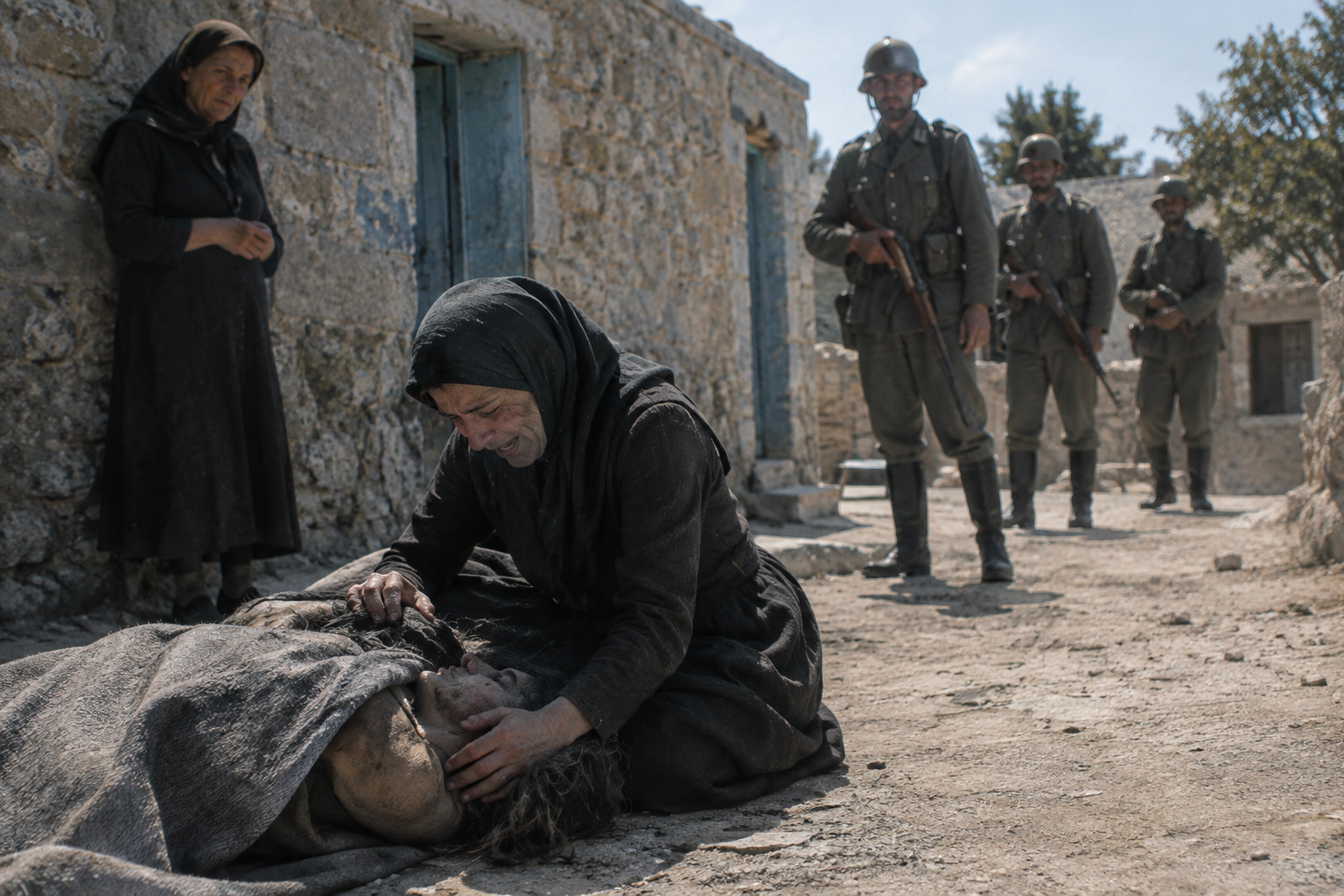
In the village of Sarakina near Rethimno on Crete, one of the most striking paternal-line finds attached to haplogroup I2a1a2b1a1a1c3 does not come from prehistory at all. It comes from a war victim dated to 1941 AD, identified as Sarakina_09a. That date places him in one of the island's most violent modern episodes, the Battle of Crete and the occupation that followed, reminding us that ancient-DNA methods are not only for Neolithic tombs and Bronze Age chiefs. They can also help identify the dead of very recent conflict.
That matters for this haplogroup because the evidence here is unusually specific in one sense and unusually narrow in another. We have a direct association with a documented male individual from wartime Crete, but we do not have a broad archaeological series of older burials securely tied to the same precise terminal branch. So the story of I2a1a2b1a1a1c3, at least from the evidence in hand, is best told not as a sweeping saga of conquests, but as a careful lesson in how paternal lines survive into the modern era and how archaeology, forensic science, and genetics meet at the edge of living memory.
The label Sarakina_09a belongs to a male war victim from the Rethimno region of Crete, dated to 1941 AD. In archaeological terms that is almost yesterday, yet the same basic problems appear as in far older burials: damaged remains, uncertain identity, disturbed contexts, and the need to establish sex and biological profile from fragmentary evidence.
That is where ancient-DNA style analysis becomes so useful. A study on shotgun sequencing and sex identification of ancient human remains, available here, helps show the kind of genetic method used when skeletal remains are too degraded or incomplete for easy conventional identification. In cases like Sarakina_09a, the science is not there to add romance. It is there to restore a basic human fact: who the dead person was, and even whether the remains are male or female.
Ancient DNA and Archaeogenetics
Y-DNA traces one line only: father to son, back through the generations. That makes it powerful, but also rather narrow. A man assigned to I2a1a2b1a1a1c3 did not "belong" only to that lineage in any fuller ancestral sense; he also inherited thousands of other lines through mothers, grandmothers, and collateral ancestors. Still, the paternal line can be extraordinarily durable, and that is precisely why it is useful in both genealogy and archaeology.
The important caution here is that I2a1a2b1a1a1c3 is a very fine-grained terminal subclade, not the whole of haplogroup I2. Haplogroup I2 as a broad umbrella has a deep European history and appears in many regions and periods. But one must not lazily transfer every claim about the parent lineage onto this exact branch. With Sarakina_09a, the secure point is modest and solid: this particular wartime male from Crete was reported in association with the article's branch.
Crete in 1941 was not an isolated backwater but a strategic island caught in the middle of a global war. The German airborne assault in May 1941, the fighting around Cretan towns and villages, and the brutal occupation that followed produced dead whose identities could easily be lost in the confusion. In such settings, human remains become both archaeological evidence and historical testimony.
For a paternal lineage study, a modern Cretan context is also interesting because Crete has long been a crossroads. Over millennia the island has seen Minoan, Greek, Roman, Byzantine, Venetian, and Ottoman rule, alongside constant local continuity. A present or recent Y-chromosome branch found on Crete may reflect deep local residence, medieval movement, early modern settlement, or any combination of these. Without older directly related samples, one should resist the temptation to turn Sarakina_09a into a mascot for all of Cretan history. But neither should one miss the obvious point: lineages with very old roots in Europe are still turning up in historically documented individuals from the eastern Mediterranean.
One of the most revealing things about this case is methodological. People often imagine ancient DNA as a discipline concerned only with the remote past: Ice Age caves, Neolithic farmers, or Bronze Age cemeteries. Yet the same laboratory logic can help with remains from the Second World War. The timescale changes; the analytical challenge often does not.
Crete is a particularly good place to see this overlap between archaeology and forensic history. The island is famous for prehistoric palaces and Classical antiquities, but its modern battlefields and graves are also part of the archaeological record. A sample such as Sarakina_09a sits right on that boundary. He is recent enough to belong to family memory and documentary history, yet distant enough in the physical condition of the remains to require archaeogenetic tools.
That is why this haplogroup entry feels different from many deep-time paternal-line articles. It is less about reconstructing grand migrations from a scatter of prehistoric males, and more about the persistence of a paternal branch into a named historical crisis. There is a certain sobriety to that. The Y chromosome here is not a banner of ethnic identity; it is part of the careful reconstruction of one lost life.
There is a tendency in public discussions of DNA to assume that more dramatic stories are automatically better stories. A famous dynasty, an aristocratic tomb, a migration map with arrows all over it: these are easy to tell. But sometimes a single, well-placed sample is more honest and more revealing. Sarakina_09a gives us an anchored person, a real place, and a clear historical moment.
He also illustrates a wider truth about lineage survival. Haplogroups are not frozen in one ancient culture. They pass through changing languages, states, religions, and identities. The same paternal line can belong, at different times, to a Mesolithic hunter-gatherer, a medieval villager, or a 20th-century war casualty. What changes is the historical setting around the lineage, not the fact of descent itself.
That broader point has resonance across southeastern Europe and the Aegean, where archaeology and genetics repeatedly show long-term continuity mixed with mobility and outside contact. If you want a wider regional frame for how deep Balkan and Aegean ancestry can persist while populations also change, one useful comparison is this discussion of deep Balkan roots and later admixture. It does not prove anything specific about Sarakina_09a, but it does show the sort of historical complexity into which such lineages fit.
For someone exploring I2a1a2b1a1a1c3 today, the most responsible takeaway is simple. This branch is attested here in a male individual from Crete in 1941, showing that the lineage was part of the island's recent human landscape during a moment of wartime upheaval. The evidence does not license a dramatic claim about one ancient tribe or a neat single migration. What it does offer is something more grounded: a documented paternal line surviving into the modern Aegean, recoverable through the same archaeogenetic tools that have transformed our understanding of the deeper past.
Comments