Haplogroup I2a1

– 5 min read


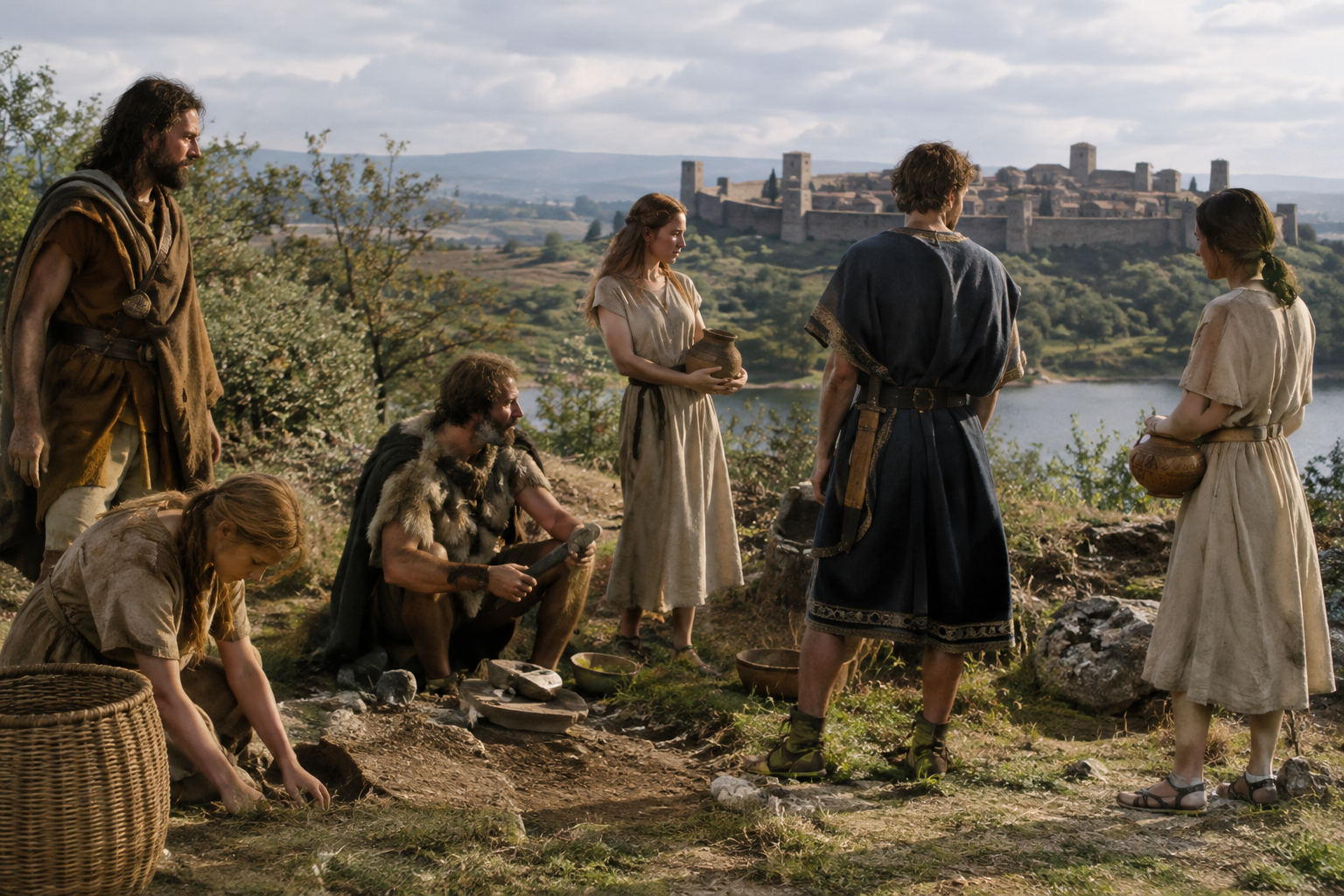
At Monteriggioni in Tuscany, an Etruscan-era individual labeled EV18, dated to around 600 BC, offers a particularly sharp way into the story of I2a1. This is not because one skeleton can stand for all Etruscans - it cannot - but because it places this paternal line inside a society that still attracts endless arguments about origin, language, and continuity. When a haplogroup like I2a1 appears in such a context, it reminds us that ancient Italy was populated by people whose paternal roots could run deep in Europe even while their culture was unmistakably local and historically distinctive.
That is the useful thing about Y-DNA. It tracks one direct paternal line only, not a person's whole ancestry, language, or identity. Even so, the appearances of I2a1 in the ancient record linked here - from Mesolithic and Neolithic Scandinavia to Bronze Age Central Europe and Iron Age Italy - make it a lineage worth following not as a badge of ethnicity, but as a durable male line moving through very different archaeological worlds.
The oldest samples in this set come from Kanaljorden at Motala, Sweden: I0015 and I0016, both dated to about 5710 BC. These individuals belong to a famous Scandinavian hunter-gatherer context, one that has become central to discussions of how northern European populations were structured before farming fully reshaped the continent. In broad terms, I2-related paternal lines are well known in European forager populations, and these Motala finds fit that larger picture.
A major ancient DNA study of prehistoric Europe, published in Nature, helped establish just how important Scandinavian hunter-gatherers were for understanding the genetic landscape of the north. The Motala material matters here because it shows that a lineage associated with I2a1 was present in a deeply pre-Bronze Age setting, long before later cultural horizons such as Corded Ware, Urnfield, or the historical peoples of the Mediterranean entered the picture.
That does not mean every later I2a1 carrier in Europe descends directly from Motala in any simple, traceable way. But it does mean that when modern testers encounter I2a1, they are looking at a branch with credible roots in very old European male-line history, including the world of post-glacial northern foragers.
Mesolithic-Neolithic Scandinavia
By the Bronze Age, the picture has changed. The samples poz506 from Bocheniec in south-central Poland, dated to around 1750 BC, and PMI006 from Miskovice in the Czech Republic, dated to around 1680 BC, show I2a1 in a very different archaeological setting. So does I7197 from Prague Jinonice, dated to around 1950 BC. We are no longer dealing with Mesolithic foragers at lake-edge ritual sites, but with Bronze Age communities in the heart of Central Europe.
This is precisely why the lineage is interesting. I2a1 does not disappear with the spread of farming or with the later demographic shifts that transformed Europe in the 3rd and 2nd millennia BC. Instead, it persists within mixed and changing populations. In practical historical terms, that suggests continuity of some paternal lines across major economic and social transitions, even when the wider ancestry of populations was shifting through repeated admixture.
Research on Central European Bronze Age populations has increasingly stressed that cultural change and genetic change do not always move in lockstep. Some cemeteries and regions show substantial continuity alongside innovation in burial custom, exchange networks, and material culture. The presence of I2a1 in Bocheniec, Miskovice, and Prague Jinonice sits neatly within that broader pattern: an old European paternal branch still present in communities already shaped by centuries of prehistoric interaction.
It is tempting to turn any haplogroup into a migration slogan. That would be a mistake here. I2a1 is better understood as a paternal thread that survives through quite different societies rather than as the signature of one single people. At Motala it appears in a northern forager setting; in Poland and the Czech lands it appears in Bronze Age communities living in a world of metalworking, exchange, and increasingly complex social structures.
That long span is historically valuable because it shows how male lines can endure through cultural transformation. Europe was never a blank slate repeatedly repopulated from scratch. Ancient DNA keeps showing us layered histories instead: persistence, mixture, local survival, and regional change all at once.
One useful comparison comes from broader work on the Baltic and Scandinavian prehistoric world, where ancient DNA has repeatedly underlined the complexity of the Mesolithic-Neolithic transition. The old contrast between "foragers" and "farmers" has had to be softened. Populations interacted, mixed, and persisted in ways that archaeology alone had not fully resolved.
The Tuscan sample EV18 is especially striking because of the historical setting. By 600 BC, Etruscan communities were urbanizing, trading widely, and participating in the competitive politics of Iron Age Italy. Monteriggioni and the wider Colle di Val d'Elsa area belong to that central Italian landscape in which local traditions, wider Mediterranean contacts, and older regional population histories all overlapped.
An ancient DNA study of Iron Age and Roman Italy available at PMC has helped reinforce a point classicists and archaeologists have long had to wrestle with: the Etruscans were not a simple biological isolate, nor does language map neatly onto genetic ancestry. A sample like EV18, associated here with I2a1, fits that caution rather well. An Etruscan-speaking or Etruscan-context individual could carry a paternal line with deeper roots in wider European prehistory without any contradiction at all.
This is where the old arguments about "where the Etruscans came from" begin to look rather blunt. Ancient societies were made from communities, not from single haplogroups. EV18 does not prove an origin myth, but it does show that paternal diversity in Etruscan Italy included lineages with a long prehistoric presence in Europe.
If your Y-DNA falls under I2a1, the most responsible takeaway is not that you "are" Motala, Bocheniec, or Etruscan Tuscany. Rather, you belong to a paternal branch that appears in ancient Europe across an impressive timespan and in very different archaeological settings. The direct male line is only one line among many, but it can preserve an unexpectedly old signal.
These particular finds suggest a branch with real depth in Europe: present among northern hunter-gatherers, still visible in Bronze Age Central Europe, and still turning up in Iron Age Italy. That is a fine example of what ancient DNA does best. It does not flatten history into a single origin story; it restores the inconvenient, fascinating fact that the past was full of continuity inside change.
For I2a1, then, the distinctive insight is endurance. This paternal line is not tied here to one empire, one language, or one famous dynasty, but to a much longer European record stretching from prehistoric foragers to complex historic societies. For family historians, that is both humbler and more interesting: your direct paternal line may be part of a story that survived Europe's greatest transformations without ever belonging to just one chapter of them.






Comments