Haplogroup I1a2b3a2a1
– 5 min read


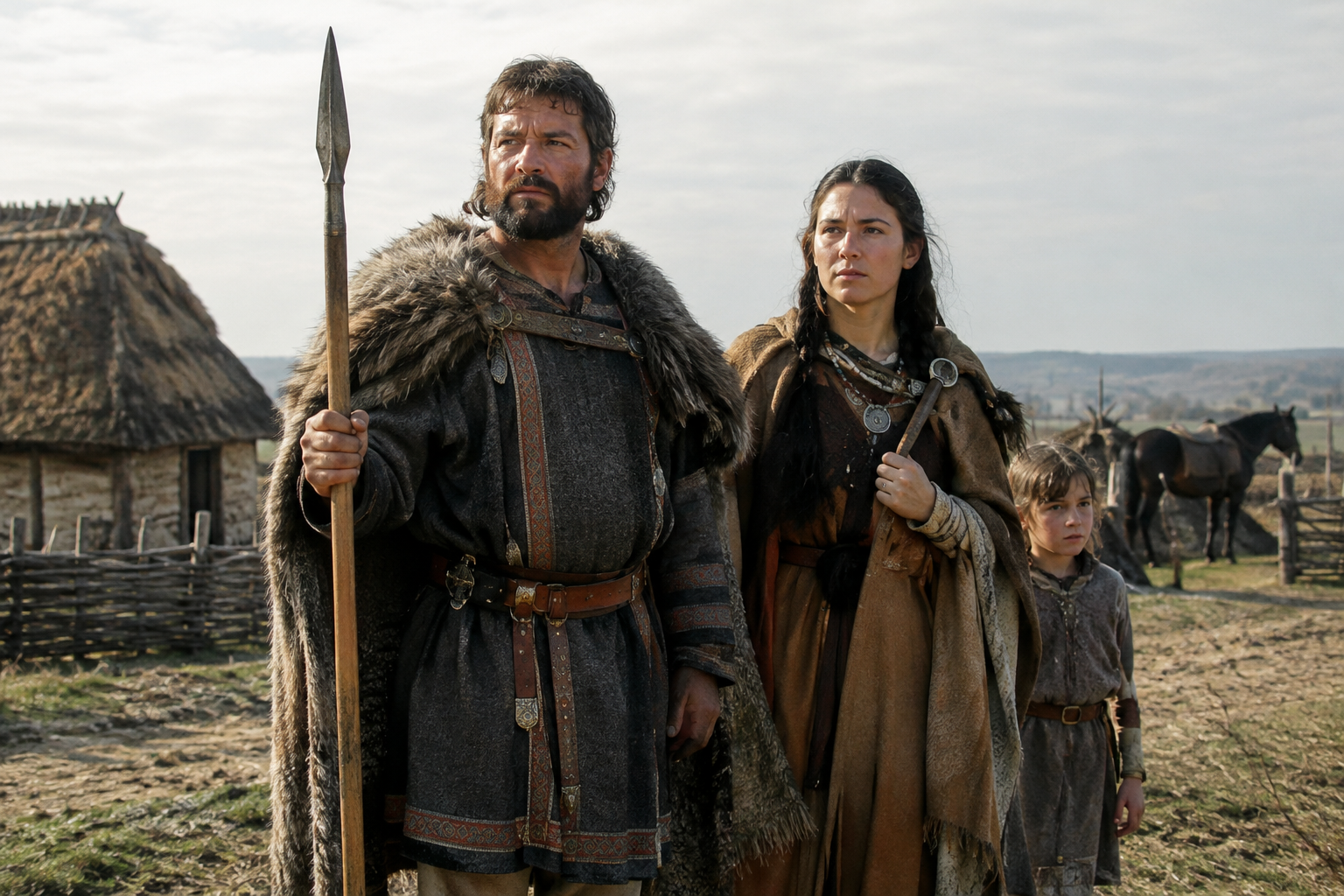
At Rakoczifalva in Migration Period Hungary, one excavated man dated to around AD 650, sample RKF275, carries the Y-DNA haplogroup I1a2b3a2a1. That is a very specific paternal label, and in a way that is exactly what makes him interesting. We are not looking at an abstract map of Europe here, but at one male line turning up in the Carpathian Basin at a time when the old Roman world had long collapsed and new communities were being assembled out of movement, alliance, marriage, and local survival.
The difficulty, and the fascination, lie together. A single Y-chromosome result does not tell us a person's whole ancestry, language, or political identity. But it does trace one direct paternal line, and when that line appears in a seventh-century burial in Hungary, it immediately raises a historical question: how did a branch so closely associated in broader terms with northern Europe come to be present in this post-Roman frontier world?
Rakoczifalva sits in the Great Hungarian Plain, a landscape that was anything but static in late antiquity and the early Middle Ages. By about AD 650, the region had already seen Roman withdrawal, the passage of Germanic groups, Hunnic power, and then the dominance of the Avar Khaganate. Burials from this era belong to a world where identities were layered and often local as much as imperial or tribal.
That matters for RKF275. The presence of I1a2b3a2a1 does not mean that this individual can simply be called "Scandinavian" or assigned to one historically named people on Y-DNA alone. What it does suggest is that one paternal line with deeper roots in the wider I1 family had reached, and was reproducing within, the communities of Migration Period Hungary. In archaeological terms, that is exactly the kind of evidence that makes the Carpathian Basin so revealing: it catches movement after movement, but also settlement after movement.
An ancient DNA study of this broader regional setting, published in Cell, helped show just how mixed and historically complicated populations in the Carpathian Basin could be across the Migration Period. The significance of RKF275 lies less in grandeur than in precision: a named burial, a date, a place, and one paternal branch anchored in a real archaeological landscape.
The haplogroup in this article, I1a2b3a2a1, is a narrow twig on the much larger I1 branch of Y-DNA. That distinction is important. The older parent lineage has a well-known history in northern Europe, especially in areas around southern Scandinavia and the Baltic world, but a precise downstream branch must not automatically be given the full biography of its parent.
So the responsible reading is modest and useful. RKF275 shows that this paternal line, or a very close equivalent reported under that label, was present in seventh-century Hungary. That is a fact about presence, not proof of a single migration route. The line may have arrived through earlier movements of Germanic-speaking groups, through smaller-scale military or familial mobility, or through generations of local integration before the burial itself.
This is one of the strengths of Y-DNA when handled carefully. It is narrow evidence, but narrow evidence can be very sharp. In a region where written sources tend to flatten people into big categories such as Gepid, Lombard, Avar, or Slav, a Y-chromosome reminds us that real communities were made of households and male lines with quite different pasts.
If you want a place where ancient DNA repeatedly overturns tidy historical storytelling, the Carpathian Basin is hard to beat. The period around AD 650 was not a simple handover from one people to another. It was a time when elite power, village continuity, intermarriage, and long-distance mobility could all exist at once.
That makes an I1-derived paternal line in Rakoczifalva historically plausible without making it predictable. The Great Plain had already been drawn into centuries of contact linking the Roman frontier, the Danube corridor, the Pontic steppe, and central Europe. Men carrying northern or central European paternal branches could arrive as part of migrating groups, military retinues, client communities, or families that had moved several times before ending up in Hungary.
In other words, RKF275 need not represent a dramatic one-off intrusion from the far north. He may instead reflect the normal, if complicated, social world of the Migration Period: people with different paternal histories living in the same cemeteries and political systems. Ancient DNA keeps forcing that point. The old labels from texts are useful, but the burials show far more human variety underneath them.
Because the wider I1 family is best known from northern Europe, there is always a temptation to turn every I1 result into a tale of Vikings or heroic migrants. For a burial around AD 650 in Hungary, that would be much too crude. The date is early for the Viking Age proper, and the historical setting is better explained through the long rearrangements of late antiquity and the early medieval frontier.
A more sensible comparison is with other ancient DNA results from the broader Migration Period world, where communities identified archaeologically as Gothic, post-Roman, or frontier populations often turn out to be genetically mixed rather than homogeneous. That does not make historical identities meaningless; it simply means they were built politically and socially, not inherited as pure biological packages.
For readers interested in how archaeogenetics has revised older ideas about "barbarian" peoples, the Gothic material is especially instructive. It shows that a named historical community could include a range of ancestries and paternal lines while still functioning as a recognizable social group.
Mixed Origins of Gothic Communities
One reason this single sample matters is that Hungary in the centuries after Rome was a crossroads in the strictest sense. It was not merely influenced by neighboring regions; it was made by them. The Danube linked it westward and southward, while the plains opened eastward into steppe connections and northward into central European networks.
That setting gives a useful frame for I1a2b3a2a1. Even if we cannot reconstruct the exact path of RKF275's paternal ancestors, the archaeological context tells us that such a path did not have to be improbable. Male lines moved with soldiers, settlers, dependants, traders, and marriage networks. They also persisted locally once established, which means a seventh-century result may reflect mobility several generations earlier rather than a recent arrival.
This is why one should resist the urge to match one haplogroup to one ethnicity. A paternal line can travel across different cultural worlds while the people carrying it adopt new languages, loyalties, and burial customs. In the Carpathian Basin, that is not a complication to explain away; it is the main historical story.
For someone who belongs to I1a2b3a2a1 today, RKF275 offers something valuable even though it is only one ancient man: a securely dated sign that this paternal branch was present in the Carpathian Basin by around AD 650, inside the churn of post-Roman and early medieval Hungary. It points toward a paternal history shaped by mobility, integration, and survival within one of Europe's great contact zones.
That is the real interest of this lineage here. Not a fantasy of a single people marching intact across a map, but a documented male line appearing in a place where worlds met and were remade. The deeper history of I1 may lead north, but this branch's ancient evidence reminds us that by the early Middle Ages, paternal ancestry was already part of a far more entangled European story.
Comments