Haplogroup I1a2a1a1a5a1a

– 5 min read


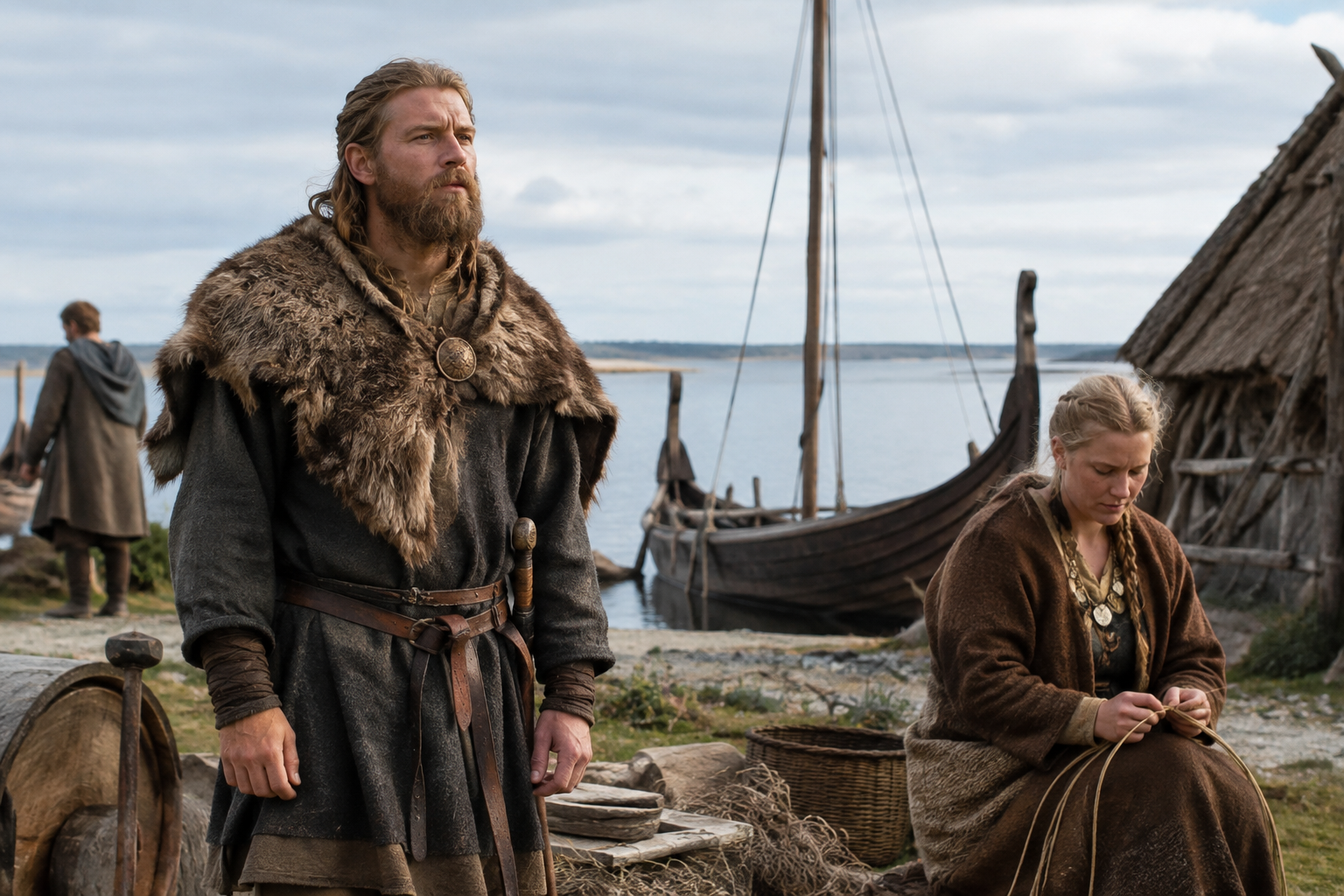
At Bogovej on the island of Langeland in Denmark, one Viking Age man has become a useful anchor for a much larger paternal story. The individual identified as VK363, dated to around AD 900, belongs to the world of late Viking Age Scandinavia: a period of sea travel, regional consolidation, and far-reaching contacts across the North Sea and Baltic. In genetic terms, he has been associated with the Y-DNA haplogroup I1a2a1a1a5a1a, a very narrow branch inside the wider haplogroup I1.
That distinction matters. Y-DNA follows one direct paternal line only, not a person's whole ancestry, language, or identity. But when a specific branch appears in an archaeologically secure Viking Age context in Denmark, it gives us something solid to discuss: not a mythic founding ancestor, but a documented male line present in the Scandinavian world at the very moment when Norse mobility reshaped much of northern Europe.
Langeland lies in the Danish archipelago, exactly the kind of place that reminds us how misleading modern maps can be when we imagine the Viking Age. Water was not a barrier here; it was the road. Islands, straits, and sheltered coasts linked communities into a maritime network, and eastern Denmark sat at the heart of that world.
Sample VK363 is therefore important not because one grave can stand for all Viking Age men, but because it places this paternal branch in a historically central Scandinavian setting. A man carrying a lineage associated with I1a2a1a1a5a1a was living in Denmark around AD 900, in the same broad era that saw intensified exchange, raiding, settlement, and political competition across the North.
The relevant scientific backdrop comes from ancient DNA research on Viking Age populations, including work circulated at https://www.biorxiv.org/content/10.1101/703405v1. Even without forcing claims beyond the evidence, studies of this kind have made one point very clearly: Viking Age Scandinavia was not genetically simple, and paternal lines must be read in their archaeological context rather than treated as ethnic labels.
The broader haplogroup I1 is well known in northern European genetic history, especially in Scandinavia and regions shaped by later Scandinavian and Germanic migrations. But the article haplogroup here is not simply I1 in general; it is the far more specific I1a2a1a1a5a1a. That longer name marks a much narrower twig on the paternal tree.
For family historians, this is where caution is useful. A broad haplogroup can have a deep time depth and wide regional spread, while a terminal or near-terminal branch may reflect a much later pattern of descent among only some of its carriers. So the presence of VK363 does not let us claim that the branch originated at Bogovej, nor that every modern carrier descends from Vikings in the popular sense. What it does show is that this line was present in Viking Age Denmark, and present there in a context that matters historically.
That is already more interesting than a bare map pin. Denmark around AD 900 was one of the principal zones from which Scandinavian influence spread west into England and the North Atlantic, east into the Baltic, and south into the Continent. A paternal lineage attested there belongs to the hub, not the fringe, of late first-millennium northern European history.
One of the most useful corrections offered by archaeogenetics is that Viking Age people were both local and connected. The local part matters: many paternal lines in Scandinavian cemeteries reflect long-standing regional continuity. But the connected part matters just as much: the Viking world tied together Denmark, Norway, Sweden, the British Isles, the Baltic coast, and river routes reaching deep into eastern Europe.
That wider picture helps explain why a lineage found in Denmark should not be trapped inside a modern national box. Men carrying branches within I1 could have participated in movements of trade, warfare, settlement, marriage exchange, and service far beyond their birthplace. Ancient DNA has repeatedly shown that the early medieval North Sea and Baltic zones were full of such entanglements.
For readers interested in how language spread and population history intersect across these northern regions, this broader frame is useful too. Paternal lines do not equal languages, of course, but they can sometimes illuminate the communities through which languages moved.
It is tempting to imagine Viking Age lineages as if they belonged only to ships and saga horizons, but the historical reality is messier and more interesting. The Scandinavian world was bound up with the early medieval mainland, especially the regions facing the North Sea and the lower reaches of the great continental rivers. Contacts between Denmark and the lands that are now northern Germany and the Rhineland were old, frequent, and consequential.
That matters because branches inside the wider I1 family often turn up in discussions of early medieval populations linked with Germanic-speaking groups, frontier interaction, and post-Roman mobility. None of that allows us to assign I1a2a1a1a5a1a to a single tribe or people-name from the written sources. But it does place the Bogovej evidence in a credible historical corridor: southern Scandinavia and the adjacent mainland were deeply connected long before and long after AD 900.
Ancient DNA from early medieval Germany and the Rhineland has helped show how varied these communities could be, even when archaeology once encouraged simpler ethnic labels. That is particularly relevant for anyone tempted to turn a haplogroup into a badge reading "Dane," "Saxon," or "Viking." The genetics are usually subtler than that, and the history certainly is.
There is an old temptation in ancestry writing to apologise for small numbers. But archaeology often advances through precisely such fragments. A securely placed individual like VK363 can matter because he fixes one branch of the paternal tree to one time and one landscape. That may sound modest, yet it is exactly how robust historical genetics is built.
In this case, the value lies in the combination of specificity and context. The branch is narrow; the date is late Viking Age; the location is Denmark; and the site sits in a region central to Scandinavian communications. Those facts together make I1a2a1a1a5a1a more than a string of letters and numbers. They make it a documented paternal line within a real historical world.
That same principle has proved useful in other early medieval studies, where ancient genomes have revealed disease, migration, and local continuity without collapsing everything into a single story. The point is not that one lineage explains an era, but that one lineage can sometimes show us where to look more closely.
If your paternal line falls under I1a2a1a1a5a1a, the strongest point this evidence currently offers is a concrete one: a lineage associated with this branch was present in Viking Age Denmark, represented by VK363 from Bogovej on Langeland around AD 900. That does not by itself prove a personal descent from a raider, settler, or named dynasty. But it does place your direct male line within a paternal landscape that is firmly at home in the Scandinavian and North Sea world of the early Middle Ages.
That is, in truth, the exciting part. Not fantasy pedigrees, but a real man in a real place, carrying a branch of the Y chromosome that still survives today.
Comments