Haplogroup I1a1b1a1e

– 4 min read


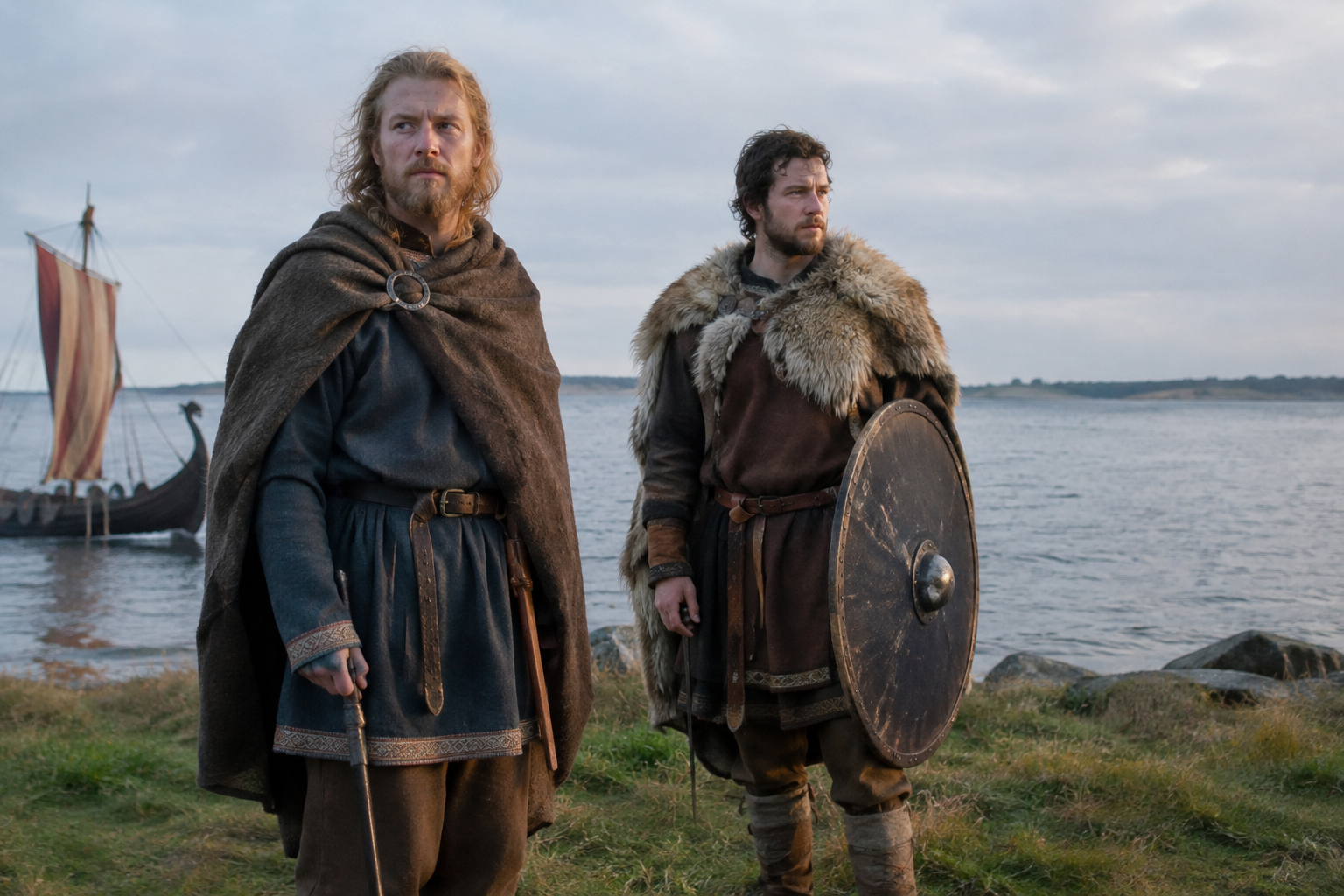
At Salme on the island of Saaremaa in present-day Estonia, archaeologists uncovered one of the most arresting finds of the early Viking Age: boat burials containing men who died far from home. Among the individuals from Salme II was sample VK511, dated to about AD 725 and associated here with the Y-DNA haplogroup I1a1b1a1e. That matters because it places this paternal line squarely inside the Scandinavian world of seaborne mobility at the very moment Viking activity was becoming visible around the Baltic.
The second clue comes from Denmark. Sample VK296, from Hundstrup on Sealand and dated to about AD 680, is earlier but close in both geography and historical setting. Together, these two finds do not tell us everything about I1a1b1a1e, but they do give it something much better than myth: a small, concrete archaeological footprint in southern Scandinavia and the Baltic at the threshold of the Viking Age.
I1a1b1a1e is a very narrow branch within the broader Y-DNA haplogroup I1, a paternal lineage long associated with northern Europe and especially with Scandinavia in both modern and ancient DNA discussions. Y-DNA follows one direct male line only: father to son, and so on. It does not describe a person's whole ancestry, language, or identity, but it can be very useful for tracing patterns of male-line continuity and movement.
In this case, the value of I1a1b1a1e lies less in grand claims than in context. Both known ancient examples supplied here come from the late 7th to early 8th century AD, before the classic raiding phase of the Viking Age had fully unfolded. That makes this branch interesting as part of the background population from which Viking Age expansion emerged, rather than as a lineage that appears only after the fact.
A broad ancient DNA study of Viking Age populations has been especially important for framing this world of movement and local variation across Scandinavia and the Baltic, and the relevant research can be found here: https://www.biorxiv.org/content/10.1101/703405v1.
Salme has attracted so much attention because it captures a violent and mobile moment in early medieval northern Europe. The burials, discovered on Saaremaa, contained men placed in boats, linking the site directly to Scandinavian maritime culture. Sample VK511 belongs in that remarkable setting.
What makes Salme especially valuable for a haplogroup article is that it is not just "Viking" in the loose popular sense. It sits at an early stage, around AD 725, when cross-Baltic expeditions were already real enough to leave bodies, burials, and a trail of political contact or conflict. A lineage like I1a1b1a1e appearing here fits a world in which Scandinavian male lines were present not only in homeland settlements but also in outward-facing expeditions.
That said, one sample is still one sample. VK511 does not mean every man at Salme shared the same paternal ancestry, nor does it prove that this exact branch defined an army, a crew, or an ethnic bloc. What it does show is more precise and more useful: this branch was present among men involved in the Baltic-facing Scandinavian sphere in the early 8th century.
If Salme shows movement, Hundstrup gives us something closer to home ground. Sample VK296, from Sealand in Denmark and dated to about AD 680, places I1a1b1a1e within the Danish landscape just before the Viking Age is usually said to begin. That is a useful chronological anchor. It suggests this paternal branch was already established in southern Scandinavia before the famous expansion of the 8th to 11th centuries.
Sealand was not a remote fringe. It lay in one of the most connected zones of early medieval Denmark, tied into the belts and sea lanes that linked the North Sea, the Baltic, and the wider Scandinavian peninsula. A male line present here in the late 7th century belongs, at least geographically, to the sort of environment from which later Viking networks could recruit people, ships, and ambitions.
We should be careful not to overdecorate the evidence. The record supplied here does not justify invented stories about rank, grave goods, or kinship. But even stripped to essentials, Hundstrup matters because it helps keep the article grounded. I1a1b1a1e is not floating free in legend; it is tied to an identifiable Danish place and period.
Put Hundstrup and Salme together, and a pattern begins to appear. Not a vast map, not a dynasty, not a guaranteed migration route, but a historically plausible corridor. One ancient carrier of I1a1b1a1e appears in Denmark around AD 680; another appears on Saaremaa around AD 725 in a burial context strongly bound to Scandinavian seafaring.
That pairing suits what historians and archaeologists already know about the period. The late 7th and early 8th centuries were not static. Elites, traders, raiders, and war-bands were testing routes and relationships across the Baltic well before the monastery at Lindisfarne made later chroniclers sit up in alarm. Genetic traces from this period are precious precisely because they catch populations in motion before the written record becomes louder.
It is also worth noting the scale of the evidence. Two ancient cases are enough to make I1a1b1a1e historically interesting, but not enough to claim it as the signature lineage of all Danes, all Vikings, or all Baltic expeditions. What they do support is a more measured point: this branch belonged to the male population of the southern Scandinavian-Baltic zone during a formative period of early Viking expansion.
Popular history often prefers the largest labels: Viking, Norse, Dane, warrior. But ancient DNA is often most revealing when it narrows the lens. A subclade like I1a1b1a1e lets us see that behind those broad historical names were many separate paternal lines, some widespread, some local, some perhaps carried farther by chance, success, or family continuity.
For someone who belongs to this haplogroup today, the strongest supported takeaway is not a claim to a famous ancestor. It is something more archaeologically satisfying. The ancient evidence places this paternal branch in late 7th- and early 8th-century Scandinavian and Baltic settings, including Denmark and the Salme boat-burial world. In other words, it sits within the human background from which Viking Age mobility emerged.
I1a1b1a1e is currently illuminated by two early medieval men: VK296 from Hundstrup on Sealand and VK511 from Salme II on Saaremaa. One roots the branch in Denmark around AD 680; the other places it in the Baltic-facing martial world of about AD 725. It is a small evidential trail, but a vivid one, and it suggests a paternal lineage at home in the connected Scandinavian seaways just before the Viking Age burst fully into history.
Comments