Haplogroup I1a1a1

– 5 min read


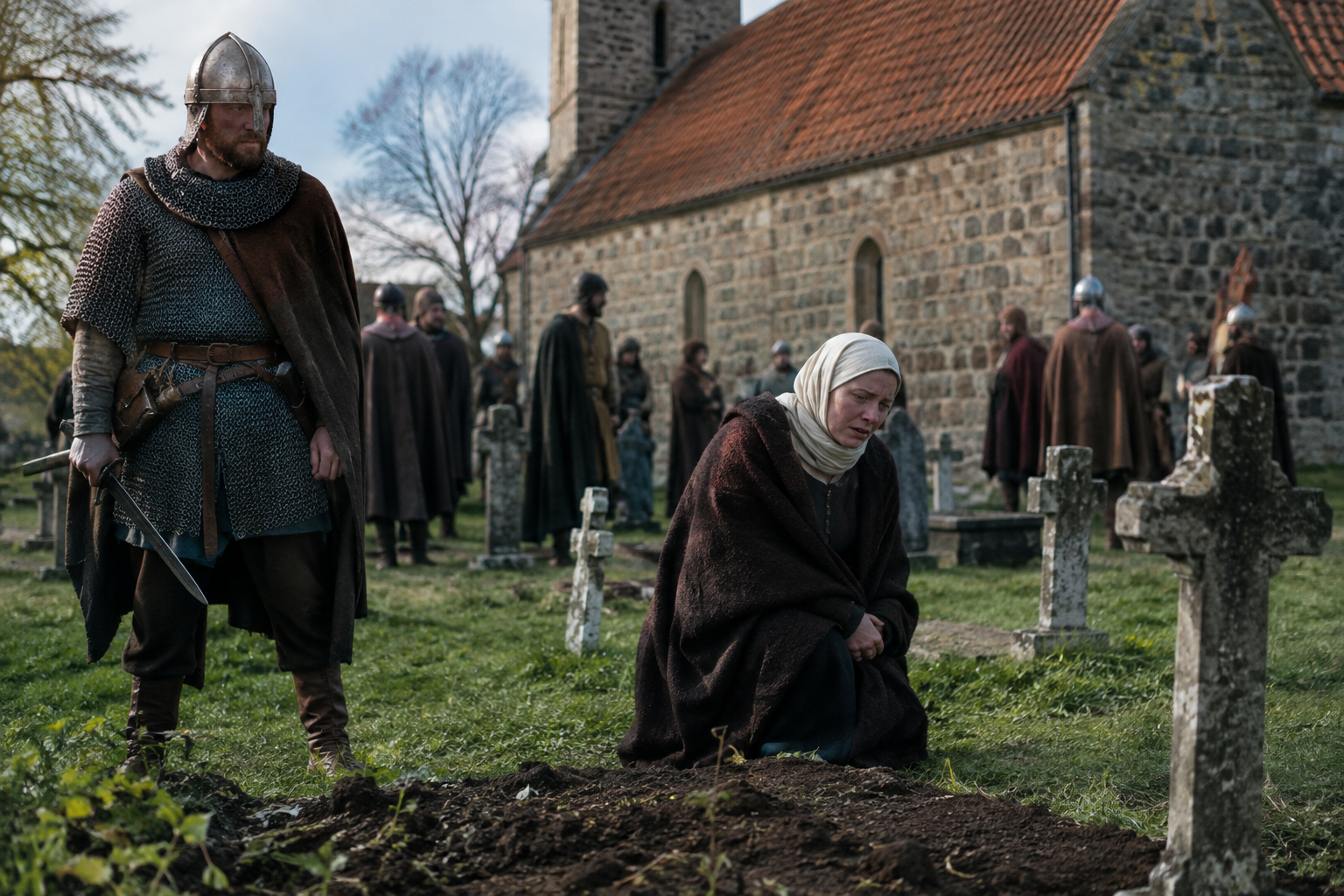
One of the clearest glimpses of Y-DNA haplogroup I1a1a1 in the historical record comes from a violent moment in early 11th-century England: sample VK167, identified among the dead of the St. Brice's Day massacre in Oxford and dated to around 1002 AD. This is not a vague prehistoric shadow but a man caught in a very specific crisis, when King Aethelred ordered the killing of Danes living in England. For anyone tracing an I1-line paternal ancestry, that is already a telling setting, because I1 is strongly associated with northern Europe, especially Scandinavia, and here we find one branch of it in the middle of the Anglo-Scandinavian world.
A second sample, CGG100441, comes from Vor Frue Kirkegard in Aalborg, Jutland, dated to about 1368 AD. By then the Viking Age was long over, but the paternal line remained in the same broad northern zone. Taken together, these two men do not give us a complete history of I1a1a1, and Y-DNA never represents a person's whole ancestry. But they do place this branch, or reported association with it, squarely in the medieval Scandinavian sphere: one man in Denmark itself, another in the Scandinavian diaspora across the North Sea.
The Oxford find matters because it is so historically anchored. The St. Brice's Day massacre is one of those episodes known from written sources, but ancient DNA makes it less abstract. Instead of "Danes" as a chronicler's category, we get real individuals, among them VK167, whose paternal line is reported in connection with I1a1a1.
That does not mean haplogroup I1a1a1 was exclusively Danish, nor that every man with this lineage in medieval England was a recent immigrant. The North Sea world had already been mixing for generations through raiding, trade, settlement, intermarriage, and military service. Still, an I1-line in this context is exactly the sort of evidence one expects to encounter in populations linked to Scandinavia during the Viking and late Anglo-Saxon centuries.
An ancient DNA study examining these Oxford remains is available at https://www.biorxiv.org/content/10.1101/703405v1. Even without claiming more than the evidence allows, the broad picture is compelling: this paternal branch appears in one of the most famous episodes of Anglo-Scandinavian conflict.
If Oxford shows I1a1a1 in movement, CGG100441 from Vor Frue Kirkegard at Aalborg shows it at home in medieval Denmark. Aalborg was an important settlement in northern Jutland, tied into maritime routes through the Limfjord and the Kattegat. A burial there in the 14th century belongs to a very different political and religious landscape from that of Viking longships and royal massacres, yet the paternal lineage still sits within the same northern European world.
This is precisely why medieval samples are so useful. They remind us that lineages do not vanish when historical periods end. The men of Viking-age Scandinavia did not disappear with conversion, monarchy, or urban growth; their descendants moved into parish graveyards, market towns, and Christian cemeteries. A lineage like I1a1a1 may look dramatic when attached to raiders or massacre victims, but most of its history was probably lived in ordinary generations of farmers, sailors, craftsmen, and townsmen.
Research on medieval and post-Viking Scandinavian populations continues to sharpen that picture, and one relevant study linked to this material is https://www.biorxiv.org/content/10.1101/2025.02.28.640770v1. What matters here is not a grand claim about one cemetery standing for all Denmark, but the simple and solid point that this paternal branch persisted in Jutland well into the later Middle Ages.
Post-Viking Christian Scandinavia
The haplogroup name matters. I1a1a1 is not the same thing as all of I1. I1 as a broader Y-chromosome lineage is famous for its concentration in Scandinavia and parts of northern Europe, but a narrower branch should not automatically inherit every origin story or migration claim attached to the parent group. Good genetic history is a matter of scale.
With the evidence here, the safest conclusion is that I1a1a1 was present in medieval populations linked to Denmark and the wider Scandinavian orbit. The Oxford and Aalborg men do not prove where the branch first formed, and they do not map its full spread. What they do show is that this paternal line belonged to the historical population stream that connected Jutland, the North Sea, and England.
That distinction is worth making because readers often want Y-DNA to behave like a surname, a tribe, or a national flag. It is none of those things. It follows one direct male line only. But when that line turns up in the right places, at the right times, it becomes a remarkably precise thread through history.
Seen together, VK167 and CGG100441 belong to a larger story: the making of a northern maritime zone in which people, languages, and political loyalties were constantly on the move. Jutland was central to that world. So was eastern England. The sea between them was less a barrier than a road.
That helps explain why an I1-line can appear both in a Danish cemetery and among men killed in Oxford. The Viking Age did not simply send Scandinavians outward once and for all; it created enduring corridors of contact. By the 11th century, England had Scandinavian settlers, mixed communities, and contested kingship. By the 14th century, Denmark had changed profoundly, but its population still carried paternal lines rooted in that same northern historical landscape.
North Sea migrations to Britain
It is also worth remembering that archaeology rarely gives us neat ethnic labels. A man buried in Oxford in 1002 may have been called Danish by his killers, by his neighbors, or by later writers, but his life was lived in a much messier human world. Genetics does not simplify that world; it usually makes it more interesting.
For someone researching I1a1a1 today, the most distinctive point is not just "Scandinavia" in the abstract. It is that this branch appears in two sharply different medieval settings: one a crisis burial tied to anti-Danish violence in England, the other a later cemetery in Jutland itself. That pairing suggests a lineage at home in the Scandinavian core and also present in the overseas networks created by Scandinavian expansion.
In other words, I1a1a1 is not merely a prehistoric curiosity. It is visible in the lived history of the medieval North Sea world. If this is your paternal haplogroup, these ancient men do not tell you your surname, your kingdom, or your exact homeland. But they do place your direct male line within a documented historical environment stretching from Danish soil to Anglo-Scandinavian England.
Deep genetic history of Denmark
That is a modest conclusion, but a valuable one. Sample VK167 from Oxford and sample CGG100441 from Aalborg give I1a1a1 something every haplogroup article needs: real people, real places, and a believable historical frame.



Comments